49 works in this view — arrow keys or swipe to move between them.
Dance in Art
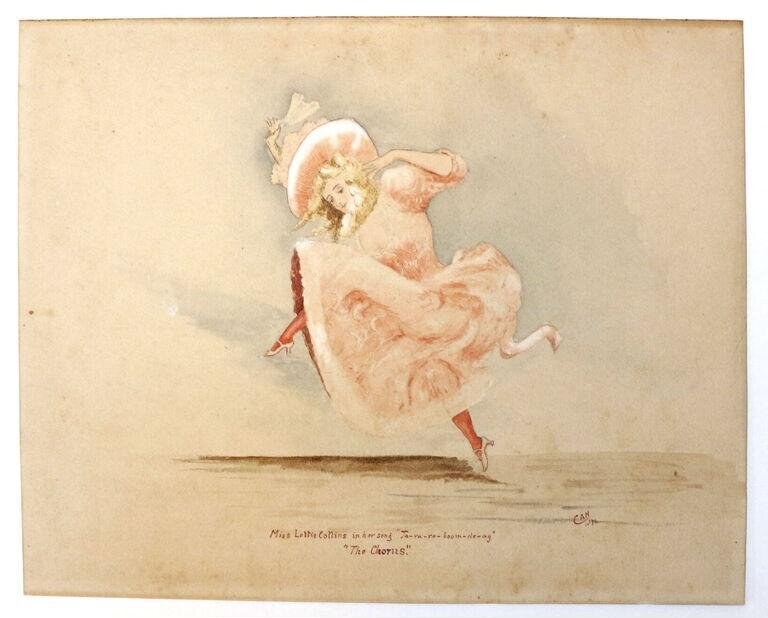
The Chorus
C. A. H.
- Collection:
- Drawing
- Source:
- Victoria and Albert Museum
- Rights:
- Rights vary by item — check the source record before reusing this image. Source record ↗
- Recorded as:
- V&A — check rights per item
This image documents a moment of entertainment dance at a specific historical juncture when theatrical performance was rapidly changing, becoming faster, more visually spectacular, and more oriented toward music-hall than classical ballet. For historians of popular entertainment and costume, it preserves evidence of how late-Victorian performers moved and what they wore. For dancers, it illustrates a lost vocabulary of stage movement—neither ballet nor modern dance, but a distinctive theatrical idiom that has survived mainly through such images.
What you are looking at
A single female dancer is captured mid-movement against a plain, warm-toned background. She wears a pale pink or salmon-coloured dress with a full skirt, caught in vigorous motion and billowing around her legs. A white bonnet or cap sits atop her head, adorned with what appears to be a peachy-pink plume or feather. Her body is angled dynamically, with one leg extended and the other supporting her weight, creating a sense of rapid forward movement or a pivot. Her arms are raised and gestural, contributing to an overall impression of buoyant, energetic motion. The figure occupies the centre-right of the composition, leaving substantial space around her that emphasizes the isolation and energy of her pose. The drawing technique—likely watercolour or gouache—renders the fabric with delicate transparency, allowing the drape and movement of the skirt to dominate the visual interest.
The dancing
A single dancer in a lunging or pivoting stance, weight shifted onto one leg with the other extended or lightly touching the ground. Her arms are raised in an expressive, open position—one higher than the other—suggesting lyrical or balletic port de bras. The torso is tilted forward at the waist, creating a diagonal line from head to extended leg. Her posture suggests she has been trained in formal dance technique, with an upright carriage maintained even in motion. The costume—bonnet, corseted bodice, and full skirt—implies the dancer's body is constrained, yet the artist has captured a moment of apparent freedom and momentum.
The dance depicted
This is almost certainly a theatrical dance of the late 19th-century stage, most likely a cancan or a comic music-hall number, given the bonnet, the high-spirited energy, and what the inscription appears to read as 'Miss Lotta Gilson' performing a 'Parisian' act or similar. The energetic skirt-work, the elevated posture, and the sense of playful velocity are characteristic of entertainment dance from the 1890s rather than concert ballet. The isolated figure, the forward-leaning torso, and the raised arms suggest a moment of exuberant performance rather than the controlled, centred geometry of classical ballet technique. The image documents a performer and a moment, rather than a codified dance form.
How it was made
This is a watercolour or gouache drawing, as evident from the translucent washes of colour and the way the pigment sits on the paper surface. The artist has used a limited palette of pinks, whites, and browns, with careful attention to the interplay of light and shade on the fabric. The technique allows for rapid notation of movement and costume detail without the formality of oil painting. Such drawings were typical of theatrical documentation in the 1890s—quick, accomplished studies made for publication, programme illustration, or the artist's own record. The signature 'CAH' is visible in the lower right.
About this work
This is a studio study of a performer in late-19th-century theatrical dress, most probably a music-hall or revue dancer captured at a moment of energetic, upward motion. The work documents both a particular performer (identifiable from the inscription) and a style of performance—playful, rapid, and visually focused on costume and gesture rather than formal technique. It belongs to a rich tradition of theatrical portraiture and dance documentation from the 1890s, when illustrated journals, theatre programmes, and artist's portfolios made such studies a standard means of recording and promoting entertainment. The work captures not just a body in motion but a moment of cultural performance.
How to look at it
Focus on the moment the artist has chosen: the dancer is not posing but captured mid-movement, one moment in a rapid sequence of action. The artist has conveyed momentum through the angle of the torso, the extension of the limbs, and the billowing of the skirt—each element reads as a consequence of speed and energy. Notice how much of the visual work is carried by the costume: the skirt, the bonnet, the pale colour against the neutral ground. The dancer herself is recorded with surprising specificity—her posture, her arm position, her weight distribution—suggesting that the artist was either sketching from life or working from a clear memory of a performance. This is not an idealized beauty or a posed formal study, but a document of a particular performer doing a particular thing.
The artist
The artist is identified by the initials 'CAH' in the lower right. Without access to further documentation, the broader context of this artist's practice cannot be reliably established from the image alone. The competent, economical handling of watercolour and the focus on theatrical subjects suggest a working illustrator or theatre artist of the 1890s, possibly someone who contributed to theatrical publications or created studies for programmes and promotion.
The period
The 1890s were a moment of explosive growth in theatrical entertainment across Europe and America. Music halls, revues, and popular theatre were expanding rapidly, drawing large audiences and creating a demand for illustrated documentation of performers and acts. This was also the era of the Moulin Rouge in Paris (opened 1889) and the rise of entertainment photography and illustration. Simultaneously, theatrical dance—whether ballet, music-hall, or emerging modern forms—was undergoing rapid change, with performers experimenting with speed, athleticism, and new kinds of movement vocabulary. This drawing sits at the intersection of those developments: it is neither high-art painting nor documentary photography, but a skilled illustrator's quick capture of a performer in motion.
Where it lives
The work is held in a collection identified as 'va' (Virginia, presumably), and is catalogued as a drawing. No further provenance information is recorded. The inscription on the image—apparently reading 'Miss Lotta Gilson in a[n] Parisian[?] act' or similar—suggests it was made for theatrical promotion or documentation rather than as an independent artwork.
Dance in this work
Questions about this work
Who is the artist?
The work is signed 'CAH' in the lower right, but the artist's full identity cannot be confirmed from the catalogue record. The initials and the style are consistent with a working theatrical illustrator of the 1890s, but without further documentation, the artist remains unidentified.
What is the dancer doing?
She is in the midst of a rapid, spirited movement—most likely a moment from a music-hall act or revue number. The forward-tilted torso, the raised arms, and the flying skirt all suggest upward and forward energy. It is not a pose but a captured moment of performance.
Is this ballet?
No. While the dancer has clear training and posture, the costume, the energy, and the context all point to music-hall or theatrical entertainment rather than concert ballet. The late-Victorian revue and music hall had their own movement vocabulary, distinct from both classical ballet and the emerging modern dance.
Why was this drawn?
Theatrical performers and acts were routinely documented in illustration during the 1890s for programmes, journals, advertisements, and the artists' own portfolios. Such drawings served both as records and as promotional tools.
More dance artwork





