49 works in this view — arrow keys or swipe to move between them.
Dance in Art
Drawing
Ritchie, Alick P.F.
- Collection:
- Drawing
- Source:
- Victoria and Albert Museum
- Rights:
- Rights vary by item — check the source record before reusing this image. Source record ↗
- Recorded as:
- V&A — check rights per item
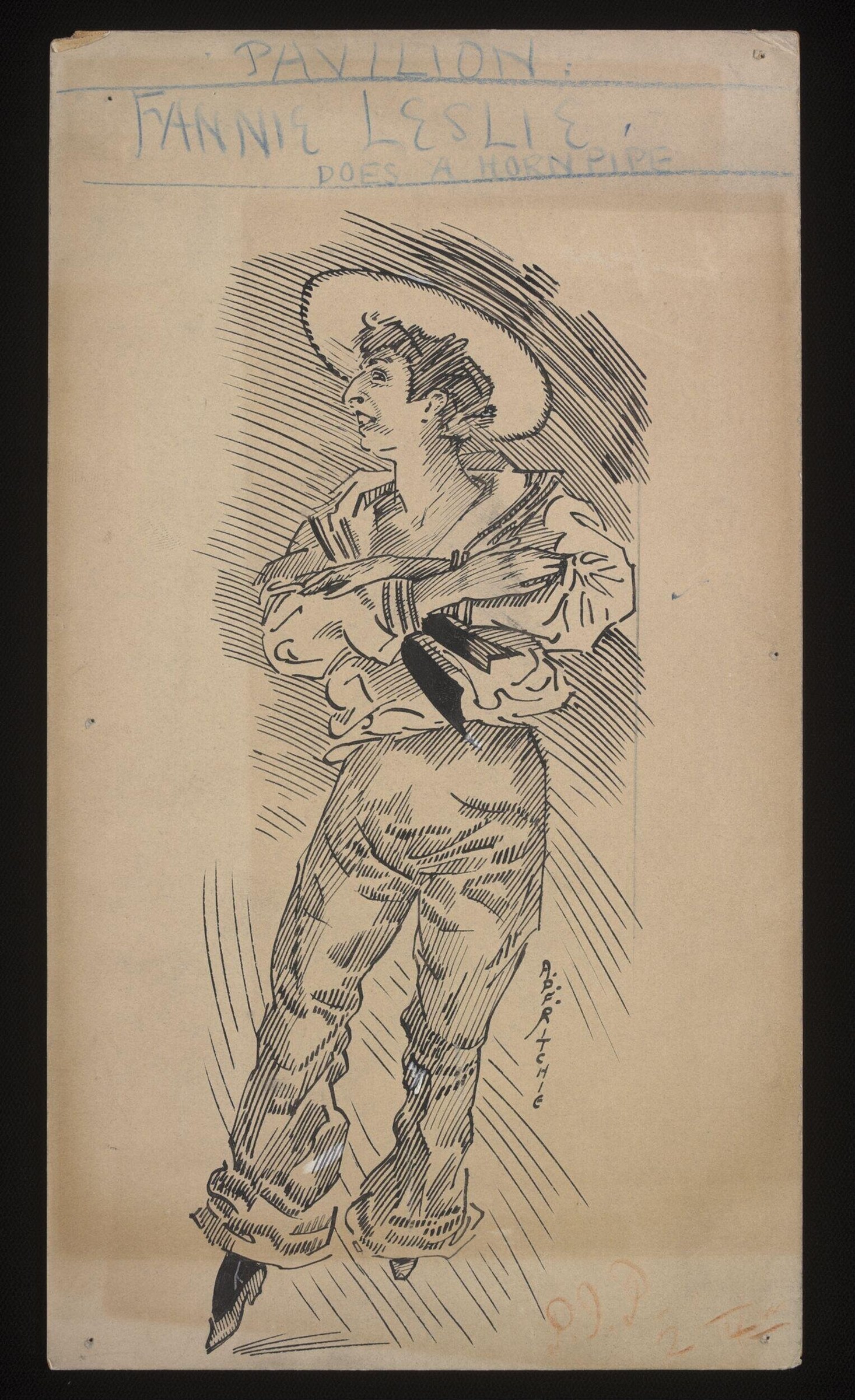
This drawing provides direct evidence of how male performers in popular and character theatre danced and dressed in the late 19th century—information that survives mainly through such sketches, playbills, and photographs, since such roles are no longer performed. The artist understood theatrical costume and the posed elegance required to present a character to an audience watching from a distance, capturing conventions of movement and display now only known through archival sources.
What you are looking at
A single figure in profile stands center, wearing late 19th-century theatrical costume: a fitted jacket with ornamental buttons, knickers or knee-length trousers, and a tall cylindrical hat with a curved brim—likely a top hat or similar period headpiece. The figure holds a small object in one hand (possibly a cane or prop) and extends the other arm outward in a gesture of performance. The pose is elegant and self-aware, with the body angled to show the silhouette clearly. The drawing is rendered in pen with bold cross-hatching for volume and shadow, creating strong contrasts. The figure occupies most of the tall, narrow composition, photographed against plain paper with minimal setting—a pure figure study rather than a scene.
The dancing
The single dancer stands in an attitude of display rather than movement, with weight balanced on one leg in a posed stance. One arm extends away from the body in an open gesture; the other holds a small prop. The torso is upright with the head held high and turned to show profile. The silhouette is deliberately theatrical—the costume is cut to emphasize line and elegance. There is no sense of dynamic motion, only of presentation.
The dance depicted
This appears to be a character from late 19th-century theatrical dance, most likely a male dancer in music hall, variety theatre, or early musical theatre costume. The formal dress, top hat, and carefully composed pose suggest a character role rather than classical ballet. The figure could represent a dandy, a gentleman character, or a specialty performer in a pantomime or burlesque tradition. Without more context on the subject named in the inscription ("Fannie Leslie"), the specific role cannot be determined, but the style points to popular or commercial theatre dance of the 1880s–1890s rather than academic ballet.
How it was made
This is a pen and ink drawing, likely executed with a fine nib for linework and cross-hatching for tonal modeling. The technique is economical and bold—the artist used parallel lines to build volume and shadow, particularly in the clothing and background. The hand is confident and practiced. This appears to be a sketch or study, possibly made for theatrical documentation, costume reference, or illustration purposes. The medium and style suggest circulation through theatrical or performance contexts rather than fine art exhibition.
About this work
A single-figure pen-and-ink character study from late 19th-century theatre, depicting a male dancer or performer in formal dress and top hat, posed in profile with theatrical bearing. The drawing captures a moment of performance presentation rather than active dancing—a frozen instant of theatrical pose. This is the kind of quick character sketch performers and theatres commissioned to document roles, costumes, and character types for reference and promotion. It belongs in a dance gallery because it documents the visual conventions and costume language of popular theatre dance in the period before film, when such drawings were a primary way to preserve images of performance.
How to look at it
Attend to the costume first—every element (hat, jacket, buttons, knickers, footwear) marks this as a specific period and theatrical genre. Notice how the artist posed the figure: the profile view exposes the silhouette; the extended arm and the cant of the body suggest performance address—the figure is being shown to an audience. The cross-hatching creates volume in the cloth, important because costume shape and line were central to how such characters were 'read' from the audience. This is not a dance-in-motion study but a portrait of how a performer presented themselves on stage.
The artist
Alick P. F. Ritchie (or Ritchey) was a theatre artist and illustrator active in the late 19th century, known for drawings and designs for performance. Little is recorded of his training or full career, but his style is consistent with theatrical sketching practice of the period—rapid, economical studies made for costume, character, and documentation purposes. The drawing style and confidence suggest professional theatre training and regular commission work.
The period
In the 1880s–1890s, theatrical dance was booming in music halls, variety theatres, and musical comedies across Britain and America. Male dancers in these contexts wore formal costume—top hats, tailcoats, knickers—and performed character roles, specialty dances (clogging, clog dancing, soft-shoe), and burlesque. Ballet remained a separate and more conservative form; this is popular theatre. Theatrical artists like Ritchie made their living producing quick costume sketches and character studies for actors, dancers, and theatre companies, both for documentation and for promotion to other theatres.
Where it lives
The work is held in a collection identified only as 'Drawing' with source 'va' in the catalogue record. It appears to be a loose theatrical sketch, likely part of a larger collection of costume studies or performance documentation. No accession information, date, or institutional context is recorded.
Dance in this work
Questions about this work
Was this a real dancer or a character type?
The inscription names 'Fannie Leslie,' which may be the performer depicted or the role; without fuller documentation this cannot be confirmed. The formal pose and costume suggest a specific character role in a theatrical production—a dandy, gentleman, or specialty performer—rather than a dance in the classical tradition. Such sketches were made from life or from photograph as reference for costume makers and other performers.
What is this kind of theatre dance?
This appears to be music-hall or variety-theatre performance from the 1880s–1890s. The costume, pose, and character type place it in the tradition of popular theatre dance—clog dancing, soft-shoe, character comedy, burlesque—rather than ballet. Male dancers in this context performed specialty dances, comic character roles, and ensemble work, all of which required skill but operated under different conventions from academic ballet.
Why would an artist make this drawing?
Theatrical sketches like this served multiple purposes: costume reference for makers, documentation of a role or production, reference for revival or transfer to another theatre, and promotion. Before photography and film were standard, such drawings were the primary way theatres recorded and circulated images of roles and performers.
More dance artwork





