49 works in this view — arrow keys or swipe to move between them.
Dance in Art
Drawing
Alfred Stevens
- Collection:
- Drawing
- Source:
- Victoria and Albert Museum
- Rights:
- Rights vary by item — check the source record before reusing this image. Source record ↗
- Recorded as:
- V&A — check rights per item
This work documents the aesthetic ideals underlying Romantic-era ballet, showing how artists trained in academic tradition visualized the dancing body. It demonstrates the circulation of dance imagery in fine art practice and the high cultural status of theatrical dance in the nineteenth century.
What you are looking at
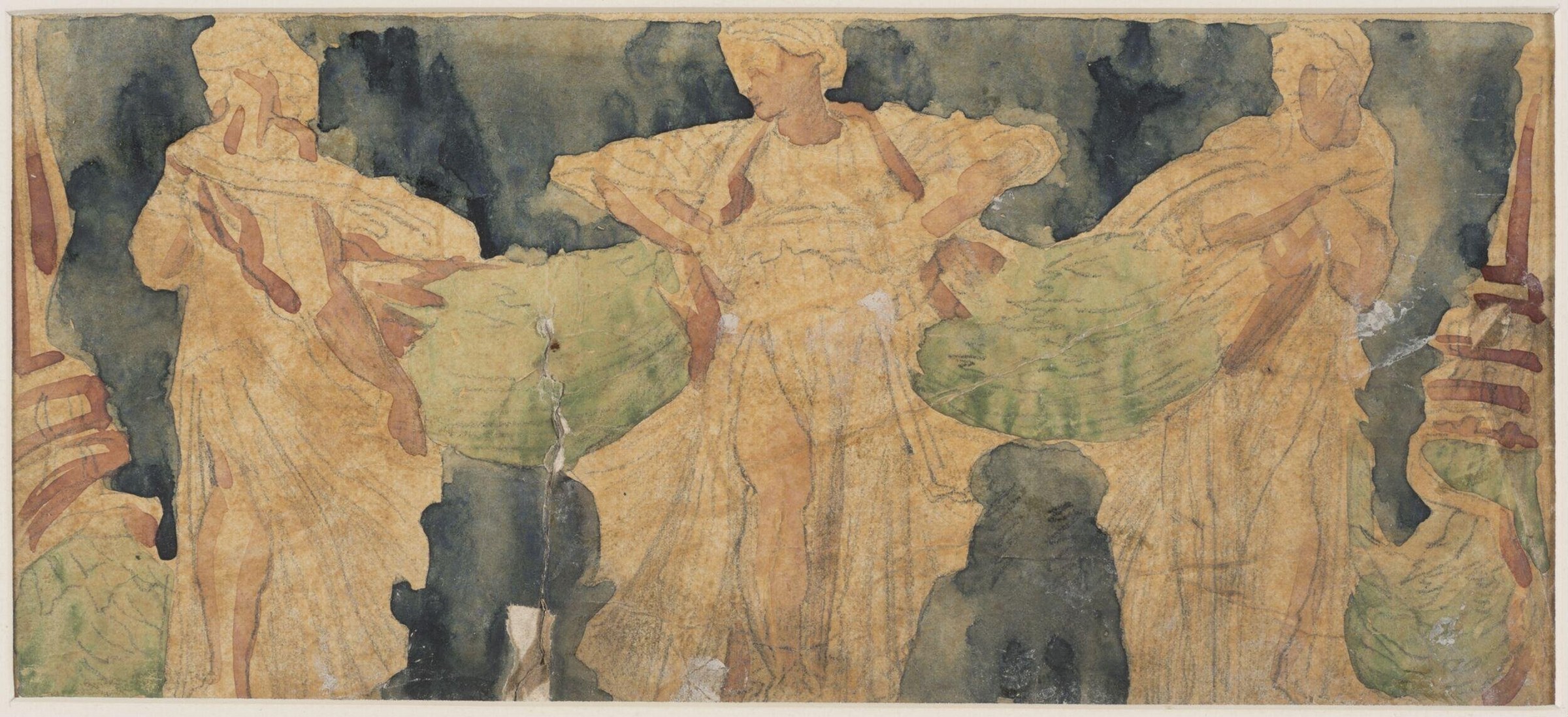
Three female figures in classical drapery stand in a row across the composition, their bodies angled in graceful contrapposto. They wear loose, flowing garments in pale yellow and cream with deep russet-brown accents—likely himation or similar classical dress. The background is rendered in dark greenish-gray washes that suggest an interior or undefined space, allowing the figures to advance. The middle figure stands most frontally with arms extended in an open, welcoming gesture; the flanking figures turn slightly, their weight settled on one leg, creating a sense of ease and poise. Fine linear hatching defines the drapery folds with considerable precision. The drawing has the quality of preparatory study or finished academic work, with areas of high finish in the figures and looser background treatment.
The dancing
All three dancers stand in classical contrapposto, weight centered on one supporting leg with the other relaxed, a posture fundamental to neoclassical movement vocabulary. Their arms are softly positioned—the central figure opens both arms in a welcoming or presentational gesture, while the flanking figures carry theirs more quietly at their sides or partially extended. The stance is upright and dignified rather than dynamic; there is no indication of rapid movement or elevation. The bodies are elongated and gracefully proportioned in the academic manner, and the drapery hangs in regular, sculptural folds that follow the underlying form. No footwork is visible, and there is no suggestion of closed holds or contact between the dancers.
The dance depicted
This appears to depict a moment from classical or neoclassical theatrical dance of the nineteenth century, most likely Romantic-era ballet or a related theatrical genre. The three-figure grouping, the classical drapery, the idealized bodies, and the contemplative, posed quality all suggest academic ballet vocabulary rather than folk or contemporary dance. The work may represent a scene from a ballet narrative—possibly a supernatural or mythological episode—or it may simply study the grace and line of trained bodies in classical dress. The static, presentational quality suggests a pause or tableau rather than a moment of active dancing.
How it was made
This is a watercolor and likely graphite pencil on paper, executed with considerable refinement. The pale washes of ochre and cream define the drapery, while darker green-gray washes establish the background; hatching in brown and black ink gives form and shadow. The technique allows for both precision in the linear definition of the figures and atmospheric softness in the receding space. The fineness of execution and the finish of the work suggest this is a formal study or exhibition drawing rather than a preparatory sketch—the kind of work that would circulate among artists, patrons, and academies as evidence of skilled draftsmanship.
About this work
This is a formal academic drawing by Alfred Stevens, a nineteenth-century artist and printmaker, depicting three female figures in classical drapery arranged in a rhythmic, theatrical composition. The work belongs to a tradition of neoclassical figure study that bridges fine art and theatrical design, showing bodies in the idealized classical postures that trained dancers of the Romantic era would have embodied. Stevens' technical mastery and the polished finish of the work suggest it was intended for exhibition or circulation as a statement of artistic accomplishment.
The drawing documents the visual language of nineteenth-century theatrical dance—not a specific choreography, but the classical vocabulary of line, proportion, and pose that gave Romantic ballet its aesthetic authority. It is a record of how educated viewers of the period understood the dancing body: elongated, restrained, governed by principles inherited from sculpture and academic painting.
How to look at it
Attend to the symmetry and balance of the composition: each figure is a variation on contrapposto, but the artist has varied the angle of the body and the position of the arms to create visual rhythm without fussy movement. Notice the precision of the drapery folds—they are not random but follow anatomical logic and the weight of the cloth. The background is deliberately simplified and recessive, a convention of academic drawing that allows the viewer to focus on the bodies themselves. The work demonstrates the neoclassical principle that beauty lies in repose and proportion, not in action.
The artist
Alfred Stevens (1823–1906) was a Belgian painter, printmaker, and draughtsman known for historical and allegorical subjects rendered in a refined academic manner. He worked extensively in watercolor and was skilled in both oil painting and printmaking, producing illustrations and designs for theatrical and literary works. His practice bridged fine art and applied design, and he was well regarded in European artistic circles for his technical precision and ability to render the human figure with classical elegance.
The period
This work dates from the mid-to-late nineteenth century, when Romantic ballet was at or past its height in Europe. The idealized classical aesthetic—the long lines, the pale drapery, the mythological or supernatural associations—reflects the visual language established by choreographers like Jean Coralli and Jules Perrot in the 1840s and 1850s. At the same time, academic training in figure drawing remained paramount for all artists working in historical or narrative modes, and the study of the human body in classical dress was a standard exercise. The persistence of classical drapery in theatrical dance design long outlasted the active Romantic period, so this drawing could document practice anywhere from the 1840s through the 1880s.
Where it lives
The work is held as a drawing in an institutional collection with the source catalogued as 'va'—likely the Victoria and Albert Museum in London, a major repository of theatrical design and academic drawings. The sparse catalogue record is typical of academic study material that entered collections in bulk and was catalogued by category rather than by individual attribution or provenance research.
Dance in this work
Questions about this work
Is this a costume design for a specific ballet?
The work has characteristics of both fine art study and theatrical design, but there is no inscription or documentation linking it to a particular production. It may represent a scene from a known ballet, or it may simply explore classical drapery as an artistic subject. The three-figure grouping and mythological associations suggest it could relate to works like Giselle or Les Sylphides, but this cannot be confirmed from the image alone.
Why are the figures so still?
The composition depicts a tableau or moment of repose rather than active dancing. This reflects both the conventions of Romantic ballet—which did include static, sculptural moments—and the formal conventions of academic drawing, which valued clarity of line and proportion over the suggestion of movement.
What does the pale drapery represent?
The classical or semi-classical dress is characteristic of nineteenth-century ballet design and associates the dancers with the world of myth and the supernatural, as opposed to historical period costume. This kind of idealized drapery is typical of Romantic-era ballet imagery.
More dance artwork





