49 works in this view — arrow keys or swipe to move between them.
Dance in Art
Theatre costume
Baylis, Nadine
- Collection:
- Theatre costume
- Source:
- Victoria and Albert Museum
- Rights:
- Rights vary by item — check the source record before reusing this image. Source record ↗
- Recorded as:
- V&A — check rights per item
Nadine Baylis was a transformative figure in post-war British theatre design, working with leading choreographers and directors. Her costumes were never merely decorative; they were engineered for specific movement vocabularies and dancers' bodies, making them primary documents of how dance and design were understood to work together in British theatre during this period.
What you are looking at
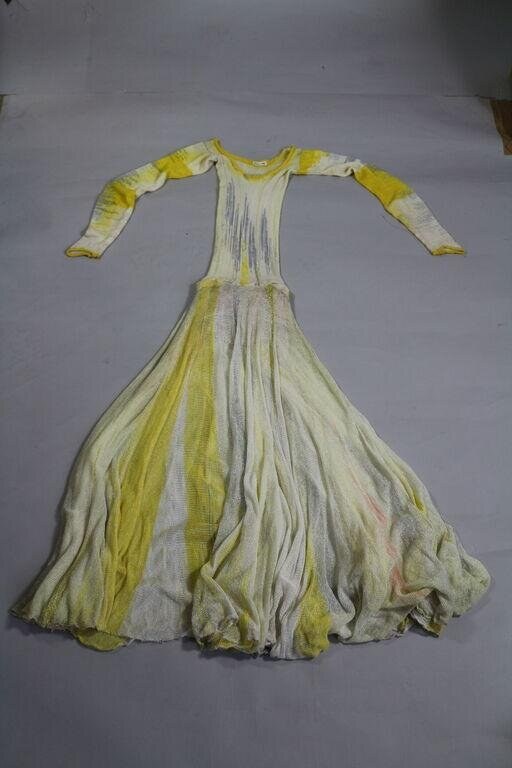
A single figure costume laid flat against a white background, displayed as if on an invisible body. The garment is a long, flowing dress with a dramatically gathered skirt that extends into vertical pleats or folds. The bodice is fitted with long sleeves that taper to the wrists. The color palette consists of pale cream and soft yellow tones, with vertical stripes of deeper yellow running through the skirt section. The fabric appears lightweight and translucent in places, suggesting silk or a similar material suitable for theatrical movement. The overall silhouette is characteristic of early 20th-century theatrical costume design, with an emphasis on elegant line and the capacity for dynamic movement through the voluminous skirt.
The dancing
No living dancer is present; this is a costume object displayed flat. The dress is constructed to allow full arm movement and extensive skirt motion. The long sleeves and fitted bodice suggest a character requiring both precision and fluidity in gesture. The gathered skirt construction implies it was designed to respond visibly to spinning, swaying, or traveling movements across a stage. The vertical pleating creates a silhouette that would read clearly from a distance in theatrical lighting.
The dance depicted
The costume's form strongly suggests romantic or early 20th-century theatrical ballet, with the flowing skirt and fitted bodice typical of that idiom. The gathered rather than tutued skirt indicates a style of ballet concerned with lyrical, grounded movement rather than the abbreviated silhouette of classical technique. The soft coloring and delicate striping suggest a role of gentleness or ethereal quality. Without identifying marks or documentation, the specific dance and role cannot be determined, though the construction indicates a principal character requiring extended solo movement.
How it was made
This is a three-dimensional textile object: a complete theatrical costume consisting of bodice and skirt. The construction technique is hand-sewn, with the skirt gathered and attached to the bodice using methods typical of mid-20th-century costume construction. The photograph documents the costume flat, which was standard practice for archival recording of theatrical pieces. The choice to photograph against white and display the garment in full extension preserves the silhouette and proportions as a designer would have conceived them.
About this work
This is a theatrical costume from 1980 designed by Nadine Baylis, a leading British costume designer. The dress represents a particular moment in British theatre design when costume was understood as integral to the visual and kinetic language of performance. Baylis worked across dance and drama throughout her career, and her designs are recognized for their sensitivity to both the body and the narrative function of dress. The piece belongs in a dance collection because its form—proportions, materials, and construction—was determined entirely by the movement language it needed to support.
How to look at it
Observe how the skirt is constructed to create vertical movement. The gathering at the waist and the deep pleating would cause the fabric to respond immediately to any shift in the dancer's weight or turn of the body. Notice the proportion between the fitted bodice and the expansive skirt—this ratio determines what kind of movement the costume invites. The color, too, is functional: the pale yellow would read as luminous under stage light and would have conveyed specific information about the character's status or emotional state to an audience.
The artist
Nadine Baylis (1917–1992) was one of the most significant British costume and set designers of the post-war era. She trained under Michel Saint-Denis and worked extensively with the Royal Shakespeare Company, the National Theatre, and major dance companies including the Royal Ballet. Her designs were renowned for their combination of visual beauty and practical intelligence—she understood movement from the inside and designed costumes that enabled rather than constrained dancers. She collaborated with major choreographers and directors and was instrumental in elevating costume design to recognition as a creative practice equal to choreography and direction.
The period
In 1980, British theatre design was at a high point of technical sophistication and artistic ambition. The 1970s and 1980s saw intensive experimentation with how costume could articulate character, narrative, and movement quality. Baylis's work of this period reflects the dominance of psychological realism in drama alongside the continued vitality of ballet and contemporary dance. The softness and delicacy of this costume suggests a character of interiority or vulnerability, consistent with the theatrical preoccupations of the period.
Where it lives
This costume is held in a theatre collection, archived as a complete garment object. It represents the kind of design work that major theatre institutions preserve as primary evidence of their production history and design practice.
Dance in this work
Questions about this work
How can I tell what role this costume was designed for?
The form suggests a lyrical, principal character in a narrative work—likely female, likely sympathetic. The softness of color and the flowing construction indicate a character defined by interiority or grace rather than dramatic confrontation. Without documentation of the specific production, the exact role cannot be determined, but the costume's engineering tells us the character needed extended solo movement and to read clearly from a distance.
Why is this object photographed flat instead of on a dress form?
Photographing the costume flat against a neutral background preserves the designer's intended silhouette and proportions without the distortion that even a perfect dress form introduces. This technique allows future viewers to understand how the garment was constructed and how it would move, and it was standard archival practice in mid-20th-century theatre documentation.
What can this costume tell us about how Nadine Baylis worked?
The precision of the gathering and pleating, the careful choice of lightweight fabric, and the proportion between bodice and skirt all demonstrate that Baylis designed from movement outward. Every formal choice serves kinetic function. The costume was not conceived as a decorative object first and a moving garment second—those were the same thing in her practice.
More dance artwork





