49 works in this view — arrow keys or swipe to move between them.
Dance in Art
Watercolour
Craig, Edward Gordon
- Collection:
- Watercolour
- Source:
- Victoria and Albert Museum
- Rights:
- Rights vary by item — check the source record before reusing this image. Source record ↗
- Recorded as:
- V&A — check rights per item
This drawing documents a moment in theater and dance history when bodily extremity and formal distortion were valued as paths to new aesthetic experience. For historians of modern dance, early circus arts, and avant-garde performance, it reveals how choreographers and visual artists of the period understood the body's malleability as a creative resource. For dancers, it raises questions about the ethics and aesthetics of flexibility, contortion, and the transformation of the human form as material for art.
What you are looking at
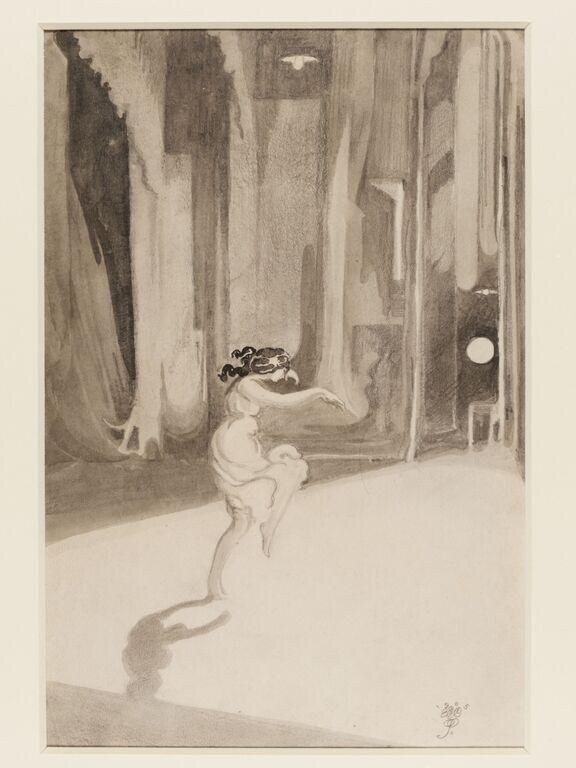
A solitary nude figure sits on the floor of a vast, austere interior space rendered in subtle grays and whites. The dancer is viewed from behind, their body twisted in an extraordinary contortion—the torso folded forward with the head turned back over the shoulder, creating a serpentine S-curve. The limbs are arranged with deliberate artificiality: one leg extends while the other appears tucked or folded. The setting is monumental and dreamlike, with tall, receding architectural forms—pillars or walls—that suggest a temple, corridor, or abstract space. A single circular light source floats in the upper background. The drawing technique is delicate and spare, using soft charcoal or graphite with careful modeling of shadow to define the musculature and convey volume. The overall effect is neither naturalistic nor comfortable: the body is presented as pure sculptural form, an object of aesthetic study rather than a moment of narrative action.
The dancing
The single figure demonstrates extreme spinal flexibility and an unnatural articulation of the human form. The head is fully reversed to look backward while the torso remains forward-facing, a configuration that exceeds ordinary movement vocabularies. The limbs are arranged with sculptural precision rather than dynamic weight distribution. There is no sense of active propulsion or balance—instead, the body reads as a posed study in extreme flexibility, closer to contortion performance or academic figure study than to conventional dance composition. The artist has attended closely to anatomical structure while deliberately distorting it.
The dance depicted
This is most likely an image of acrobatic or contortion performance art rather than theatrical dance in the conventional sense. The extreme spinal hyperextension and twisted configuration of the limbs suggest partner acrobatics (adagio) or solo contortion work—physical practices that existed in early 20th-century avant-garde performance and circus traditions. The figure's isolation and the dreamlike setting suggest this may be a study of the body's expressive potential at the limits of flexibility rather than a depiction of a specific choreographed piece. Without inscription or documented context, the work cannot be definitively attributed to a particular dance form or performer.
How it was made
This is a drawing in charcoal or soft graphite on paper, likely a study or finished work on its own. The artist has used tonal modeling—selective shading and blending—to create volumetric form and spatial recession. The technique allows for precise anatomical rendering while preserving an ethereal, otherworldly quality through the spare, high-keyed palette. The delicate line work and atmospheric perspective suggest this was a careful preparatory study or an autonomous work meant for exhibition or reproduction. The medium's intimacy and the work's modest scale suggest a gallery drawing or a study for theatrical costume or choreographic innovation rather than a monumental public statement.
About this work
This is a figure study depicting an extreme contortion or acrobatic pose, rendered as a pencil or charcoal drawing in a modernist idiom. The work belongs to early 20th-century avant-garde theater practice, when artists and choreographers—particularly those associated with symbolism, modernism, and experimental stagecraft—were investigating the body as pure form and pushing the boundaries of human physicality. Edward Gordon Craig, a pivotal figure in theater reform and scenic design, was deeply invested in exploring the expressive potential of the human figure in abstract space; this drawing exemplifies that investigation. The work demonstrates the period's fascination with contortion, acrobatics, and non-naturalistic body practice as legitimate subjects for serious artistic study.
How to look at it
Attend to the precise point of maximum distortion: the turned head and folded spine that create an impossible and vertiginous spatial relationship. Notice how the artist has chosen a view from behind, which emphasizes the abstract geometry of the pose over the face or psychological expression. The setting—vast, empty, architectural—creates a stage or performance space that isolates the body as an object of pure contemplation. Look at how light and shadow define the musculature not as a naturalistic figure but as a sculptural form, almost like a classical torso transformed by an act of imaginative violence. The artist is asking you to see the body as composition, line, and form rather than as a person in a moment of natural action.
The artist
Edward Gordon Craig (1872–1966) was a revolutionary theater director, scenic designer, and theorist who fundamentally transformed twentieth-century stagecraft. As the son of actor Henry Irving and actress Ellen Terry, Craig was immersed in performance from birth, but he rejected naturalistic theater in favor of abstract, symbolic, and formally experimental work. He founded the journal *The Mask* (1908), which became a laboratory for modernist theater practice and visual culture. Craig's designs often featured stark geometric forms, dramatic lighting, and sculptural approaches to the human body; he saw the actor as a vehicle for visual composition rather than psychological naturalism. His drawings frequently explored the body as pure form—musculature, line, and spatial presence abstracted from narrative context. Craig worked across multiple media (woodcut, lithography, drawing) and was influential on European avant-garde practice, including Russian theatrical innovation and early modernist dance.
The period
This drawing dates to 1905, a moment of profound ferment in theater and visual culture. The early 1900s saw the emergence of modern dance through figures like Isadora Duncan (who rejected ballet's rigidity) and the rise of symbolism in visual art and theater. Simultaneously, circus arts and acrobatics were being reclaimed as legitimate subjects for serious artistic attention—not as mere popular entertainment but as expressions of the body's formal and expressive potential. Craig's theater reformism coincided with broader modernist skepticism about naturalism and growing interest in abstraction, formal experimentation, and non-Western performance traditions (Japanese Noh theater, Indian classical dance). The body was being theorized anew: not as a vehicle for character or plot, but as sculptural material, a site of extreme possibility, and a means of visual rather than narrative communication.
Where it lives
The work is recorded in the VA (Victoria and Albert Museum) collection. The catalogue record identifies it as a watercolor, though the visual evidence suggests charcoal or graphite drawing; the medium field is not recorded in the provided documentation.
Dance in this work
Questions about this work
Is this meant to be a ballet dancer?
No. The pose exceeds the physical vocabulary and aesthetic conventions of ballet, which is based on turned-out positions, verticality, and flowing line. This depicts contortion or acrobatic practice, which pursues extreme flexibility and non-naturalistic bodily configuration as ends in themselves. The setting and treatment also suggest a modernist theater study rather than classical ballet documentation.
Who is the person in the drawing?
The catalogue record does not identify a specific performer or model. The figure is presented as a type—a study of extreme bodily flexibility in abstract space—rather than a portrait of an individual. Craig's theater practice often used anonymous or archetypal figures to emphasize formal and sculptural values over narrative or biographical specificity.
What is the setting supposed to represent?
The tall, receding forms suggest an interior architecture—a temple, corridor, or abstract stage space—rendered in soft, dreamlike perspective. The space is monumental but empty, emphasizing isolation and formal presentation. Craig was celebrated for his scenic designs that created abstract, non-representational environments; this drawing likely reflects his practice of imagining the body within stylized theatrical space.
Why would Craig draw a contortionist?
Craig was investigating the expressive and formal potential of the human body beyond naturalistic representation. Contortion and acrobatics offered extreme examples of bodily malleability and sculptural form. For a modernist theater reformer, the contortionist body represented a kind of artistic freedom and a rejection of academic conventions—it was both formally radical and liberating.
More dance artwork





