49 works in this view — arrow keys or swipe to move between them.
Dance in Art
Fancy dress costume design
Jules Helleu
- Collection:
- Fancy dress costume design
- Source:
- Victoria and Albert Museum
- Rights:
- Rights vary by item — check the source record before reusing this image. Source record ↗
- Recorded as:
- V&A — check rights per item
Costume design drawings like this are essential evidence of how 19th-century dancers actually looked in performance—not how artists imagined them, but how designers specified them to be built. The technical precision and the attention to surface detail show that dance spectacle was a serious discipline requiring collaboration between choreographer, designer, and maker. This particular drawing is also a record of a Paris production in the 1860s, a moment when European ballet was consolidating the visual language—the tutu, the pointe shoe, the tiara, the feathered skirt—that still dominates classical ballet today.
What you are looking at
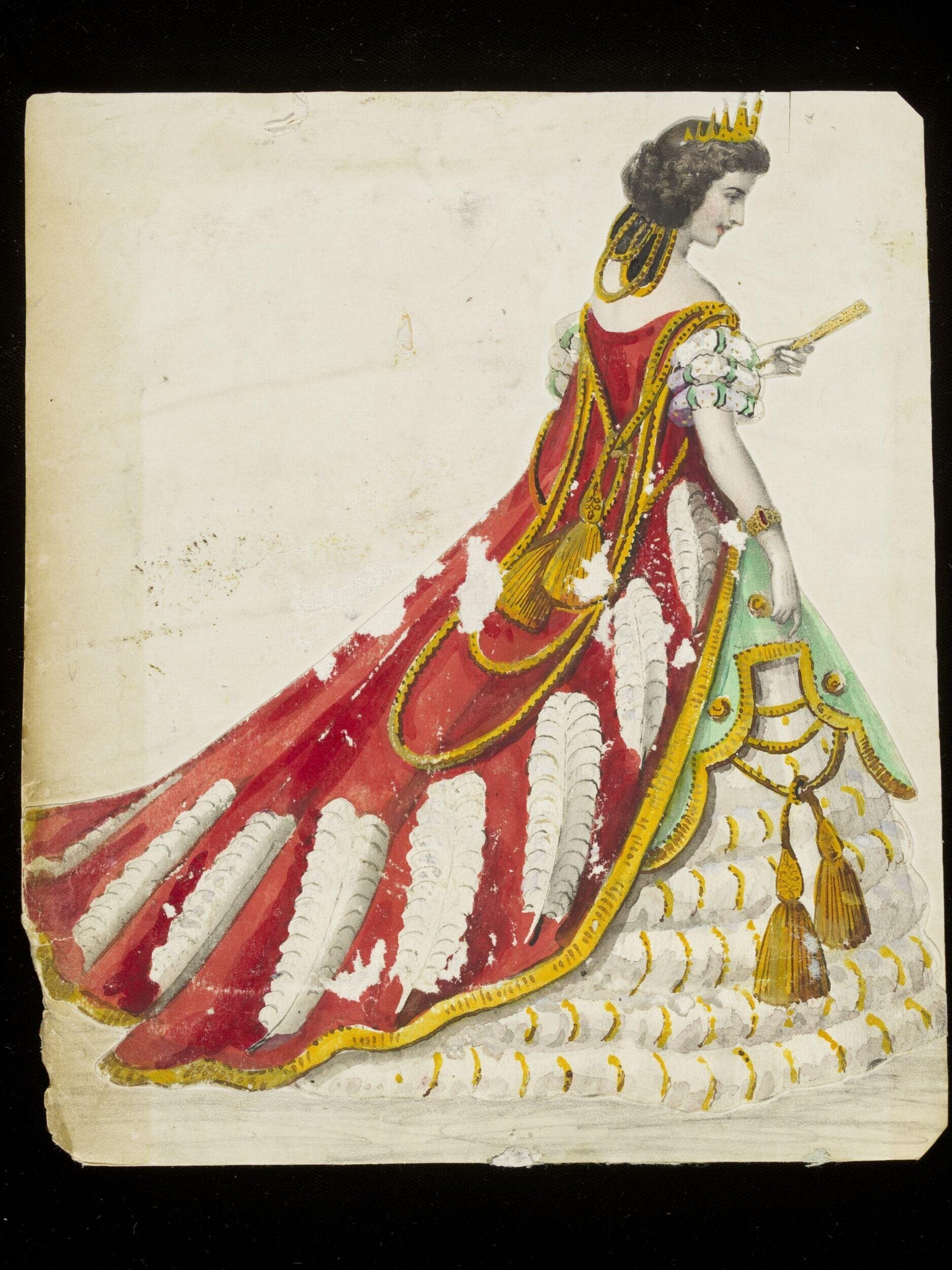
A woman in elaborate theatrical costume stands in a three-quarter pose against a neutral background, her body angled to show the full extent of her dress. She wears a crimson gown with a dramatic trained skirt that extends across the lower half of the composition; the skirt's hem is decorated with alternating white ostrich feather plumes and gold ornamental trim arranged in a formal pattern. Over the gown she wears a short bolero jacket or cape in matching crimson, heavily trimmed with gold braid and fringe, with white feathered or ruffled shoulders. A matching gold-trimmed red drapery with white feather decoration swags across her torso. On her head sits an ornate gold crown or tiara. In her right hand (viewer's left) she extends a long, slender object—possibly a fan, wand, or pointer—with a decorative gold handle. Her left arm rests naturally at her side. The figure's dark hair is styled in an elaborate updo characteristic of mid-19th-century fashion. The rendering is detailed and precise, emphasizing the rich textures and colors of the costume; the pale background isolates the figure completely, presenting the dress as the subject rather than a narrative scene.
The dancing
The single figure stands with weight evenly distributed, in a stable, frontal-facing pose with the body rotated slightly to display the costume. The extended arm holding the wand or fan suggests a theatrical or courtly gesture—presenting, directing, or commanding—though the pose is static rather than dynamic. There is no active footwork or complex movement visible; the body position is formal and composed, the kind of stance used to display regalia or costume in full.
The dance depicted
This appears to be a costume design for theatrical dance, most likely a Romantic-era ballet or operatic spectacle production of the 1860s. The ostrich-feather skirt and gold ornament are characteristic of mid-19th-century theatrical fashion. The formal pose, the lack of active movement, and the emphasis on costume detail suggest this is a design drawing meant to communicate the visual spectacle of a character or role to an audience unfamiliar with the story. The extended arm and regal bearing might indicate a role of authority—a queen, sorceress, or principal character. Without more context, the specific ballet or opera cannot be identified, but the style and period are consistent with the grand ballet spectacles popular in Paris during the 1860s.
How it was made
This is a hand-colored costume design drawing, executed with careful detail in what appears to be watercolor, gouache, or similar medium over a preliminary sketch. The precision of the line work, the subtle gradations in the drapery, the careful rendering of feather textures, and the selective application of gold pigment all point to a professional theatrical design intended as a working document for costume makers and as a record of the production design. The technique allows the designer to show not only the silhouette and construction of the costume but also the color, surface texture, and ornamental detail essential for execution. This kind of drawing would have circulated among the theater's workshops and possibly been retained in the archive as part of the production's visual record.
About this work
This is a theatrical costume design drawing, attributed to Jules Helleu and dated 1860, depicting an elaborate Romantic-era character costume for what was likely a major Paris opera or ballet production. The design shows a woman's gown of the period in its most theatrical excess: a crimson trained skirt trimmed with white ostrich feathers and gold braid, layered with a short bolero jacket and decorative draperies, all topped with a formal crown. The figure is posed to display the costume fully, holding a long wand or fan as an attribute of rank or character type. As a design document, it records both the aesthetic ambitions of mid-19th-century spectacle and the practical requirements for realizing them: the drawing communicates color, texture, construction, and ornamental detail with the precision a costume maker would need. The work belongs in a dance collection because Romantic ballet depended as much on the visual spectacle of costume as on choreography, and because the design records how dance and fashion intersected in the theater of the period.
How to look at it
The viewer should attend first to the costume itself—the feather trim, the gold braid, the layering of fabrics and drapes—which occupies almost the entire canvas. Then notice the pose: the figure is not dancing but displaying, standing still to be looked at. The extended arm and the formal bearing suggest a character of rank or supernatural power. Finally, consider what this drawing would have conveyed to the costume maker: not just what to build, but how much ornament the piece would carry, where the heavy embroidery and feathers would sit, and how the skirt's weight and volume would move when the dancer actually danced in it.
The artist
Jules Helleu (1821–1884) was a French costume and scenery designer who worked extensively for the Paris Opéra and other major theaters during the Second Empire and early Third Republic. He was known for elaborate historical and fantastical costume designs executed with great technical refinement. His designs were influential in establishing the visual standards for grand opera and ballet spectacle of the period. Helleu's work exemplifies the high standard of professional theatrical design in Paris during the mid-19th century, when the city was the center of European dance innovation.
The period
By 1860, Romantic ballet was entering its mature and most visually extravagant phase. The ballets of Delibes and Minkus, with their emphasis on dazzling ensemble effects and ethereal female figures, required costume designs of increasing sophistication. The 1860s saw the development of the tutu as a standard garment and the proliferation of feathered skirts and elaborate headdresses as markers of the supernatural or exotic female characters—fairies, sylphs, odalisques—that populated the repertory. In the visual arts, academic painting and graphic design were at their most technically refined; the precision of Helleu's drawing reflects the broader aesthetic values of academic art in the Second Empire. Theatrical design was both an art and a practical craft, and the best designers, like Helleu, operated competently in both registers.
Where it lives
The work is held by the V&A (Victoria and Albert Museum) and is recorded as coming from their 'va' collection code. It is catalogued as a costume design, a category of theatrical document that the V&A collects systematically as evidence of stage practice and visual culture.
Dance in this work
Questions about this work
Did this costume actually appear in a performance?
Almost certainly yes. Helleu was a working designer for major theaters, and this drawing has the precision and finish of a design that was intended for execution. However, without additional archive information linking it to a specific production, we cannot confirm which ballet or opera it was designed for. The V&A's collection includes both realized designs and rejected or alternative proposals.
What is the object the figure is holding?
It appears to be a long, slender wand or fan with a decorated gold handle. In theatrical costume of the period, such objects were often attributes of character type—a scepter for a queen or deity, a fan for a coquette, a wand for a sorceress. Its exact identity would depend on which role the costume was designed for.
Why are there so many feathers?
Ostrich feathers were a luxury material and a signal of spectacle and expense in theater. By the 1860s, feathered skirts had become almost a uniform for the exotic or supernatural female characters central to Romantic ballet. The feathers also created movement and visual interest—they would flutter and sway as the dancer moved, extending the apparent reach of her body.
How would a dancer actually move in this?
The weight of the feathers and the heavy beading and braid would resist movement and require significant physical effort. The trained skirt would demand careful footwork and control. The costume would limit range of motion but would also create a grand, weighty presence on stage—the effort itself would be part of the spectacle.
More dance artwork





