49 works in this view — arrow keys or swipe to move between them.
Dance in Art
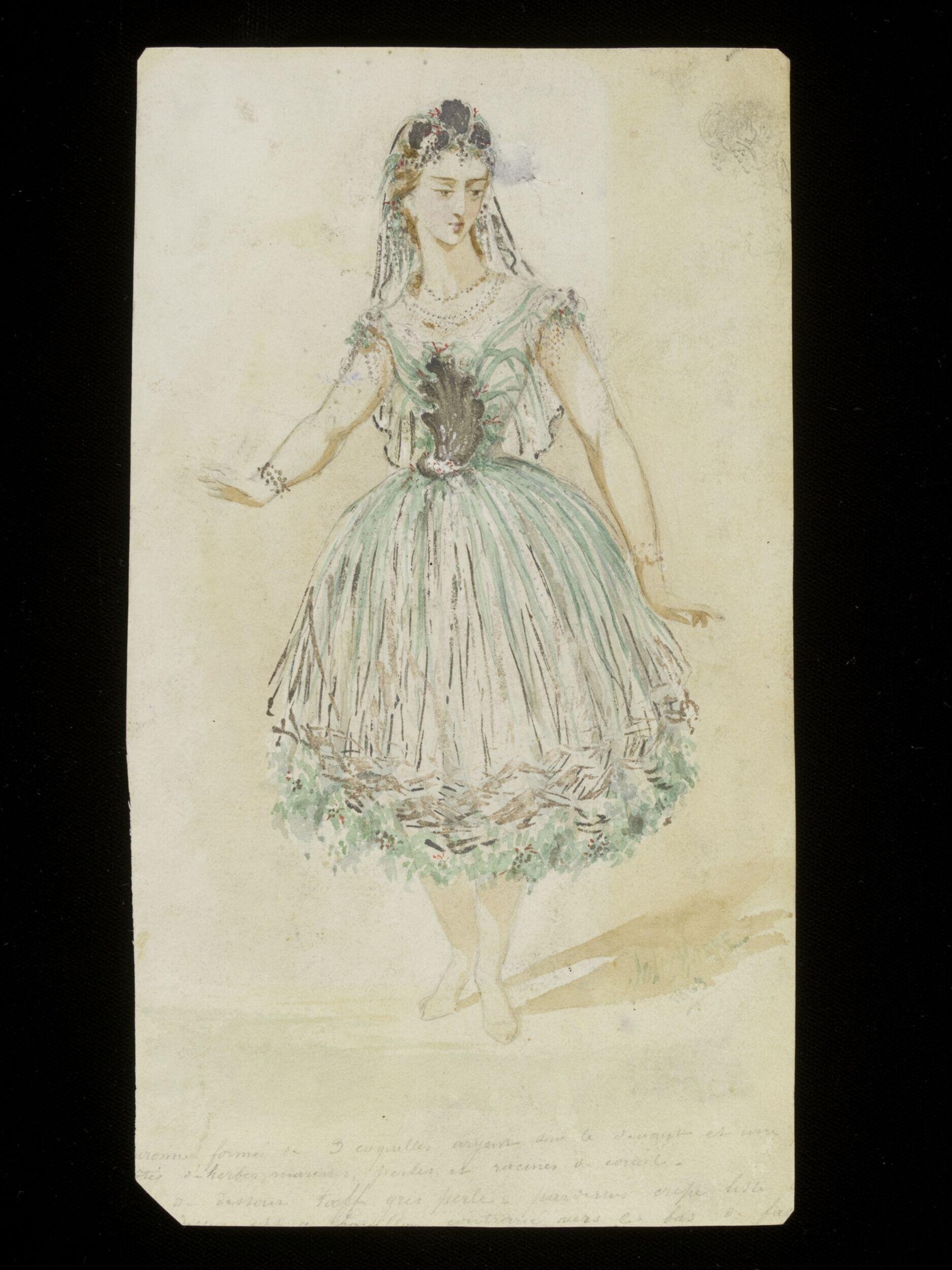
Fancy dress costume design
Jules Marre
- Collection:
- Fancy dress costume design
- Source:
- Victoria and Albert Museum
- Rights:
- Rights vary by item — check the source record before reusing this image. Source record ↗
- Recorded as:
- V&A — check rights per item
This drawing is direct evidence of Romantic ballet costume design in the 1860s, showing how dancers of the period were dressed for roles that demanded a visual transformation into otherworldly beings. The foliage and veil details, the soft colors, and the graceful, upright posture encode the aesthetic values and technical demands of mid-19th-century ballet practice.
What you are looking at
A young woman stands alone in three-quarter view against a neutral background, posed as if mid-performance or captured in a moment of graceful waiting. She wears an elaborate mid-19th-century costume: a pale green bodice with decorative beadwork or embroidery at the center, short puffed sleeves with transparent detailing, and a voluminous skirt composed of multiple layers of pleated or gathered pale green and white fabric that falls to mid-calf. The skirt's hem is trimmed with what appears to be greenery or floral garland—ivy leaves or similar foliage rendered in pale green watercolor. She wears a long decorative veil or headdress that cascades down her back, adorned with beads or jewels at the crown. Her hair is styled up with the veil attached. She wears a pearl or beaded necklace and holds her arms in an open, welcoming position—one hand extended gently to the side, the other resting near her body. Her stance is upright and dignified, weight evenly distributed, with her gaze directed downward and to the side in a contemplative expression. The drawing is executed in pencil with selective watercolor wash, primarily in greens and flesh tones, leaving much of the background bare paper.
The dancing
A single figure dominates the composition, standing in a relaxed but formal stance with symmetrical weight distribution and an open, receptive arm position. The body is elongated and gracefully proportioned in the Romantic style; the artist has paid particular attention to the taper from waist to the columnar line of the skirt. The arms hang naturally with one slightly extended, neither in any closed frame or partner hold. The upright carriage and downward gaze suggest a performer at rest or in a moment of quiet reflection within a theatrical scene, not mid-action.
The dance depicted
This appears to be a costume design for a theatrical female dancer, most likely from a mid-19th-century Romantic ballet. The soft, ethereal aesthetic—pale colors, layered tulle or gauze, floral ornamentation, the veil, and the graceful but static pose—are consistent with the sylph or fairy roles that dominated Romantic ballet in the 1840s–1860s, such as *La Sylphide* (1832) or *Giselle* (1841). The foliage trim on the skirt hem, in particular, suggests a woodland or supernatural character. However, the work is labeled "fancy dress costume design" rather than identified as a ballet design, which may indicate it was for a masquerade, theatrical tableau, or other social spectacle. The artist has captured the dancer in repose, not in motion, so the specific vocabulary of the dance—steps, poses, partnering—cannot be read from the figure itself.
How it was made
The work is executed in pencil and watercolor on what appears to be laid paper, with the drawing done first in fine graphite line and then selectively tinted with pale washes. The technique is characteristic of 19th-century costume design practice: sufficient detail in monochrome to establish form and proportion, with watercolor added to indicate color, fabric, and material properties. The restraint of the palette—pale greens, flesh tone, and near-white—is both practical (limiting the cost of pigment) and evocative (suggesting the diaphanous, ethereal fabrics favored in Romantic theater). This is a design drawing, not a finished artwork for exhibition, and would have been used by theater practitioners to guide the execution of the actual garment.
About this work
This is a mid-19th-century costume design for a female theatrical dancer, drawn in pencil and watercolor by Jules Marre. The figure is rendered in Romantic style, with the elongated proportions, ethereal palette, and woodland ornamentation typical of fairy and sylph roles in the Romantic ballet repertory. The work belongs to a body of theatrical and operatic design work from the period when lithography and engraving made such designs reproducible and collectible; it documents both a moment in theater history and the material culture of how dancers were dressed.
The design exemplifies the mid-Victorian fascination with the spectral and supernatural as expressed through dance and costume. It is at once a practical working drawing for theater practitioners and an artwork in its own right—a study in the rendering of delicate fabrics, the geometry of a full skirt, and the posture of an idealized female performer. For the dance historian, it is primary evidence for how Romantic ballet costumes were conceived, proportioned, and ornamented.
How to look at it
Look first at the proportions: the long lines of the body, the small waist, the generously full skirt—these are exaggerated in a way that would have been visually striking on stage and read at a distance. Notice the foliage trim at the hem: this is not merely decorative, but signals character and narrative (a woodland or supernatural being). The veil cascading down the back suggests both movement (it trails) and otherworldliness. The pose itself is worth attending to: the dancer is not caught mid-step, but in a moment of stillness and composure, suggesting the kind of sustained, controlled grace that Romantic ballet valued. The downward gaze and open arms express a mood—solemnity, reverie—rather than a specific step or position.
The artist
Jules Marre was a French theater designer and lithographer active in the mid-19th century, known for designs for ballet, opera, and theatrical spectacle. He worked during the height of the Romantic era in Paris, when the Opéra was producing major works in the ballet repertory and when costume design was an increasingly specialized and documented practice. Design drawings and prints by theater practitioners like Marre circulated among theater professionals and were collected as documents of theater history and fashion.
The period
This design dates to 1868, toward the end of the Romantic ballet era in Europe. By the 1860s, the aesthetic established by *La Sylphide* and *Giselle* remained dominant, though it was beginning to shift toward the technical spectacle and more elaborate pantomime that would characterize later 19th-century ballet. The soft, ethereal costume seen here—with its pale colors, layered skirts, and supernatural ornamentation—represents the mature Romantic ideal, now a half-century old but still the model for fairy and spirit roles. In the broader context of theater design, this is a moment when such designs were increasingly produced as professional, reproducible documents rather than as unique preparations.
Where it lives
The work is held in a collection identified in the record as "va" (likely the Victoria & Albert Museum, London, which has extensive holdings of theater design and costume drawings). The catalogue record provides minimal information beyond title, artist, and date, indicating this is one of many such designs in the collection, many of which have not been fully catalogued or described.
Dance in this work
Questions about this work
Is this for a specific ballet or role?
The design is not explicitly labeled with a ballet or character name. However, the aesthetic strongly suggests a Romantic-era fairy or sylph role—the type of supernatural female character that was central to the ballet repertory from the 1830s onward. The foliage trim is particularly suggestive of woodland roles like the Sylph in *La Sylphide*. Without archival documentation, we cannot name the specific production, but the costume vocabulary is unmistakable.
Could this be for something other than ballet?
The catalogue record calls it "fancy dress costume design," which could encompass masquerade balls, tableaux vivants, or theatrical productions beyond ballet. However, the style is consistent with mid-19th-century theatrical ballet costume, and the notation "fancy dress" may simply reflect the archival classification of the holding institution. Without further documentation, the most evidence-supported reading is that this is a ballet or theatrical dance costume.
Why is the dancer posed at rest rather than mid-movement?
This is a design drawing, not a performance image. The figure is shown in a stable, frontal pose that allows the costume to be read clearly—the proportions of the bodice and skirt, the placement of ornament, the way the fabric falls. A mid-movement pose would obscure details that a costumer or seamstress needed to understand. The stillness is practical, not aesthetic.
What do the watercolor washes tell us?
The pale greens, whites, and flesh tones indicate the actual colors of the costume as designed, likely in silk, gauze, or tulle. The selective wash (rather than full color) was economical for a working drawing, but it also conveys an impression of how the costume would look on stage—ethereal, diaphanous, and subtly colored rather than bright or stark. The tones chosen are those that would read well by gaslight.
More dance artwork





