49 works in this view — arrow keys or swipe to move between them.
Dance in Art
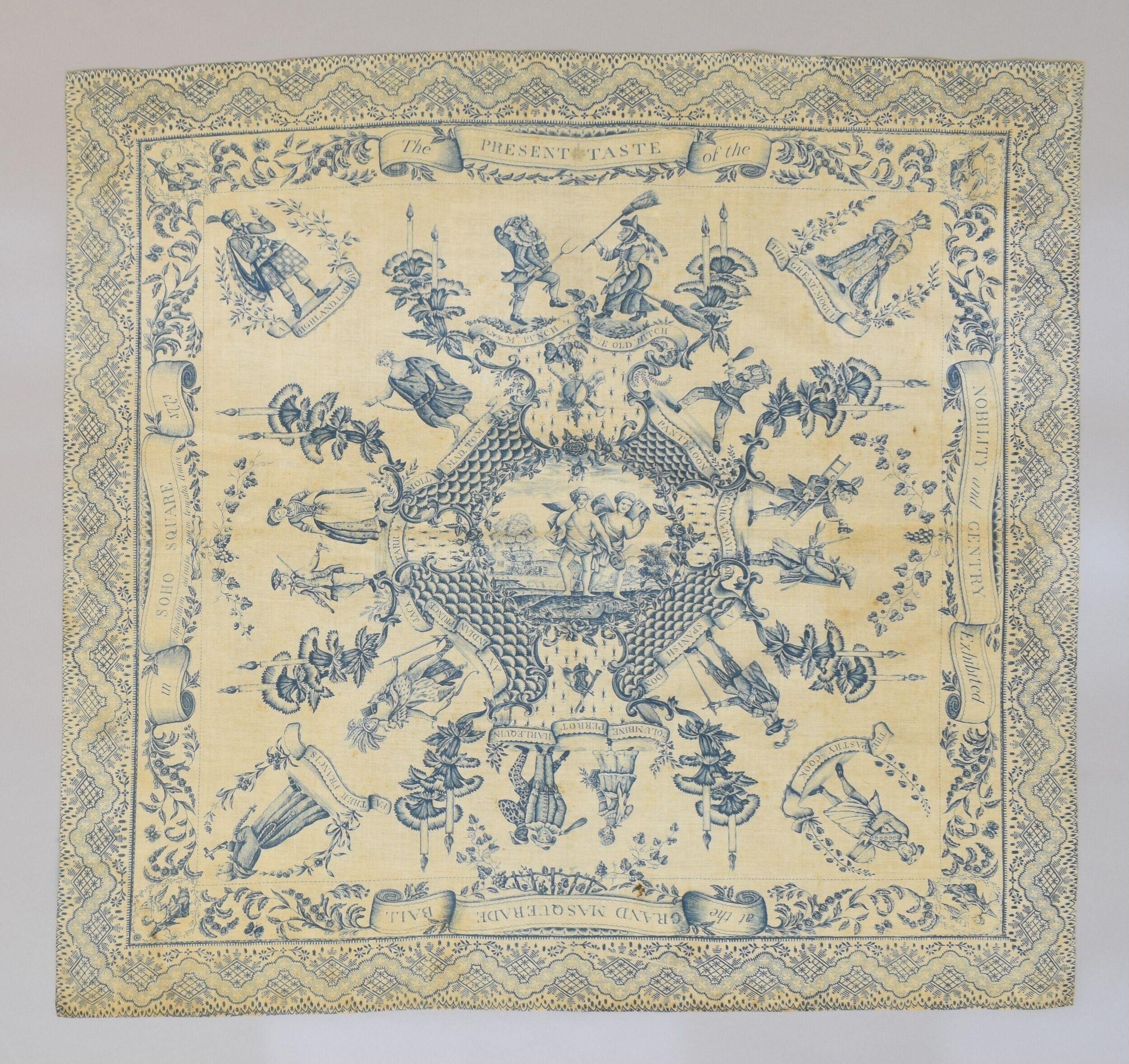
Present taste of the Nobility and Gentry Exhibited in the Grand Maquerade Ball in Soho in 1771
Unknown
- Collection:
- Handkerchief
- Source:
- Victoria and Albert Museum
- Rights:
- Rights vary by item — check the source record before reusing this image. Source record ↗
- Recorded as:
- V&A — check rights per item
Masquerade balls were a defining feature of 18th-century fashionable culture, and this image preserves a vivid record of a celebrated London event. It shows not formal dance technique but the social experience and visual spectacle of the ball—how masquerade was experienced as a space of temporary licence, costume, and social mixing. The survival of the image as a printed handkerchief also tells us how such events were commodified and distributed as consumer goods for fashionable audiences.
What you are looking at
A densely populated masquerade ball rendered in blue line engraving on cream linen, with figures distributed across a shallow stage-like space framed by ornamental borders. The composition centers on two large vase-shaped objects or architectural features, possibly urns or fontains, which serve as focal points around which dancers cluster. Hundreds of small figures—some paired, some in groups, some alone—are scattered throughout in various attitudes of movement and repose. The figures wear 18th-century dress: the women in wide skirts, the men in coats and breeches. Many carry attributes of masquerade: masks, feathered headdresses, fans, and what appear to be props or costume pieces. The space is shallow and compressed; there is no clear stage depth, and figures overlap and intermingle without strong spatial recession. The upper margins contain banners and cartouches with text, and the entire composition is enclosed in an elaborate lace-pattern border typical of fine linen handkerchiefs.
The dancing
The dancers are depicted at many different scales and in varied postures: some stand in conversation, some bow or curtsy, some appear to leap or turn, others recline or sit. Pairs of figures often face each other or stand side by side. Many adopt exaggerated or theatrical poses—one figure appears to be in a high kick, another suspended in air, several in deep bows. The gestures are playful and carnivalesque rather than formally balletic; the emphasis is on the variety and licence of masquerade rather than on technical precision or unified formation. No strict dance hold or frame is visible; instead, figures mingle freely, many without clear partnering.
The dance depicted
This is a representation of the Grand Masquerade Ball held in Soho in 1771, a fashionable entertainment of the London season. Masquerade balls of this period combined elements of social dance, theatrical performance, and costume spectacle; the dances performed would have included country dances, cotillions, and minuets, though the emphasis in the image is on the social chaos and visual abundance of the event rather than on any single dance form. The abundance of figures, the prominence of masks and costumes, and the mingling of ranks and types suggest the famous licence of masquerade—the temporary suspension of social hierarchy. The image documents not a choreographed performance but the culture of a social occasion.
How it was made
This is a linen handkerchief printed by engraving, a medium that allowed mass production of decorative textiles for the fashionable market. The blue-on-cream palette and fine hatching are characteristic of copperplate engraving on textiles. Such handkerchiefs were souvenirs and tokens—mementos of a celebrated event, or gifts for those who wished to possess a memento of a famous ball. The technique required a single copper plate and could produce many impressions; the linen support makes this a domestic or personal object, not a hanging or framed art, and its very existence as a textile tells us it circulated among a broad commercial market of fashionable consumers.
About this work
This is a printed linen handkerchief documenting a famous masquerade ball held in Soho, London, in 1771. The composition is a compressed, ornament-filled visualization of the social chaos and costume spectacle of the event, showing hundreds of small figures in 18th-century dress, masks, and masquerade props arranged around symbolic architectural forms. It is a document of Enlightenment-era fashionable leisure and of the masquerade ball as a specifically urban, commercialized, and socially transgressive entertainment.
The work sits at the intersection of textile design, commemorative printmaking, and social history. It captures not the technical content of ballroom dance but the culture and experience of a celebrated social event—the mingling of figures, the abundance of costumes and props, the visual excess and licence of masquerade. For a dancer or historian, it offers evidence of what masquerade balls looked like, how they were remembered, and how they circulated in popular culture.
How to look at it
Attend to the abundance and variety of gesture: this is not a formal procession or unified dance, but a crowded scene of individual and paired figures in many different postures and attitudes. Notice the costumes—the masks, feathered headdresses, fans, and exotic or theatrical props—which are central to masquerade culture. Look at the two large central vases or urns, which appear to be focal points or gathering places. The ornate lace-pattern border is integral to the design; this is a handkerchief, not a print, and the entire composition is framed as a portable object. The small scale of the figures and the density of the scene reflect the overwhelming visual and social spectacle of the ball itself.
The period
The masquerade ball was at its height of fashion in mid-18th-century London. The form combined elements of Venetian carnival tradition with British ballroom culture and urban entertainment spectacle. Masquerades were sites of transgression—they allowed participants to wear masks, adopt temporary identities, and mix socially in ways normally forbidden. They were also controversial, condemned by moralists as occasions for immorality and disorder. The Soho masquerade of 1771 was a public, celebrated event, sufficiently famous to merit commemoration on a printed textile. By the time this handkerchief was made, the masquerade ball had already become a subject of satire and commentary in both literature and visual culture.
In the visual arts, masquerade scenes were a popular subject in the 18th century, appearing in paintings, prints, and theatrical imagery. The compressed, ornament-heavy composition of this handkerchief is typical of commemorative engraved textiles, which often packed narrative and documentary detail into a densely populated scene framed by decorative borders. The style reflects the visual taste of fashionable London: ornate, encyclopedic, interested in recording the abundance and variety of social spectacle rather than in formal clarity or spatial depth.
Where it lives
This is a printed linen handkerchief in the collection of the Victoria & Albert Museum. Handkerchiefs were mass-produced commemorative textiles, and their survival in museum collections is common; they circulated as fashionable goods and souvenirs among urban middle and upper-class consumers.
Dance in this work
Questions about this work
What is a masquerade ball and why was it controversial?
Masquerade balls were fashionable social entertainments of the 18th century in which participants wore masks and costumes, temporarily concealing their identity and social rank. They were celebrated as occasions of pleasure and licence but condemned by moralists as sites of immorality, disorder, and illicit mixing. The Soho masquerade of 1771 was a famous public event, large enough and fashionable enough to be commemorated on printed textiles.
Why was this scene printed on a handkerchief?
Fine linen handkerchiefs were fashionable consumer goods in the 18th century, often printed with commemorative or decorative designs. They served as souvenirs and gifts, allowing purchasers to own a memento of a celebrated event or to display their fashionable taste. The copper-plate engraving technique allowed for mass production, making handkerchiefs an affordable way to circulate images of fashionable culture among a broad urban market.
What dances would have been performed at this ball?
Masquerade balls of the 1770s would have featured cotillions, minuets, and country dances—the standard ballroom forms of the period. However, the licence of masquerade allowed for more theatrical and transgressive performance than at formal court balls. This image emphasizes the social chaos and costume spectacle rather than the specific technical forms of the dances themselves.
How many figures are shown in this scene?
The composition is densely packed with hundreds of small figures, arranged apparently without strict organization. They vary greatly in scale and are distributed unevenly across the space, some clustered around the central vases, others scattered throughout the composition. Counting them precisely is difficult; the abundance and density are more important than an exact number.
More dance artwork