49 works in this view — arrow keys or swipe to move between them.
Dance in Art
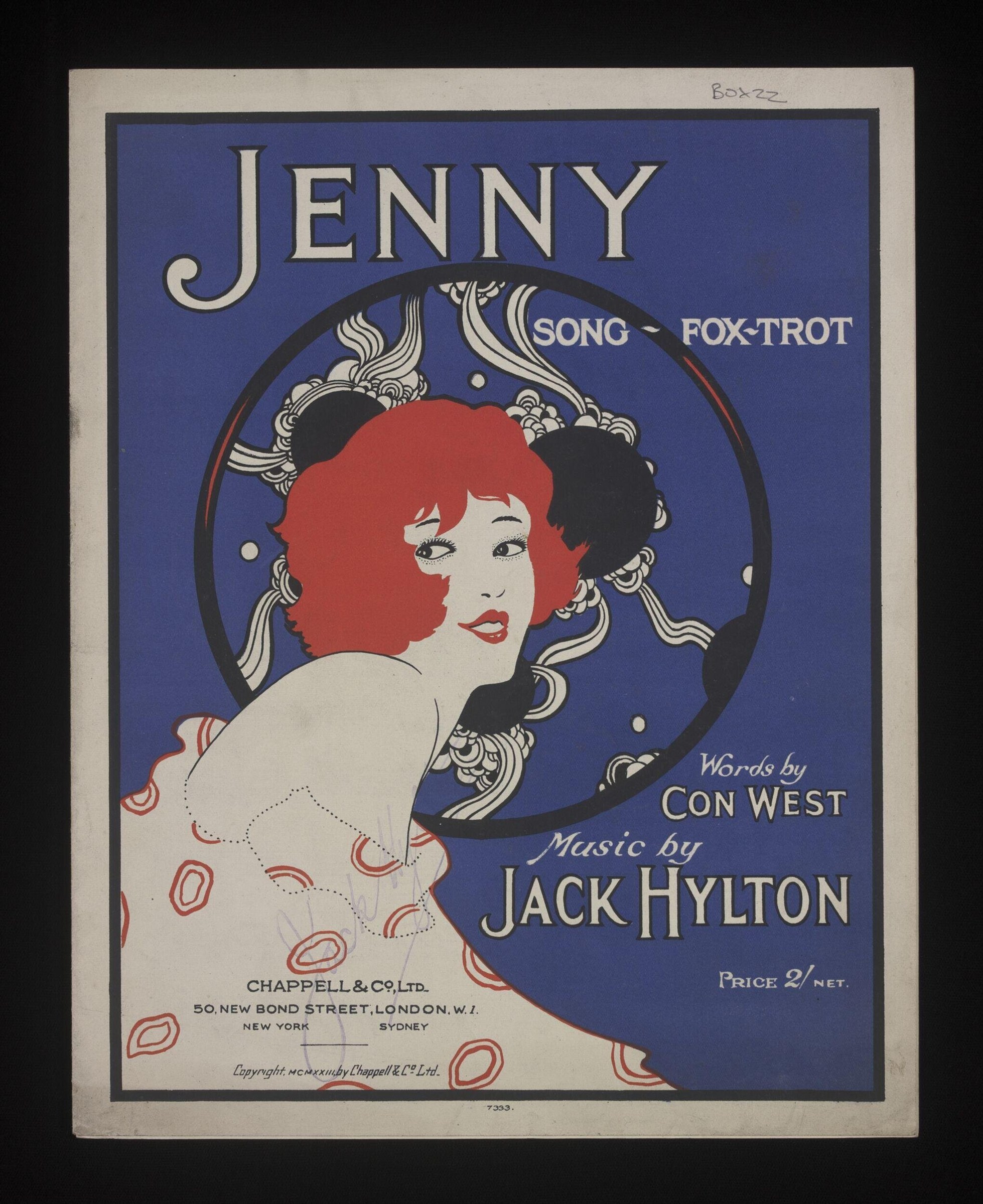
Jenny Song-Foxtrot
Chappell & Co.
- Collection:
- Sheet music
- Source:
- Victoria and Albert Museum
- Rights:
- Rights vary by item — check the source record before reusing this image. Source record ↗
- Recorded as:
- V&A — check rights per item
Sheet music covers are often overlooked in dance history, yet they are direct evidence of which dances were commercially popular, how they were marketed to the public, and what visual language was used to make them desirable. This cover shows a significant moment in the social history of ballroom dance: the foxtrot's emergence as a dance of modernity and style, marketed to a mass audience through graphic design. The Art Deco aesthetic, the emphasis on the performer's face, and the price point (2 shillings net) all testify to the foxtrot's status as entertainment for the urban middle class.
What you are looking at
Sheet music cover for a foxtrot, rendered in Art Deco style with vivid blues, creams, and reds. A woman's face in three-quarter profile occupies the center, her distinctive bobbed hair split into two halves—one bright red, one deep black—suggesting movement or a mirror reflection. She wears dramatic makeup with defined eye makeup and red lips, gazing upward. Behind her head, ornamental baroque flourishes in cream and black scroll across the blue background, creating an elaborate frame. Her bare shoulder and upper back are visible, rendered in pale cream, with decorative red circular motifs down one side suggesting either jewelry or textile patterning. The composition is flatly graphic, with no depth of field: the figure floats against the abstracted background rather than inhabiting a space.
The dancing
A single figure—the dancer or subject—is shown from the shoulders up, her body angled to present the head in profile while facing slightly toward the viewer. The upward gaze and the tilt of her head suggest buoyancy and vitality rather than a fixed pose. The split-colored hair is the dominant gesture: it reads as whimsical, modern, and dynamic, evoking the sense of rapid movement or the duality of reflection. No active footwork or hold is visible; this is a portrait-based composition rather than a narrative dance scene.
The dance depicted
The work is promoted as a foxtrot—one of the most popular ballroom social dances of the 1910s–1920s. The foxtrot was a syncopated, relatively smooth social dance performed by couples at dance halls and in theatrical entertainment. The image offers no direct depiction of the dance itself—no partner, no frame, no footwork—but rather presents the face and allure of a performer or dancer associated with the foxtrot craze. The sheet music format and theatrical styling suggest this was music for performance or home dancing during the height of the foxtrot's popularity in early twentieth-century popular culture.
How it was made
This is a lithographic cover for sheet music, a medium perfectly suited to the bold, flat color blocking and fluid lines of the Art Deco aesthetic. The technique allowed for bright, affordable color reproduction and was the standard for mass-produced sheet music covers of the era. The separation of colors—pure reds, blues, creams, and blacks—with minimal shading is characteristic of lithographic design. The format speaks to the work's audience: amateur musicians and dancers in middle-class homes, music halls, and dance venues. Sheet music covers were collectible and decorative as well as functional, and their visual design was often as much a draw as the music itself.
About this work
This is a sheet music cover for 'Jenny,' a foxtrot composed by Jack Hylton with words by Con West, published in 1913 by Chappell & Co. It documents the foxtrot at the height of its early popularity in the British Isles and internationally. The cover image—a stylized woman's face split between red and black hair, rendered in the geometric, flattened idiom of Art Deco—captures the modernity and allure that made the foxtrot a sensation. Rather than showing couples dancing, the designer chose to market the music through an image of a performer's face, emphasizing glamour, movement, and the theatrical energy of the dance craze. The work is a primary source for how the foxtrot and its associated dancers were visualized and promoted to the public.
How to look at it
Observe the way the designer has chosen to represent movement not through action but through the split coloring and upward tilt of the head. The red and black hair is not naturalistic; it is a graphic device suggesting vitality, duality, or the blur of motion. The baroque ornaments behind the head are deliberately anachronistic—a rococo frame around a modernist face—which plays into the period's fascination with mixing historical references. Notice the absence of the dance itself: this is marketing through personality and glamour rather than through representation of the physical act. The price and publisher information ground the image in the commercial world of amateur dancing and home entertainment.
The artist
Chappell & Co. was a major British music publisher based in London, with branches in New York and Sydney. The cover is a commercial design product, not attributed to a named artist on the visible surface, though it reflects the professional standards of commercial lithographic design of the 1910s. The publisher was one of the largest music houses of the era and would have commissioned designers skilled in the emerging Art Deco style.
The period
The foxtrot emerged in the United States around 1912–1914 and spread rapidly to Britain and Europe, becoming one of the defining social dances of the 1910s and 1920s. It was faster and more improvisational than earlier ballroom dances, and its popularity coincided with broader social changes: the rise of commercial dance halls, the increasing visibility of women in public entertainments, and the association of dance with modernity and cosmopolitanism. The Art Deco movement was just beginning to establish itself as a visual language for modern design in 1913, and sheet music covers were among the first mass-produced objects to employ its flattened forms, bright colors, and geometric ornamentation. This cover sits at the intersection of these trends: new dance, new design, new consumer culture.
Where it lives
This is a sheet music cover held in the collection VA (likely the Victoria and Albert Museum or a related archive). Chappell & Co. was based at 50 New Bond Street, London, with branches in New York and Sydney, indicating this was distributed across the English-speaking world.
Dance in this work
Questions about this work
Is this a photograph of a real dancer?
No. This is a lithographic design—a hand-drawn or processed image reproduced in color on stone, not a photograph. The style is highly stylized and graphic, not photorealistic. The split hair and idealized face are design choices meant to convey modernity and movement, not documentary accuracy.
What is a foxtrot?
The foxtrot is a ballroom dance in 4/4 time, typically performed by couples in closed position or open variations. It emerged around 1912 and became one of the most popular social dances of the twentieth century. It is characterized by a relatively smooth, gliding movement with varied rhythm, and was considered modern and fashionable in the 1910s–1920s. Unlike older waltzes, the foxtrot allowed for improvisation and a less rigid frame.
Why is the hair two colors?
The split coloring is a design convention of the period, likely meant to suggest movement, duality, or the eye-catching modernity of the flapper era. It may also play on the visual possibilities of lithographic printing, where bold, contrasting colors were both practical and eye-catching on a shop shelf. It is a graphic device, not a representation of actual hair color.
Who was Jenny?
The song is simply titled 'Jenny,' and the cover does not identify a specific historical person. The face may have been modeled on a performer of the era, or it may be a generic ideal of a modern, glamorous woman. Sheet music covers often did not credit the models or specific sources for their imagery.
More dance artwork





