49 works in this view — arrow keys or swipe to move between them.
Dance in Art
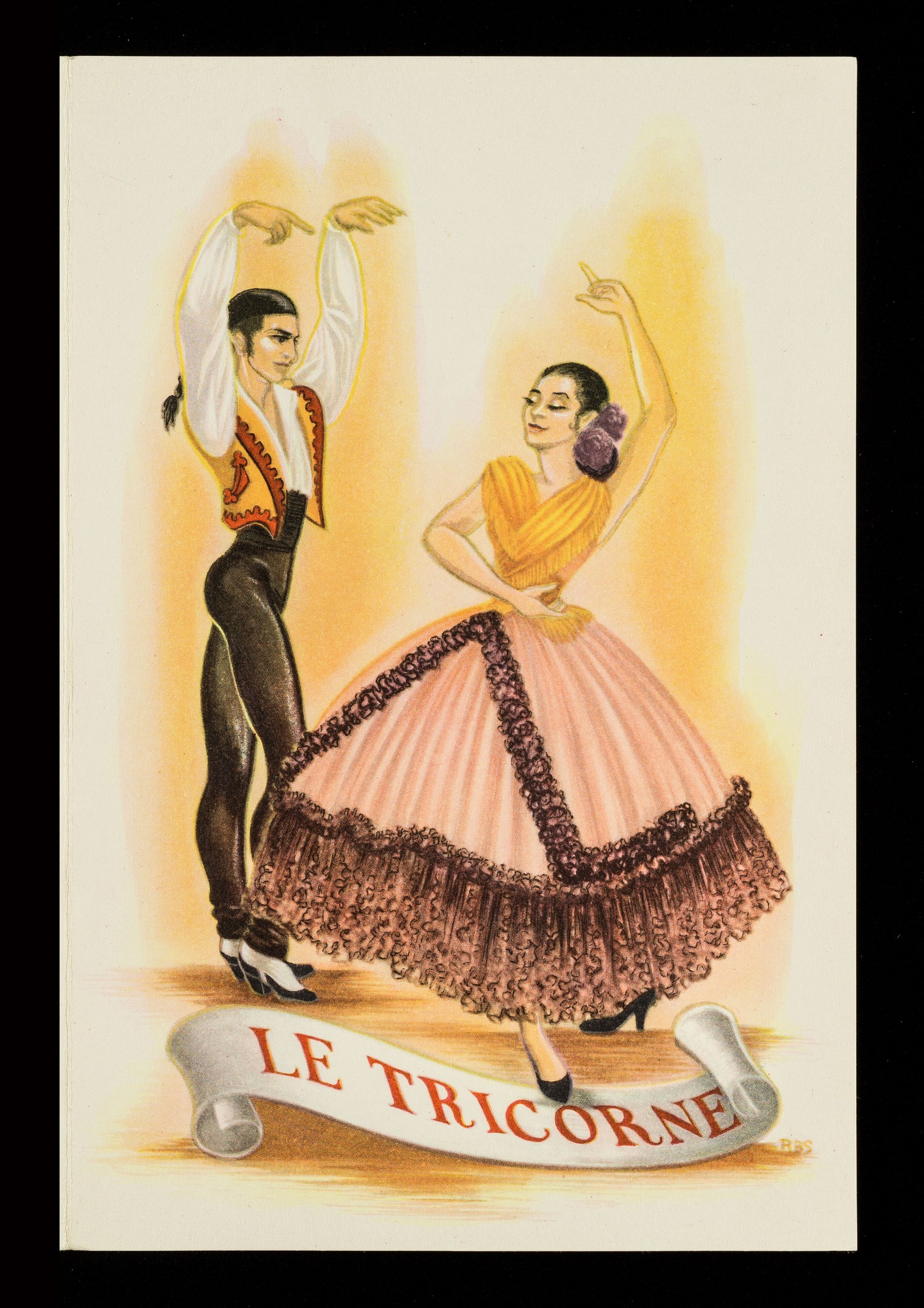
Le tricorne / designed by R.B. Sutcliffe.
Unknown artist
- Source:
- Wellcome Collection
- Rights:
- Rights reserved by the holding institution — do not reuse without permission. Source record ↗
- Recorded as:
- In copyright
*El Tricorne* was transformative for Spanish dance in the Western theatre, and this image is documentary evidence of how the ballet staged Spanishness through costume and gesture. For historians of the Ballets Russes and of modernist appropriation of folk forms, this watercolour is a precise, contemporaneous record of the visual language the company used.
What you are looking at
A man and woman perform a Spanish dance in a golden-lit theatrical space. The man stands at left in dark trousers and a short red embroidered jacket, holding aloft a white cloth or handkerchief with both arms raised in a graceful arc. The woman at right wears a yellow bodice and a voluminous pink skirt with heavy brown ornamental trim or ruffles at the hem, her right arm raised in a curved position while her left hand rests at her side. Both dancers face the viewer with slight smiles. The composition is intimate and frontal, set against a warm yellow wash that suggests stage lighting. A banner at the base reads "LE TRICORNE" in red letters. The drawing style is delicate and refined, with soft shading in watercolour or gouache, the figures rendered with careful attention to fabric texture and the subtle modelling of faces.
The dancing
Both dancers are upright and poised, with elegant port de bras. The man's arms frame the raised handkerchief in a sweeping, open gesture characteristic of Spanish folk dance; his torso remains nearly frontal. The woman's raised arm mirrors a classical graceful line, her body held in formal posture with slight counterbalance. Their positioning suggests a moment of mutual regard and coordination rather than contact—they are close but not joined, a spatial relationship typical of Spanish courtship dances. Both stand with visible confidence and control.
The dance depicted
This depicts a moment from *El Tricorne* (The Three-Cornered Hat), the iconic 1919 Spanish-themed ballet choreographed by Manuel de Falla with sets by Pablo Picasso, most famously performed by the Ballets Russes with Leonide Massine. The handkerchief and the Spanish costume—the jacket and the ornate skirt—are signature elements of this work. The relaxed spatial relationship and the theatrical framing identify this as a theatrical interpretation of Spanish dance rather than folk practice, positioning it within the early 20th-century vogue for Spanish exoticism in European high dance.
How it was made
This is a watercolour or gouache illustration on paper, executed in a soft, diffused style with careful colour modulation. The artist has used transparent washes to build the yellow atmospheric glow and has reserved the white paper for the handkerchief and highlights on the dancers' faces, a technique that gives the work a luminous, stage-lit quality. The technique suggests a professional theatrical design or publicity image, made for reproduction or as a record of a performance costume and pose. The style and finish indicate this was likely created during or shortly after the work's premiere, as a keepsake or promotional image.
About this work
This is a delicate watercolour record of a moment from *El Tricorne*, the 1919 Ballets Russes production that became one of the most celebrated Spanish-themed ballets in the modernist repertory. It captures the work at a moment of high international prestige, when Spanish folk idiom was being absorbed into European theatrical dance. The image shows the ballet's signature vocabulary—the handkerchief, the ornate costume, the formal yet sensual bearing—frozen in a single pose. As a design document and as a window into how this pivotal work was understood and visualised, it belongs in any archive of early 20th-century theatrical dance.
How to look at it
Attend to the quality of the handkerchief—how it is held and framed—as the focal point of the composition. The artist has positioned it to catch the light and draw the eye, making it a prop as important as the bodies themselves. Notice too the asymmetry of pose: the man's arms are raised and open, the woman's arm raised but controlled, their bodies angled away from strict frontality. This slight turning and the spatial gap between them suggest narrative tension—a moment in a story of courtship or display. The soft, golden light unifies them and emphasises the artifice: this is theatre, not street or village, and the artist wanted the viewer to feel the stage.
The artist
The designer is credited as R.B. Sutcliffe. Without further documentation, little can be confirmed about this artist; the elegant, refined style of the work suggests professional training in theatrical or fashion illustration, and the date (unknown) places them within the early-to-mid 20th-century British or European commercial art world. The work's quality and precision suggest a designer with access to the Ballets Russes circle or a sympathetic theatrical milieu.
The period
The 1910s and 1920s saw an explosion of interest in Spanish dance across Europe, driven partly by the success of *El Tricorne* and other Ballets Russes productions, partly by the international fame of dancers like La Argentinita, and partly by broader modernist hunger for 'authentic' folk forms. At the same time, theatrical ballet was consolidating its vocabulary of gesture and costume, and Spanish dance—with its recognisable props (fans, handkerchiefs, castanets) and dramatic silhouettes—proved highly theatricalisable. The designer's choice to render the dancers in soft, flattering light, with attention to the texture and architecture of costume, reflects the period's investment in spectacle as a moral and aesthetic good.
Where it lives
The image is held in the Wellcome Collection. It may have been part of a theatrical archive, costume record, or promotional portfolio for the Ballets Russes or a related production. The inscription of the designer's name and the title suggests it was a finished, freestanding work intended for circulation or record-keeping rather than a preliminary sketch.
Dance in this work
Questions about this work
Is this the actual ballet or a later interpretation?
The style and medium—a delicate watercolour in a soft, stage-lit manner—and the designer credit suggest this was made as a record or promotion of a theatrical production, likely close to the ballet's debut in 1919. It captures the work as it was performed on stage, not a later reconstruction. Without archival documentation, we cannot confirm which production or company this represents, but the precision and finish suggest professional theatrical documentation.
What is the handkerchief?
The handkerchief is a signature prop in Spanish folk dance and in Spanish-themed theatrical ballet. In *El Tricorne*, it functions as a flirtation prop, a display object, and a marker of Spanish identity. The artist has made it the compositional centre of the image, suggesting its dramatic and symbolic importance to the choreography.
Why is this in a dance archive and not an art museum?
This is first and foremost a record of dance—a visual document of how a major theatrical work was performed, costumed, and understood in the early 20th century. While it is also a refined artwork, its primary value and interest lie in what it tells us about dance practice, theatrical convention, and the history of a specific, influential ballet.
More dance artwork





