49 works in this view — arrow keys or swipe to move between them.
Dance in Art
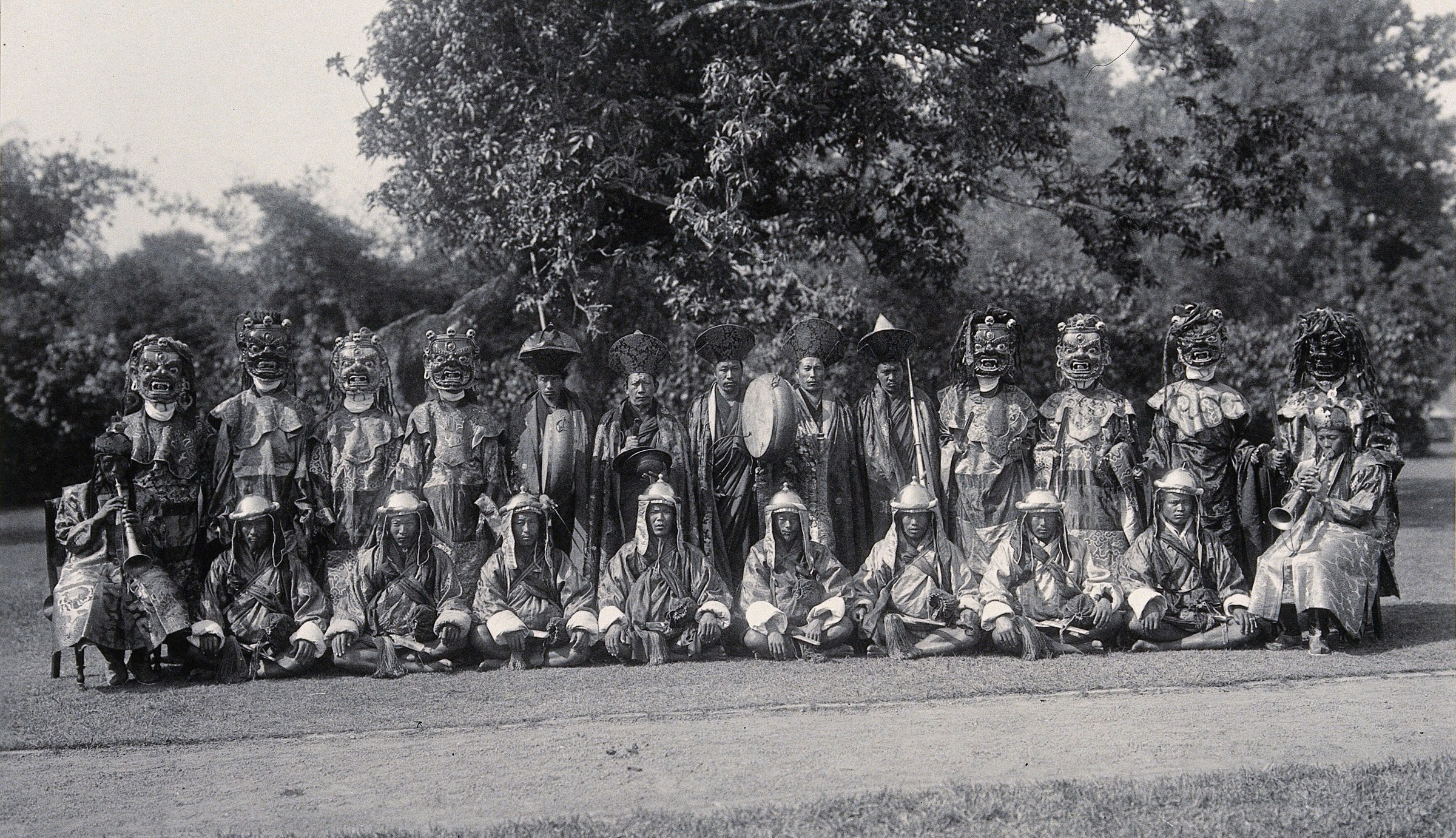
The Maidan park, Calcutta, India: traditional Bhutan Devil dancers, some wearing masks: group portrait. Photograph, 1906.
Unknown artist
- Source:
- Wellcome Collection
- Rights:
- Public domain — free to use, share and adapt.
- Recorded as:
- Public Domain Mark
This photograph documents a masked sacred-ceremonial dance tradition at a specific historical moment, preserving visual evidence of costume and mask design that might otherwise be lost. For historians and dancers interested in Himalayan ritual performance, masked traditions, or the history of how colonial institutions recorded non-Western dance, this image is direct evidence. The photograph also reveals the analytical distance of early anthropological documentation—the performers arranged like specimens for the camera, which tells us as much about colonial attitudes toward dance as it does about the dance itself.
What you are looking at
A formal group portrait of twenty-five figures arranged in two rows on an open lawn, with dense trees behind them. The back row stands; the front row sits cross-legged on the ground. All figures wear elaborate costumes: fitted jackets or robes with ornate patterning, and most importantly, carved wooden masks covering their faces. The masks are grotesque and expressive—some demon-like with prominent features, others more stylized. Some figures wear conical or cylindrical headdresses; others wear wide-brimmed hats or helmet-like crowns. The setting appears to be a park or public garden, likely in Calcutta as the title states. The photograph is black and white, the lighting flat and diffuse, typical of early 20th-century outdoor photography. The composition is strictly frontal and ceremonial—every figure faces the camera directly, their bodies aligned for documentation rather than action.
The dancing
The figures are stationary and posed rather than captured mid-movement. Their bodies are upright and formal; those seated maintain an attentive posture with legs folded. Arms hang naturally at sides or rest on laps. There is no dynamic weight shift, no gestural dialogue, no sense of choreographed motion. The tableau conveys authority and solemnity rather than physicality. The masks dominate visually—the carved faces are the primary focus, not the bodies beneath them or any interaction between dancers.
The dance depicted
The catalogue identifies these as 'traditional Bhutan Devil dancers.' The masks, costumes, and formal arrangement suggest a ritual or ceremonial masked dance tradition, likely from Himalayan Buddhist practice rather than Bhutanese origin (the geographical confusion may reflect early colonial documentation practices). These appear to be performers or monks gathered for documentation of their tradition, posed for the camera rather than in performance. Without seeing the dance in motion—the footwork, the group dynamics, the music, the ritual sequence—we can only infer that this represents a sacred-ceremonial masked performance tradition where the mask and costume are central to the transformation and meaning of the dance.
How it was made
This is a black and white photograph, likely gelatin silver print or albumen print given the date and the Wellcome Collection provenance. The flat, even lighting and sharp focus indicate studio or daylight-balanced outdoor photography. The formal arrangement and posed quality suggest this was made with a large-format camera requiring long exposure and careful composition. The photograph served documentary purposes—colonial-era ethnographic recording of 'native' performance traditions. The medium's accessibility and reproducibility made such images valuable for circulation in medical, anthropological, and administrative contexts, though they typically flattened the living practice into a static, decontextualized record.
About this work
This is a documentary photograph of a masked dance tradition recorded in colonial Calcutta in 1906. The identities of the performers and the photographer are not recorded, and the geographical attribution to Bhutan may not be precise. The image is valuable not for capturing the dance in performance—which requires movement, music, and ritual context—but as evidence of the tradition's existence, its costuming conventions, the centrality of carved masks, and the formal knowledge-transmission structures within the tradition. The photograph is a product of early 20th-century colonial documentation, made at a moment when such traditions were being systematized, catalogued, and often displaced by colonial administration and missionary activity.
How to look at it
Look first at the masks themselves: the carving, the expression, the variety of designs, which suggest distinct character roles within the tradition. Notice how the masks completely transform the face—the dance is not about individual expression but about the persona the mask conveys. Observe the costumes: the layering, the patterning, the weight of the garments, which would constrain and define movement in performance. The formal posed arrangement tells you this is not a performance photograph but a record—similar to how early ballet companies posed for group portraits. The cross-legged seated position of the front row may indicate a hierarchical arrangement or simply the photographer's practical choice for composition. The outdoor setting and the garden backdrop suggest this was a public or semi-public gathering, possibly staged for documentation.
The period
In 1906, colonial India was in the grip of intensive ethnographic documentation and categorization. Dance traditions were being recorded, classified, and often suppressed as 'primitive' or 'superstitious' by British administrators and missionaries. Simultaneously, the early 20th century saw growing international curiosity about non-Western performance, fueled by museum collecting, anthropological exhibitions, and the circulation of photographs through medical and scientific journals. The Wellcome Collection—a major repository for this image—was founded in 1913 to gather 'specimens' of human experience, medicine, and culture from across the world. Photographs like this one served that collecting impulse, positioning masked traditions as exotic curiosities rather than living, meaningful practices.
Where it lives
The photograph is held by the Wellcome Collection, a London-based archive of medical, scientific, and cultural artefacts accumulated by pharmacologist Henry Wellcome. It was likely acquired as an ethnographic or anthropological specimen in the early 20th century. The collection's provenance records for this period are often incomplete, reflecting the ad-hoc nature of colonial collecting.
Dance in this work
Questions about this work
Are these dancers performing or posing?
They are posing for the camera. The formal frontal arrangement, the static positions, and the direct gaze at the lens indicate this is a documentary photograph made to record the tradition's existence and appearance, not to capture the dance in action. A performance photograph would show movement, asymmetry, and spatial depth.
Why are the dancers wearing masks?
In masked dance traditions—especially in Himalayan Buddhist and Hindu ritual—the mask effects a spiritual or ritual transformation. The wearer ceases to be an individual and becomes a deity, demon, or other supernatural being. The mask is not costume but the core of the practice. Without understanding the specific mythology and ritual context, we can see only that the masks are carved, expressive, and treated as sacred objects.
What does 'Bhutan Devil dancers' mean?
The term reflects early colonial categorization and may not be precise. 'Devil' likely translates a Sanskrit or Himalayan term for a class of beings—demonic, protective, or ambiguous spiritual entities. The attribution to Bhutan may be approximate; the photograph was taken in Calcutta, and the performers' origin is not recorded. Modern scholarship would use more specific cultural and linguistic terminology.
How was this photograph circulated and used?
As part of the Wellcome Collection, this image was gathered for a museum of human culture and experience. Such photographs were used in anthropological publications, museum displays, and medical or scientific journals to document and categorize 'native' traditions under colonial gaze. They shaped how non-Western dance was understood and valued in the West.
More dance artwork





