49 works in this view — arrow keys or swipe to move between them.
Dance in Art
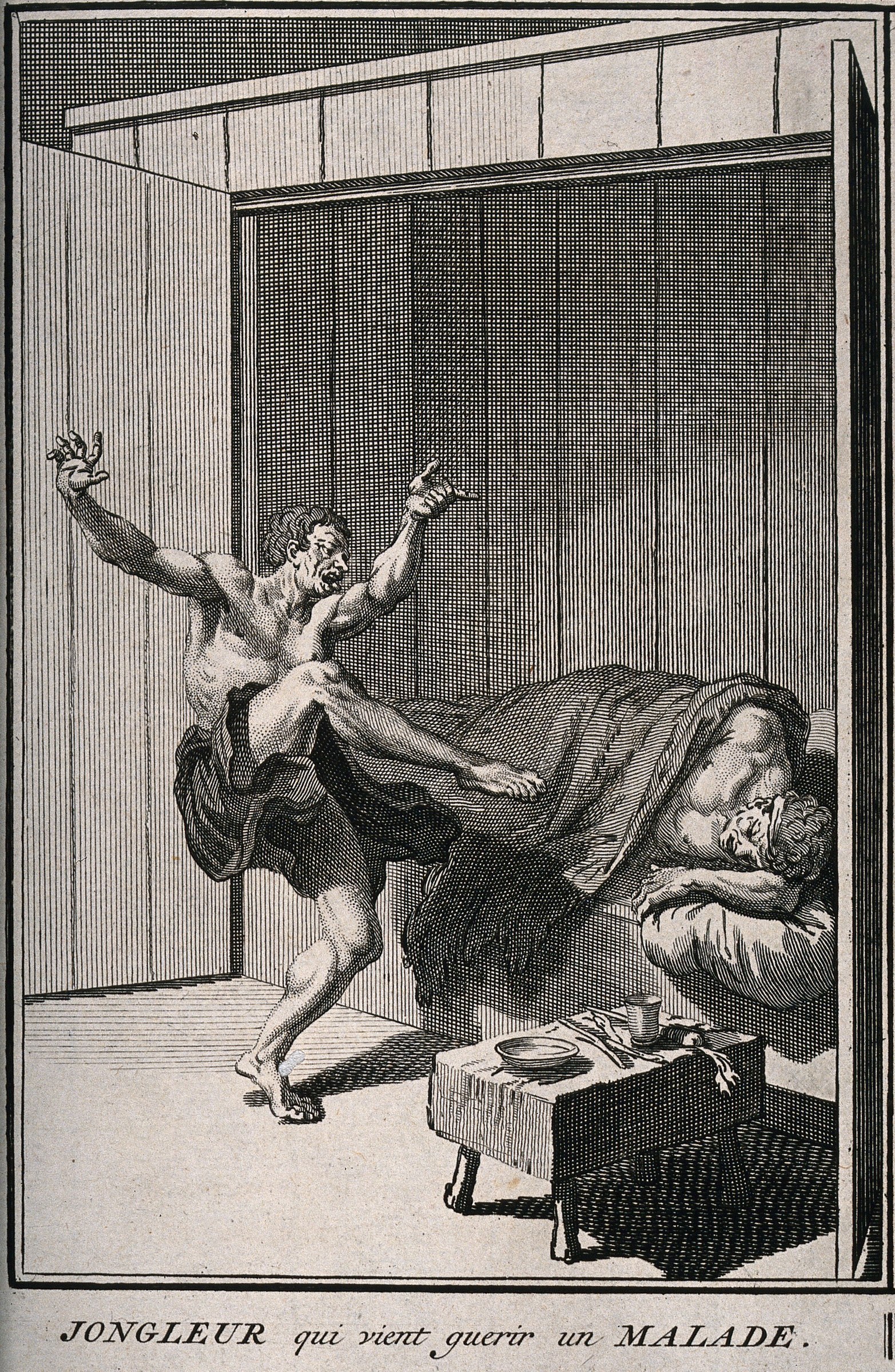
A dancing, juggling man who brings relief to sick people. Engraving.
Unknown artist
- Source:
- Wellcome Collection
- Rights:
- Public domain — free to use, share and adapt.
- Recorded as:
- Public Domain Mark
For dance and performance history, this image preserves evidence of a non-theatrical, vernacular form of acrobatic and embodied performance that left little written record. It shows that movement and physical virtuosity were understood to have curative, transformative, or emotional power—a belief that connects popular entertainment to medicine and psychology. The work also illustrates the jongleur as a cultural figure whose body was a commodity and a tool, valued for its capacity to astonish, entertain, and, in this case, to heal.
What you are looking at
An engraving depicting a figure in an interior space, performing with acrobatic gestures before a recumbent patient. The performer is nearly nude, muscular, with one leg extended high and both arms raised in an expansive, celebratory pose. He appears mid-leap or in a virtuosic moment of physical display. To the right, a clothed figure—possibly a physician or attendant—reclines or sits on a bed or couch, watching intently. The setting is austere: plain walls with vertical paneling, a small table with vessels (possibly medicinal), suggesting a chamber or sickroom. The Latin inscription at the base reads "JONGLEUR qui vient guérir un MALADE" (The juggler who comes to cure a sick person). The engraving employs fine parallel lines and crosshatching to create volume and shadow, with careful attention to the musculature of the performer's body.
The dancing
The central figure displays explosive, high-energy physicality: one leg is kicked upward to near-horizontal, the torso is fully extended and twisted, and the arms are thrown open in a gesture of triumph or invocation. This is not a static pose but a captured moment of dynamic, full-body movement. The reclining figure is passive, a witness or recipient. The composition emphasizes the contrast between the performer's muscular exertion and the patient's stillness—a visual rhetoric of vitality transferring to infirmity.
The dance depicted
This is not dance in the classical sense but acrobatic performance or "jonglerie"—the medieval and early modern practice of juggling, tumbling, and bodily display by traveling entertainers. The title explicitly identifies the figure as a jongleur, a performer type common in European culture from the medieval period through the Renaissance and early modern era. The image suggests a specific belief or practice: that such vigorous physical performance and entertainment could possess curative or medicinal power. The exaggerated musculature and high-energy pose imply that the performer's body itself—its strength, agility, and vitality—was the vehicle of the cure. This reflects folk or popular medicine traditions in which the body's energy, humor, or spirits could be affected by witnessing extraordinary feats.
How it was made
This is a fine engraving on paper, executed with careful control of line and tone. The technique—likely burin engraving given the precision of the parallel hatching and the fine detail in the musculature—allows for wide reproduction and circulation. The quality and finish suggest a mid- to late sixteenth- or seventeenth-century print, intended for a literate, educated audience interested in curiosities, medicine, or the performative arts. Engravings of this type circulated in collections of emblem books, medical tracts, or works on natural philosophy and human custom, reaching physicians, scholars, and the educated nobility.
About this work
This is a satirical or earnest representation of a jongleur performing acrobatics before a sick patient, a subject that touches on the borderline between entertainment, popular medicine, and the performative power of the body. The engraving documents a real historical practice: the presence of acrobats and entertainers in domestic and medical contexts, where their physical virtuosity was believed to have restorative or psychological effect. The image captures both the theatricality of the performance—the exaggerated pose, the muscular display—and the visual evidence that the sick did seek out or receive such performers as part of their care. It is a document of folk healing, itinerant performance, and the cultural status of the acrobatic body in early modern Europe.
How to look at it
The viewer should attend to the moment captured: not the end of a movement but its apex, the point of maximum extension and energy. The performer's body is organized around this explosive moment—the high kick, the open arms, the tensed musculature. Notice also the contrast between the performer's complete physical commitment and the patient's repose: this is the image's central argument, the idea that vitality and spectacle can flow from one body to another. The engraver has chosen to render the performer's muscularity with anatomical precision, emphasizing the body as a tool of power and display. The plain interior and the absence of costume or props direct attention entirely to the body itself.
The period
The engraving likely dates to the sixteenth or seventeenth century, an era when jongleurs and acrobats were common in European cities and courts, and when the boundaries between entertainment, medicine, and spectacle were less rigidly defined than later. The period saw growing interest in the classification and documentation of human types, professions, and customs, reflected in emblem books, collections of prints, and illustrated treatises. Medical theory of the time emphasized the role of the humors and the senses in health; entertainment and spectacle could theoretically affect these. The image sits at the intersection of curiosity, medicine, and social documentation—genres that characterized early modern visual culture.
Where it lives
The work is held in the Wellcome Collection (a major repository of medical history, art, and natural philosophy images). The classification as an engraving of medical or para-medical interest reflects the Wellcome's focus on the history of medicine and healing practices.
Dance in this work
Questions about this work
Was this a real medical practice?
Yes, in the sense that entertainers and acrobats were sometimes called upon or sought by the sick or their families. Whether the jongleur's performance was believed to have direct curative power, or was rather a form of psychological comfort or distraction, is unclear from the image alone. The engraving may be satirical (mocking the belief) or earnest (documenting it). Either way, it testifies to the presence and cultural role of such performers in early modern healing contexts.
What is a jongleur?
A jongleur was a traveling entertainer common in medieval and early modern Europe, skilled in acrobatics, juggling, music, storytelling, and bodily performance. Jongleurs performed in streets, markets, courts, and private homes, and occupied a low social status despite their skill. They were distinct from court musicians and dancers, though the boundaries were fluid.
Why is the performer nude or nearly nude?
The minimal clothing emphasizes the body itself as the performer's instrument and the source of visual astonishment. Acrobatic performance often involved the display of an extraordinarily trained, muscular body. The nudity or near-nudity also suits the engraver's interest in anatomical precision, rendering the musculature visible. It may also reflect actual practice, as acrobats often performed in minimal dress to display their skill and physique.
More dance artwork





