49 works in this view — arrow keys or swipe to move between them.
Dance in Art
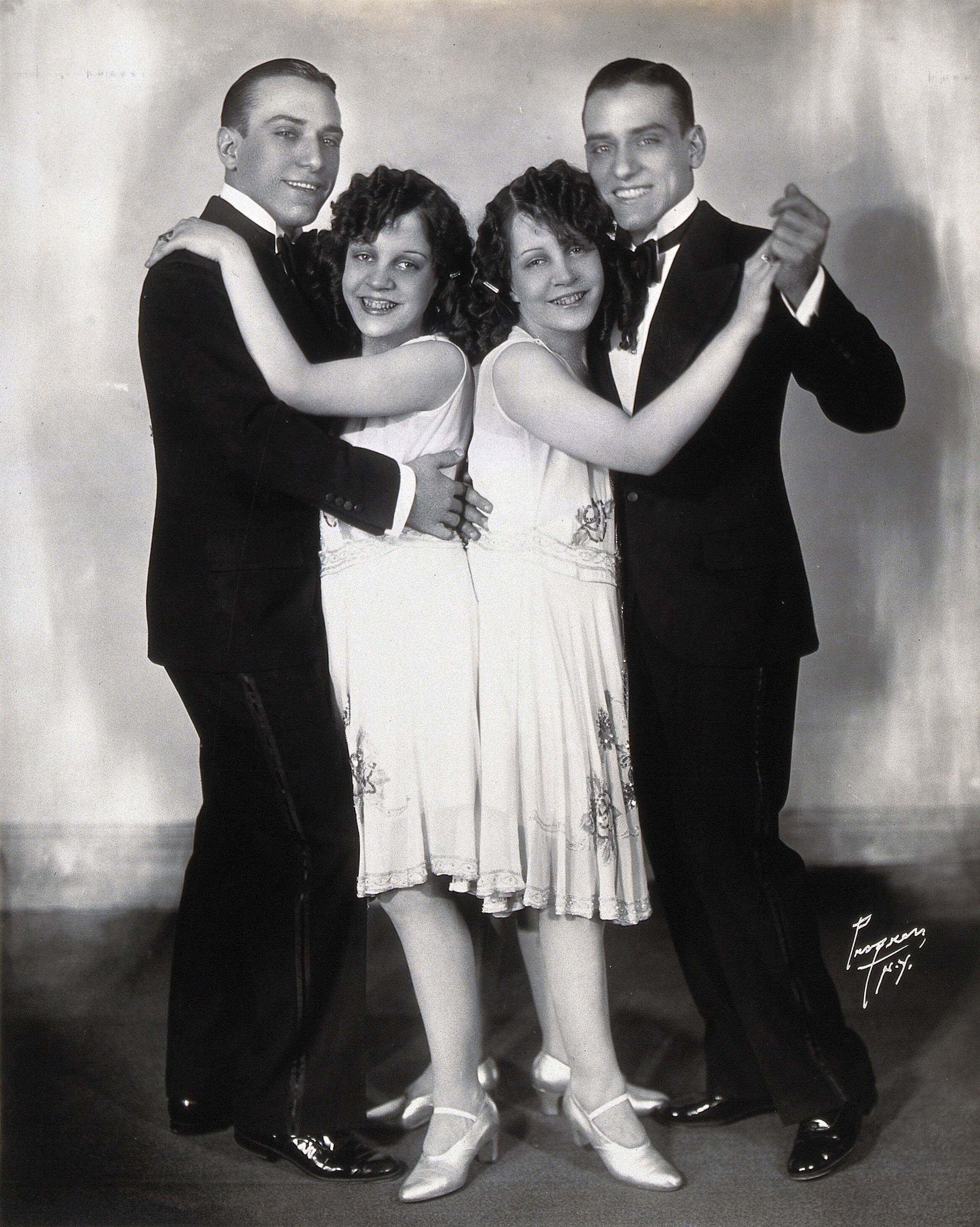
Daisy and Violet Hilton, conjoined twins, dancing with two young men. Photograph, c. 1927.
Unknown artist
- Source:
- Wellcome Collection
- Rights:
- Rights reserved by the holding institution — do not reuse without permission. Source record ↗
- Recorded as:
- In copyright
The photograph captures the theatrical presentation of social dance in early 20th-century entertainment, showing how ballroom dancing was packaged as spectacle for public consumption. It documents a specific historical moment in the performance of partner dance and the business of theatrical entertainment during the 1920s.
What you are looking at
A studio photograph capturing four performers in formal evening wear arranged in a choreographed tableau. Two women in sleeveless white dresses stand centrally, their bodies angled toward each other in a mirrored pose, arms linked with the two men flanking them. The men wear tailored black tuxedos with bow ties. All four performers smile directly at the camera, their posture upright and controlled. The backdrop is a plain grey studio wall with soft, even lighting that casts minimal shadows, typical of professional dance or entertainment photography of the era. The composition is symmetrical and frontal, emphasizing the paired arrangement of the performers.
The dancing
The two central women stand close together, their bodies nearly parallel, with arms raised and linked through the arms of the men beside them in what appears to be a promenade or social dance frame. The men stand at slight angles, their weight evenly distributed, their free hands relaxed at their sides or gesturing lightly. All four bodies are held upright with an almost rigid posture—no visible weight shift or dynamic movement, but rather a posed moment showing the formation and relative positioning typical of ballroom or partner dance. The women's legs are visible below the knee, showing heeled shoes suited to social dancing.
The dance depicted
This appears to be a publicity photograph documenting a theatrical or vaudeville dance performance, most likely from a ballroom or partner-dance context, though the exact style cannot be definitively determined from a static pose alone. The symmetrical two-couple arrangement and formal evening costume suggest American or European social ballroom dancing of the 1920s era. The pose emphasizes visual spectacle and the novelty of the performers' partnership rather than capturing the movement of any particular dance form. The photograph served as promotional material to publicize the performers and their act.
How it was made
This is a professional studio photograph, likely gelatin silver print or similar photographic process standard in the 1920s. The technical quality—even lighting, sharp focus, and controlled composition—indicates it was taken by a professional theatrical or entertainment photographer, not a candid snapshot. The photograph was designed for wide circulation as promotional material, intended for press, theater programs, and publicity. The studio setting and formal arrangement show it was created specifically for promotion rather than documentation of a live performance.
About this work
This is a 1920s theatrical publicity photograph of four performers in formal evening dress arranged in a symmetrical, mirrored ballroom dance formation. The image documents a moment from what appears to be a vaudeville or theater dance act, preserving the spectacle and novelty of the partnership through its carefully composed studio setting. As a promotional photograph, it represents how dance performance was marketed and publicized to audiences during the interwar period, emphasizing visual formation and entertainment value over technical documentation of movement.
How to look at it
Notice the absolute symmetry of the composition—the two women mirrored, the two men mirrored—which emphasizes visual spectacle over movement. Observe the rigid, held posture and the direct engagement with the camera, indicating this is a moment of presentation rather than a captured instant of dancing. The formal evening wear and studio setting show this is theatrical entertainment, not social dancing. The photograph freezes a promenade formation or opening pose, the kind of visual tableau that would open or punctuate a theatrical dance act.
The artist
The photographer is not identified in the catalogue record. The professional quality and the signature mark visible in the lower right corner suggest this was taken by an established theatrical or portrait photographer, likely working in a major American entertainment center. The work exemplifies the studio portrait photography used to promote stage performers and dance acts of the era.
The period
The 1920s saw a flourishing of partner dance in both social and theatrical contexts, with ballroom dancing becoming a staple of vaudeville, Broadway, and touring entertainment. Formal evening wear for dance performance was standard, and the aesthetics of precision, symmetry, and visual spectacle dominated theatrical choreography. Photography had become the primary medium for promoting performers and acts, with studio portraits circulated widely in newspapers, theater programs, and fan publications. The formal, posed composition reflects the conventions of theatrical promotion rather than documentary photography of actual performance.
Where it lives
The photograph is held by the Wellcome Collection. It is indexed as a historical image documenting performance and entertainment from the 1920s-1930s era.
Dance in this work
Questions about this work
Who are the four people in this photograph?
The catalogue identifies two of them as Daisy and Violet Hilton, conjoined twins who performed in vaudeville and theatrical entertainment. The two male dancers are not identified in the available records. The photograph was created to promote their act and circulate their images to press and audiences.
What dance are they performing?
The photograph does not capture active movement, so the specific dance style cannot be determined with certainty. The formal evening wear, partner arrangement, and ballroom frame suggest social ballroom dancing of the 1920s, likely a waltz, foxtrot, or one-step adapted for theatrical presentation. The posed, symmetrical composition emphasizes visual novelty rather than technical dancing.
Why is this photograph in a dance collection?
It documents the theatrical performance and presentation of social partner dance during the interwar period. It preserves evidence of how dance was performed, promoted, and consumed as entertainment, and it shows the relationship between dance and vaudeville theater in the 1920s.
What does the pose tell us about how ballroom dance was performed theatrically?
The rigid posture, direct camera engagement, and emphasis on symmetrical visual formation show that theatrical ballroom dancing prioritized spectacle and novelty over naturalistic movement. The posed arrangement—two mirrored couples—would have opened or structured the act, using visual symmetry to create impact and emphasize the unusual partnership of the performers.
More dance artwork





