49 works in this view — arrow keys or swipe to move between them.
Dance in Art
The Dance Class
Edgar Degas
- Medium:
- Oil on canvas
- Collection:
- European Paintings
- Source:
- The Metropolitan Museum of Art
- Rights:
- Public domain — free to use, share and adapt.
- Recorded as:
- CC0 (Public Domain)
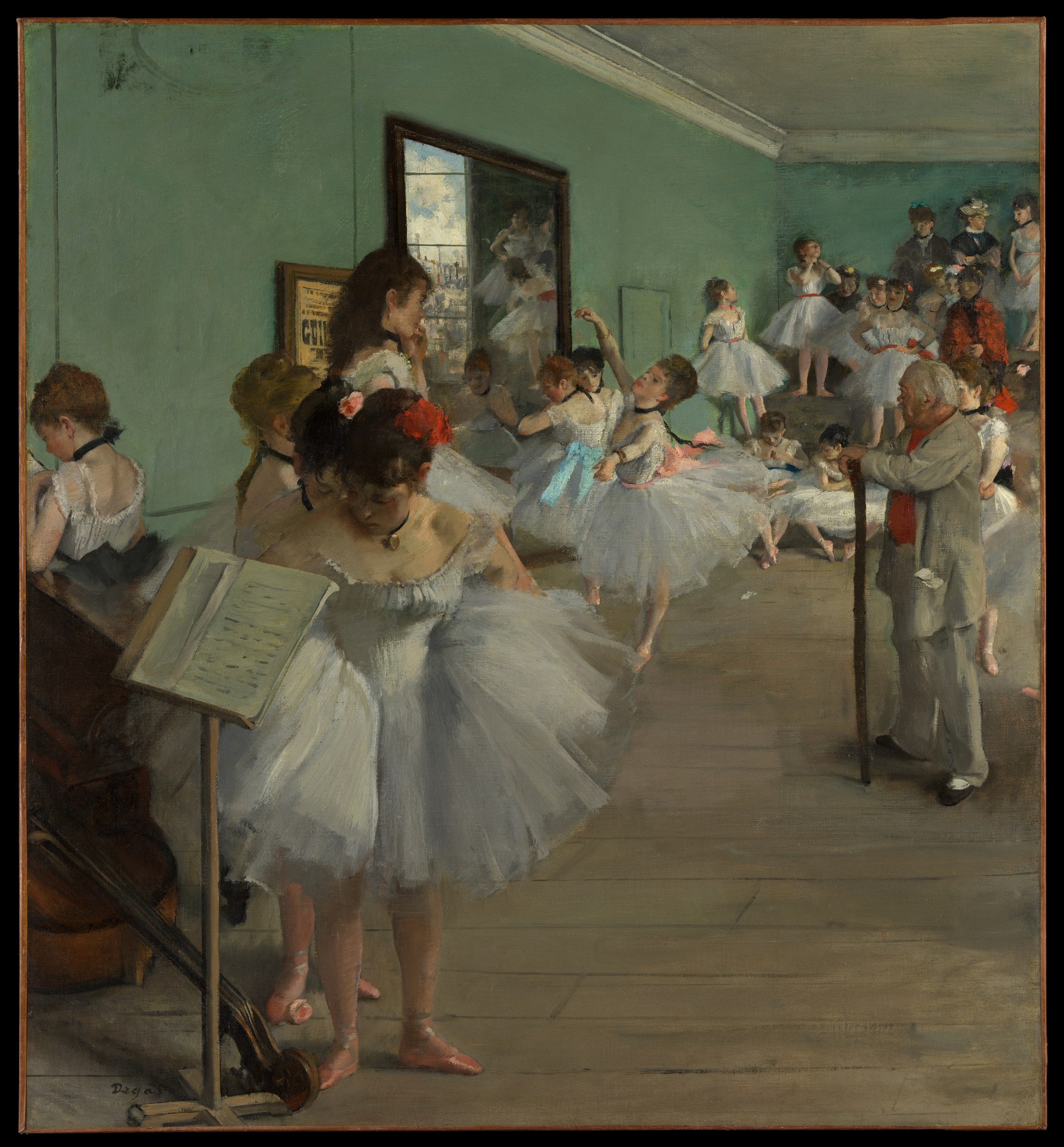
For dancers and ballet historians, this image is the most important visual document of 19th-century ballet pedagogy—it shows the daily institutional reality of ballet training, the spatial arrangement of the studio, the relationship between master and pupil, and the bodily discipline required of young female dancers. For art historians, it is evidence of how a major painter engaged with modern subject matter and movement, and how he employed observational realism and compositional innovation to represent labor and institutional discipline.
What you are looking at
A ballet instructor, an elderly man in a pale suit, stands at the center-right of a sunlit studio, conducting or correcting a group of young female dancers in white tutus. The studio has pale green walls and tall windows; sunlight floods across the wooden floor. The dancers are scattered throughout the space—some in active poses, some at rest, some watching—creating a naturalistic snapshot of a rehearsal or class in progress. At the left foreground, a woman in dark dress holds sheet music and appears to be accompanying the class at the piano. The composition is asymmetrical and informal, capturing the irregular geometry of bodies in motion and pause rather than a formal arrangement. The palette is cool and luminous, with flesh tones and white tutus set against the pale green walls.
The dancing
The young dancers wear classical white tutus and pointe shoes; their bodies are positioned in various attitudes of repose and preparation rather than synchronized movement. One dancer in the center-right foreground stands in a pose suggesting instruction or correction; others sit, stretch, or stand in informal readiness. The instructor's posture—erect, commanding, with his body oriented toward the dancers—demonstrates the authority relationship typical of a ballet master. The pianist is seated at the left in profile, her arms at the keyboard. None of the dancers are in a unified formation or synchronized movement; instead they occupy the space as individuals attending to their own preparation or awaiting direction.
The dance depicted
This is a ballet class or rehearsal, a scene from the daily disciplinary practice of theatrical ballet training in the late 19th century. The white tutus, pointe shoes, and pale studio interior are iconographic of Romantic and Classical ballet; the instructor's role as master-figure conforms to the hierarchical pedagogy of the Paris Opéra ballet school. The image documents not performance but the institutional apparatus of ballet—the rehearsal space, the master-pupil relation, the repetitive discipline that precedes public presentation. The dancers appear to be young pupils, likely from the Opéra school, though nothing in the image permits identification of a specific choreography or narrative ballet.
How it was made
Oil on canvas. The technique employs rapid, confident brushwork in the background and more detailed modeling in the foreground figures, particularly the faces and hands of the instructor. The light effects—the luminous green walls and the directional sunlight from the upper left—are rendered through layered color and tonal gradation rather than chiaroscuro. The asymmetrical composition and cropped framing suggest the influence of photography and Japanese prints, popular in Parisian artistic circles of the 1870s. The painting's scale and finish suggest exhibition intention rather than a preparatory study.
About this work
This is one of the earliest and most celebrated paintings of ballet instruction, depicting the interior world of the Paris Opéra ballet school in the 1870s. The work documents a moment of pedagogical authority and female bodily discipline, rendered with unprecedented attention to the informal spatial geometry of a working studio rather than the idealized poses of ballet imagery. The painting moves away from narrative or performance-based ballet imagery toward the documentary representation of ballet's social and institutional infrastructure. It participates in a broader 19th-century fascination with backstage and behind-the-scenes subjects—the reality behind theatrical illusion.
The work sits at a juncture in the history of both ballet and visual art: it depicts ballet at a moment of transition from Romanticism to a more austere Classical training regimen, and it employs observational realism and photographic composition at precisely the moment those techniques were disrupting academic tradition. The painting has become iconic in the historiography of both ballet and Impressionism.
How to look at it
Attend first to the light and the palette—the cool greens and pale tones create an effect of clarity and stillness, unusual in ballet imagery. Then observe the composition: the instructor is not centered but positioned to the right, and the dancers fill the canvas in asymmetrical positions, some cropped at the edge of the frame, as if the viewer has entered the studio as an observer rather than positioned before a formal scene. Notice the variety of the dancers' poses and gazes—some watch the instructor, some are at rest, some are in partial or preparatory attitudes. This is not a synchronized performance but a moment of individual work within a group. The painting captures the spatial and temporal complexity of rehearsal, not the unified spectacle of performance.
The artist
Edgar Degas (1834–1917) made ballet one of his primary subjects from the 1860s onward, producing dozens of paintings, pastels, and drawings of dancers, rehearsals, and performances. Unlike most artistic representations of ballet, which were confined to the public spectacle of performance, Degas gained access to the backstage and rehearsal spaces of the Paris Opéra, and he documented the unglamorous labor, discipline, and social hierarchies of ballet training and daily work. His interest was not in narrative or romanticism but in movement, light, spatial complexity, and the body as an object of study and institutional control. His ballet paintings are central to understanding both his artistic practice and 19th-century ballet culture.
The period
This painting was executed in 1874, during the consolidation of Impressionism and at a moment of significant change in ballet practice. By the 1870s, French Romantic ballet (with its emphasis on supernatural heroines and spectacle) had given way to a more austere, technically rigorous Classical training regime, focused on physical perfection and disciplinary control. The expansion of ballet training into a formalized school structure, associated with the Paris Opéra, meant that ballet was increasingly an institutional, pedagogical practice rather than purely a performance art. Simultaneously, Parisian visual culture was being transformed by photography, by the influence of Japanese prints, and by Impressionist painting's commitment to contemporary subject matter, unusual compositions, and the effects of natural light. Degas's ballet paintings emerge at the intersection of these developments.
Where it lives
The work is held by The Metropolitan Museum of Art, in the European Paintings collection. It is one of Degas's major ballet paintings and has been in the Met's collection since 1929.
Dance in this work
Questions about this work
Why did Degas paint so many ballet scenes?
Degas had privileged access to the backstage world of the Paris Opéra, granted by his social position and personal friendships with dancers and administrators. He was fascinated by movement, the human body in motion and under strain, and the spatial complexity of the rehearsal studio. Ballet offered him an ideal subject for exploring light, composition, and the representation of modern work and discipline. Unlike other painters, he was interested not in the glamorous spectacle of performance but in the labor, the training, and the social hierarchies behind it.
Who was the instructor in this painting?
The elderly man at the center-right is not identified with certainty in the catalogue record or in scholarly literature. He may represent a composite figure or a specific ballet master of the Opéra school, but the painting is not annotated with a name. Some scholars have speculated that he may be based on Jules Perrot or another renowned master, but this remains unconfirmed.
What do the dancers' poses tell us about ballet technique in 1874?
The dancers wear pointe shoes and white tutus, which were standard for Classical ballet by this date. Their poses—including extended legs, upright posture, and the characteristic carriage of the shoulders—conform to the academic ballet technique codified in the 19th century. The informal arrangement in the studio suggests a moment between exercises or choreographed pieces, when dancers would stand, stretch, and recover rather than maintaining the unified formation of a performance.
How does this painting relate to Impressionism?
The painting was exhibited in the second Impressionist exhibition in 1876. It demonstrates several Impressionist innovations: asymmetrical composition, cropped framing (influenced by photography and Japanese prints), attention to effects of natural light, and a contemporary subject. However, Degas's technique is more linear and sculptural than the broken-color painting of Monet or Renoir; he belongs to Impressionism more through subject matter and compositional choice than through a shared painting method.
More dance artwork





