49 works in this view — arrow keys or swipe to move between them.
Dance in Art
The Rehearsal of the Ballet Onstage
Edgar Degas
- Medium:
- Oil colors freely mixed with turpentine, with traces of watercolor and pastel over pen-and-ink drawing on cream-colored wove paper, laid down on bristol board and mounted on canvas
- Collection:
- European Paintings
- Source:
- The Metropolitan Museum of Art
- Rights:
- Public domain — free to use, share and adapt.
- Recorded as:
- CC0 (Public Domain)
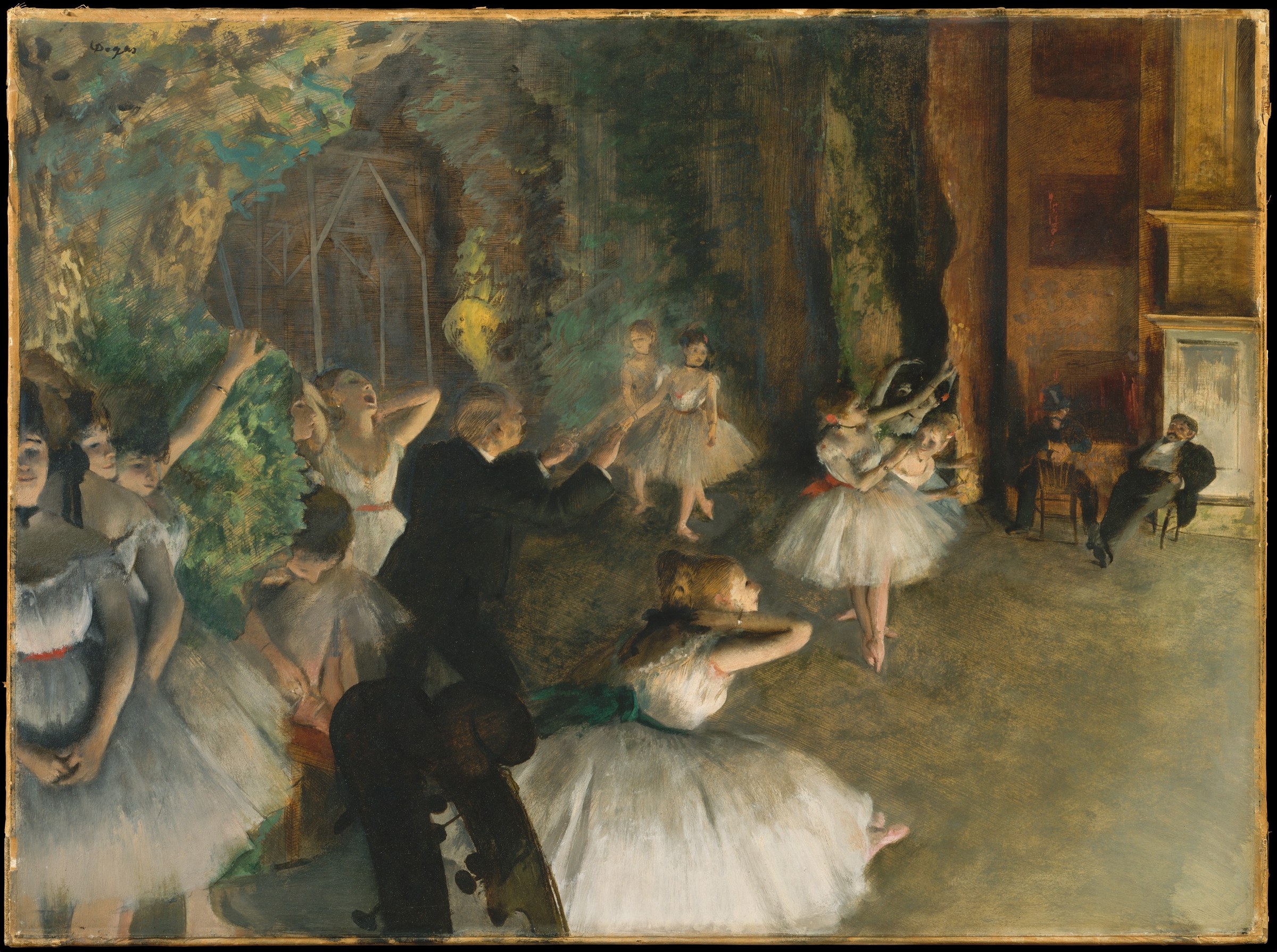
This image shows the origin of a major theme in modern art: the theater and the studio as subjects worthy of the same serious visual attention as history painting or portraiture. For dance historians, it is invaluable documentation of 19th-century ballet pedagogy—the role of the maître de ballet, the informal arrangement of the corps, the bodily carriage expected in training, and the mixed-gender hierarchy of the rehearsal space. The work inaugurated a visual tradition of showing dance as labor, which persists in contemporary photography and video.
What you are looking at
A ballet rehearsal in a studio or stage space, captured in a moment of pause or instruction. The room is defined by high pale green walls and a simple wooden floor; on the left, vines or foliage climbing the wall suggest a garden backdrop or painted scenery. A male figure in dark clothes—likely a ballet master or choreographer—stands centrally, gesturing with raised arm toward the assembled dancers. Around him are twelve to fifteen female dancers in white tutus and pointe shoes, arranged informally rather than in formal line: some stand at attention, others face toward the master, a few are in profile or three-quarter view. The light is cool and even, falling across the figures from the left. On the right side of the composition, several figures in dark clothes (possibly other dancers or staff) sit or stand near a doorway. The overall effect is of a working rehearsal paused mid-session, with the dancers' bodies showing fatigue or waiting—weight shifted to one hip, arms lowered or held loosely.
The dancing
The dancers display the turned-out stance and posture of classical ballet, with feet in positions and spines held upright. Several wear their hair pinned up in the period style. The male instructor's raised arm and forward-leaning posture suggest he is demonstrating or correcting; his dark silhouette contrasts sharply with the pale tutus. The dancers' poses are not synchronized—they are not performing but listening, watching, adjusting. One dancer in the foreground right leans into an arabesque or extended position; others stand in neutral repose. There is no closed-hold partnering visible; the space is hierarchical, with the master commanding the floor and the dancers arranged semicircularly around him.
The dance depicted
This is a ballet rehearsal, almost certainly from the Romantic era or its immediate aftermath. The tutu style—full-length, bell-shaped skirts in gauze or tulle—is consistent with mid-to-late 19th-century ballet aesthetics. The pointe work is evident from the dancers' stance and the shoes. The informality of the arrangement and the pedagogical focus (the master instructing rather than the corps performing) identify this as a studio scene documenting the process of training and choreographic work. The setting and subject matter were particularly popular in French art of this period, offering a glimpse into the labor and discipline behind the illusion of ballet.
How it was made
The work is executed in oil colors mixed with turpentine and touched with watercolor and pastel over pen-and-ink drawing, mounted as a composite on paper and canvas. This mixed-media approach—combining the translucency of watercolor and pastel with the body of oil paint—allows the artist to achieve both fine linear detail (in the ink underdrawing and the dancers' features) and atmospheric soft focus in the background and walls. The technique produces a luminous quality in the pale tulle and skin tones while maintaining sharp definition in the composition's structure. This is a working study or finished work that demonstrates how 19th-century academic artists combined media to capture both precise observation and mood.
About this work
This is Edgar Degas's study of a ballet rehearsal, one of a suite of works he produced investigating the structure and practice of ballet in Paris during the 1870s. The painting places the viewer inside a studio, witnessing not performance but the unglamorous pedagogical moment: instruction, repetition, fatigue. Degas's interest in ballet was not romantic sentiment about ethereal creatures, but documentary fascination with the labor, discipline, and geometry of dance training. The work sits alongside his many pastels, drawings, and paintings of dancers in similar quotidian moments—at rest, adjusting, being corrected. It represents a major shift in how artists represented dance: away from the completed spectacle toward the hidden machinery of rehearsal.
How to look at it
Look first at the spatial composition: how Degas has arranged the dancers not as a symmetrical corps line but as a loose semicircle responding to the master's gesture. Notice the variety of poses and the asymmetrical weight distribution, which makes the moment feel observed rather than posed. Attend to the contrast between the central male figure in dark clothes and the surrounding pale tutus—this hierarchy of color and attention directs you to the power structure of the rehearsal. Look at the individual dancers' faces and arm positions: some are attentive, others seem to be resting or thinking. The painting captures not a moment of dancing but a moment of waiting, listening, and being shaped by instruction. This is a choice about what moment of the dance process to immortalize.
The artist
Edgar Degas (1834–1917) was a French Impressionist painter and printmaker who became obsessed with ballet from the early 1870s onward. He attended rehearsals at the Palais Garnier in Paris, sketched dancers in the wings and in the studio, and created hundreds of works across media—oil paintings, pastels, charcoal drawings, etchings, and lithographs. Unlike many of his Impressionist contemporaries, Degas worked from detailed preliminary sketches and studio preparation, building compositions with sculptural solidity. His ballet works are remarkable for their refusal of sentimentality: he painted dancers as workers, often depicting them from unusual angles (from above, from behind, cropped and informal) that emphasize the constructed and contingent nature of the spectacle. This practice shaped modern art's relationship to dance and performance.
The period
In the 1870s, when this work was created, ballet in Paris was in transition. The Romantic era's heroines—the sylphs and specters of mid-century—were giving way to the technical spectacularity of the later 19th century. The ballet d'action was yielding to emphasis on pure dance and virtuosity. Degas's rehearsal paintings document this moment of change, showing the pedagogical apparatus that produced the new style. Simultaneously, the growth of the Paris Opéra and the increase in public fascination with backstage life made the rehearsal itself a subject of interest—not just to artists, but to journalists and photographers. Degas's commitment to depicting the studio and the rehearsal was therefore both aesthetically radical (asserting the studio as worthy subject matter) and culturally timely.
Where it lives
The work is held in the Metropolitan Museum of Art's collection of European Paintings, from which the image is sourced. The medium is documented as a mixed-media work on paper and canvas, reflecting the experimental materials Degas employed throughout his career.
Dance in this work
Questions about this work
Why is the maître de ballet's gesture so central to the composition?
The raised arm and forward posture of the male instructor are not incidental: they are the organizing principle of the whole scene. This is a rehearsal, not a performance, and the instruction—the correction, the demonstration, the imposition of will upon the dancers' bodies—is what Degas chose to document. The dancers' gazes and poses respond to his gesture, making him the focal point even though he is not the most numerous or colorful figure.
What does the mixed-media technique tell us about how Degas worked?
Degas combined oil, watercolor, pastel, and ink because each medium served a different purpose. Ink allowed him to establish precise structure and facial features; watercolor and pastel provided transparency and soft color; oil gave body and luminosity. This layering mirrors his working process: he would sketch from life at the theater, then build finished studies in the studio, combining observed detail with artistic refinement. The technique also suggests this may be a working study rather than a final exhibition painting.
How does this painting differ from earlier depictions of ballet?
Earlier ballet paintings typically showed the completed performance—the ballerina en pointe in the spotlight, the spectacle as the audience saw it. Degas instead painted the backstage and studio, the moment of making rather than the moment of display. This democratized ballet as subject matter: the unglamorous rehearsal became as worthy of art as the glamorous performance. It also shifted the viewer's identification from spectator to insider.
What can you learn about 1870s ballet training from this image?
The painting shows that ballet training was hierarchical and personalized: the maître de ballet gave individual correction to a group of dancers rather than a uniform corps moving as one. The dancers wore tutus even in rehearsal, suggesting the importance of understanding how the costume moved. The informality of the grouping and the variation in the dancers' attention suggest that not all dancers were equal or equally valued. The presence of male dancers and staff in the background indicates a more complex division of labor than the performance stage might suggest.
More dance artwork





