49 works in this view — arrow keys or swipe to move between them.
Dance in Art
Dancer with a Fan
Edgar Degas
- Medium:
- Pastel on gray-green laid paper
- Collection:
- European Paintings
- Source:
- The Metropolitan Museum of Art
- Rights:
- Public domain — free to use, share and adapt.
- Recorded as:
- CC0 (Public Domain)
This work documents the actual practice and appearance of 1880s ballet with an intimacy no photograph of the era could achieve; Degas's repeated access to rehearsals and his sympathy with the dancer's physicality gave him unique authority to record the pose, the clothing, and the mood of the ballet world. For dance historians, Degas's pastels are among the most reliable visual evidence we have of how nineteenth-century dancers held their bodies, what they wore, and how they understood grace and extension. The work also demonstrates the evolution of ballet into a form centred on the individual dancer's technique and beauty rather than narrative spectacle alone.
What you are looking at
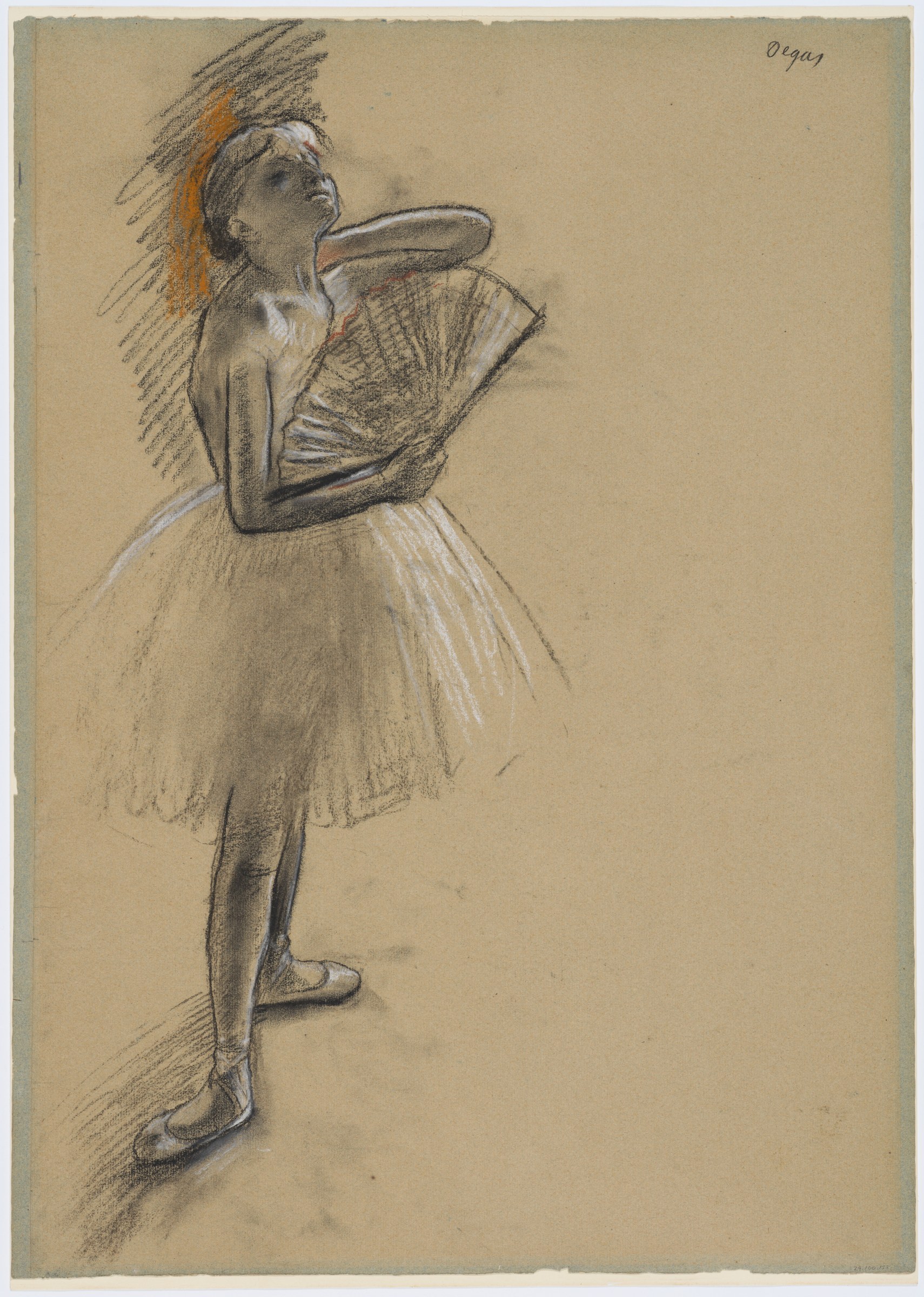
A young dancer in a pale tulle skirt stands in profile, weight shifted onto her right leg with the left leg extended behind her in a graceful arabesque or similar extension. She wears a fitted bodice with short sleeves and holds a large fan close to her face with both hands, her head tilted back slightly. The composition is intimate and studies a single moment of stillness within dance. The figure is rendered in soft pastels—grays, ochres, and whites dominate—against a warm beige paper, with loose directional hatching suggesting the movement of drapery and a sense of fleeting motion. The dancer's pose suggests the casual grace of rehearsal or a moment stolen between movements rather than a finished performance piece.
The dancing
The dancer's posture shows a single leg supporting the body while the other extends behind, a fundamental arabesque position. Her torso is upright and controlled; her arms are raised and bent, framing the fan that occupies much of the upper body's visual weight. The pose demonstrates the long lines and extension characteristic of classical ballet technique, with an emphasis on verticality and the stretch through the supporting leg. There is no partner or group; this is a study of an individual dancer's form.
The dance depicted
This work depicts a dancer of the 1880s ballet world, almost certainly a student or professional ballerina of the Paris Opera, where Degas had regular access to rehearsals. The extended leg position, the tulle skirt, and the pointe work implicit in the stance all point to classical ballet as practised in the Romantic and late-nineteenth-century repertory. The fan—an elegant but unusual accessory—suggests a character role or a moment of theatrical portraiture rather than strict classical technique. This is not a narrative scene but a study of the dancer's body at rest, capturing the poise and refinement the ballet world valued.
How it was made
Pastel on laid paper, a medium that allows soft blending and rapid adjustment—ideal for capturing the translucency of tulle and the subtle modelling of flesh. Degas used pastel extensively throughout his career to study dancers, building up layers of colour and tone with directional marks that suggest both form and movement. Pastel's immediacy and the artist's ability to work at scale without the constraints of oil or watercolor made it the perfect medium for rehearsal sketches and studio studies that could be either complete works or preparatory material for larger compositions. The warm toned paper acts as a unifying mid-tone, allowing Degas to work with highlights and shadows economically.
About this work
This is a pastel study by Edgar Degas of a ballet dancer in the relaxed moment of a studio pose, executed around 1880 when the artist was at the height of his engagement with the world of Paris Opera ballet. The work exemplifies Degas's method of capturing dancers not in grand performance but in the private acts of preparation, rest, and self-awareness that revealed their physical mastery and poise. The fan adds an element of feminine grace and theatricality, hinting at the performer's dual identity as both trained athlete and staged character. This is a work about looking—Degas observed the dancer from a specific angle, recording her form with the precision of a draughtsman and the sensitivity of a colorist attuned to the fragility and strength of the adolescent female body.
How to look at it
Attend to the dancer's face and the fan: Degas has tilted the head back and hidden much of the features behind the fan, emphasizing the neck, the line of the jaw, and the upward tilt that suggests both exhaustion and pride. The extended leg draws the eye downward and outward, creating a diagonal line of tension across the composition. Notice how the pastel handling varies—the face and bodice are modelled with soft blends and careful anatomy, while the skirt is sketched with quicker, broader strokes that suggest the movement of fabric without depicting every fold. This is the moment between movements, the dancer caught at a point of balance and repose, not mid-leap or mid-turn.
The artist
Edgar Degas (1834–1917) was a French artist and founding member of the Impressionists who became obsessed with the world of the Paris Opera from the 1870s onward. Unlike the Impressionists' focus on light and nature, Degas was a draughtsman and observer of human form, and he found in ballet an inexhaustible subject for studying the body in motion and repose. He gained regular access to rehearsals, backstage areas, and classrooms, and produced hundreds of drawings, pastels, paintings, and prints of dancers. Degas's engagement with ballet was not romantic or sentimental; he was fascinated by the technical discipline, the geometry of the pose, and the unglamorous reality of professional dance training. His works on dancers remain among the most celebrated in his oeuvre and have shaped how the nineteenth-century ballet is remembered.
The period
In the 1880s, ballet was undergoing transformation. The great Romantic era, with its emphasis on narrative and the supernatural, had given way to a new focus on virtuosity, technique, and the spectacular possibilities of the individual dancer's body. The rise of the ballerina and the decline of male dancers as leads meant that the female form became the primary subject of choreography and visual art. In Paris, the Opera Ballet was a thriving institution, and dancers were celebrities in a new popular culture of entertainment and leisure. Simultaneously, artists and writers were becoming fascinated with the dancer as a subject—both for the grace she embodied and for the labour and often brutal physical cost of her training. Degas's pastels sit at the intersection of high art and popular observation, treating the dancer as both a formal study and a sympathetic portrait of a working performer.
Where it lives
The work is held in the European Paintings collection of the Metropolitan Museum of Art, New York, indicating its status as a significant study by a canonical artist. As a pastel on paper, it is a more fragile and intimate object than oil paintings, and it would have required conservation and careful handling; its presence in a major museum suggests its early recognition as an important work within Degas's oeuvre.
Dance in this work
Questions about this work
Is this a finished work or a sketch?
In Degas's practice, the distinction between sketch and finished work is fluid. This pastel is signed and appears complete as a composition, but it may also have served as a study for a larger work or as material for Degas's own reference. The scale, the refinement of the pastel technique, and the focused observation all suggest it was considered a finished work, even if it documents a moment of apparent casualness.
Why is she holding a fan?
The fan was a standard prop in late-nineteenth-century ballet, used in character dances and in the vocabulary of feminine gesture on stage. The fan also serves Degas's compositional interest in framing and obscuring the face, directing attention to the body's line and the elegance of the pose. It may represent a moment from a specific ballet, though Degas often used props and costumes more abstractly, as formal elements rather than as markers of narrative.
How did Degas have access to ballet dancers?
Degas cultivated relationships with the dancers and staff of the Paris Opera, where he was permitted to attend rehearsals and observations. His persistence, his genuine interest in the technical aspects of training, and his status as a respected artist gave him unusual access to a world normally closed to outsiders. He used this access systematically, returning again and again to study poses, movements, and the lived experience of professional dancers.
What does the arabesque position tell us about ballet in 1880?
The arabesque is one of the five fundamental positions of classical ballet, and its prominence in Degas's work confirms that by 1880, the vocabulary of classical technique was fully established and valued. The extended line, the verticality, and the balance required all reflect the evolution of ballet toward a form centred on athletic virtuosity and the display of the trained body rather than on mime or narrative alone.
More dance artwork





