49 works in this view — arrow keys or swipe to move between them.
Dance in Art
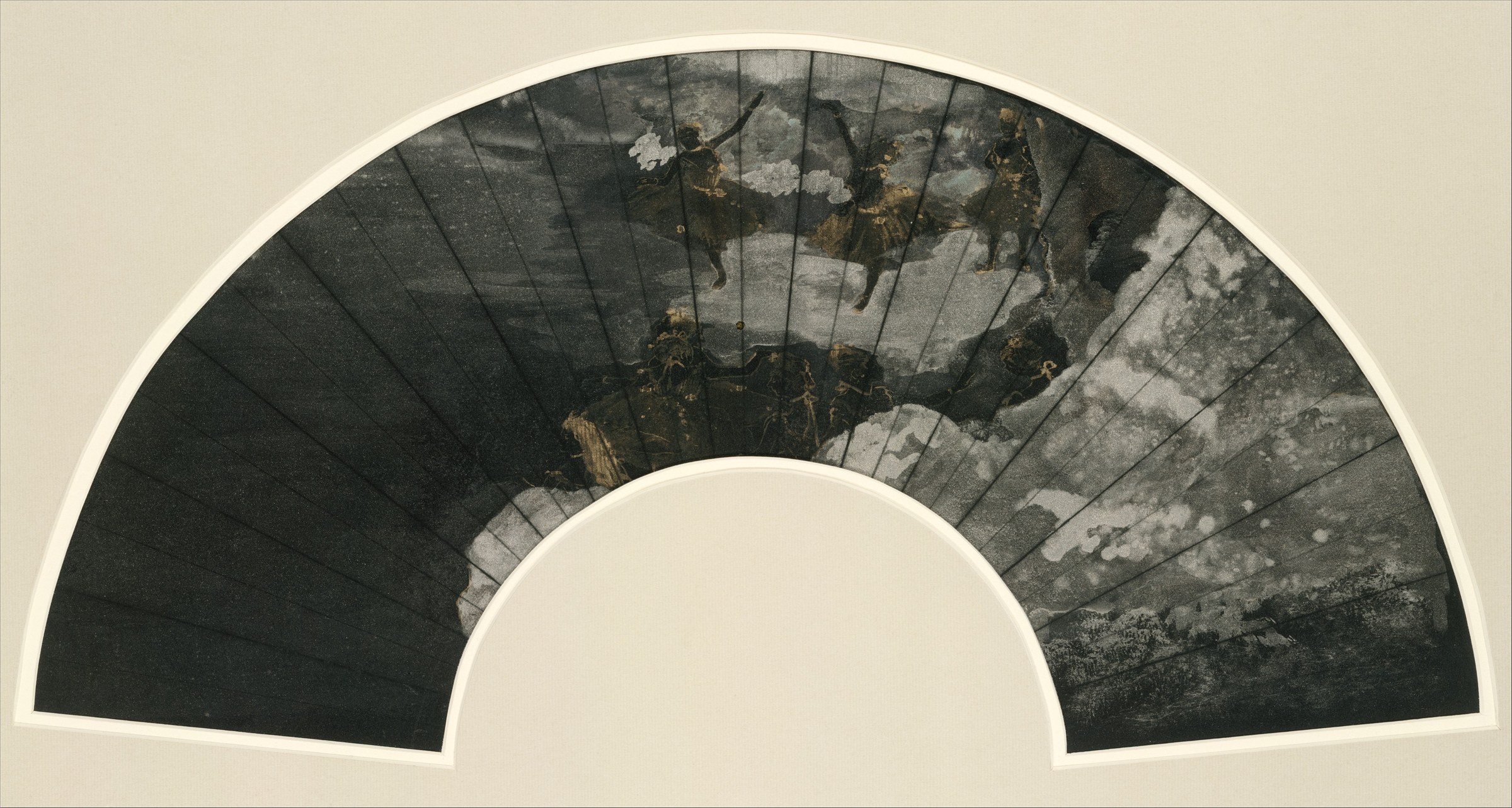
Fan Mount: The Ballet
Edgar Degas
- Medium:
- Watercolor and metallic paint on silk
- Collection:
- European Paintings
- Source:
- The Metropolitan Museum of Art
- Rights:
- Public domain — free to use, share and adapt.
- Recorded as:
- CC0 (Public Domain)
For historians of ballet, this work captures an essential truth: that the real dance happens in rehearsal, in the studio, in moments of preparation and fatigue. For art historians, it demonstrates how Degas adapted Japanese compositional strategies to modern Parisian subjects, and how he used format (the fan) to reshape perspective and viewer access. It stands as evidence of ballet's centrality to 19th-century visual culture and to the modernist artistic project itself.
What you are looking at
This fan mount presents a semicircular view into a ballet studio or rehearsal space, rendered in watercolor and metallic paint on silk. The composition radiates from a central vanishing point, with vertical lines suggesting the ribbed structure of the fan itself becoming part of the pictorial architecture. Multiple dancers in pale practice clothes occupy the space at various distances, some standing, others in movement or rest. The scene is dimly lit, with soft light defining the figures against darker background elements—possibly walls, mirrors, or stage elements. The atmospheric quality and the flattened perspective characteristic of looking through a fan create an intimate, voyeuristic view of backstage ballet practice. The metallic paint catches light across the surface, particularly on the dancers' bodies and the architectural elements, creating a shimmering, ethereal effect.
The dancing
The dancers are distributed across the depth of the space with no single focal point, creating the sense of a snapshot of ongoing work. Several figures appear to be in standing positions with arms raised or extended, while others seem to be stretching, waiting, or observing. The bodies are rendered in elongated proportions typical of late 19th-century ballet imagery. The poses suggest classical ballet posture—erect spines, lifted torsos—but the informality of the arrangement and the casual groupings indicate this is a working rehearsal rather than a performed sequence. No clear partnering or formation is visible; the dancers seem absorbed in individual preparation.
The dance depicted
This is plainly ballet, most likely Parisian ballet of the 1870s–80s based on the dress and the studio setting. The painting captures the world Degas observed repeatedly: the daily work of Opera dancers in rehearsal and practice, not the glamour of performance. The informality of the composition—dancers scattered, unposed, some incomplete or cropped by the frame—distinguishes this from academic ballet imagery. The fan mount format itself echoes the Japanese prints that were influencing Parisian art at this moment, and that Degas particularly admired. This is ballet as lived practice, filtered through the discipline of a confined, fan-shaped field.
How it was made
The work is watercolor and metallic paint applied to silk, a delicate support that allows for transparency and luminosity impossible in oil or gouache. The metallic elements—likely gold or silver leaf or paint—are visible particularly on the dancers' bodies and architectural elements, creating highlights that shimmer and catch light. The fan mount itself was a luxury object, and this particular approach to it suggests Degas was experimenting with how a Japanese fan format could frame and reshape a scene. The medium's fragility and the specificity of the mount indicate this was a work of considerable refinement, likely made for a collector's cabinet rather than public exhibition.
About this work
This is an intimate study of ballet practice, rendered by Degas in the refined medium of watercolor and metallic paint on a fan-shaped silk surface. It belongs to Degas's extensive meditation on the ballet world of Paris, particularly the spaces behind the curtain where dancers rehearsed and prepared. The fan format—adopted from Japanese print tradition—becomes part of the work's meaning, creating a voyeuristic frame that collapses the distance between observer and observed. This is not a performance image but a document of labor, technique, and the daily rhythm of a dancer's life.
How to look at it
Approach this as you would a real fan: hold it or imagine holding it, and notice how the radiating lines guide your eye toward and away from the center. The semicircular format flattens the traditional perspectival box; instead of standing before a scene, you are looking through a mask that shapes what you can see. Attend to the distribution of the figures: Degas has avoided any hierarchy or narrative; the dancers are simply *there*, in the casual arrangement of a working day. The metallic paint catches light unevenly, creating an effect of shimmer or incompleteness that suits the informal subject. Notice which figures are whole and which are cropped or obscured—this is a signature Degas move, insisting that the frame cuts arbitrarily through life, not according to classical composition.
The artist
Edgar Degas (1834–1917) was obsessed with ballet from the 1860s onward, making hundreds of drawings, paintings, and pastels of dancers in rehearsal, performance, and rest. He had access to the Paris Opera through connections and spent countless hours in the foyer de danse and backstage spaces, sketching dancers in their working clothes, stretching, adjusting their costumes, waiting. Unlike painters who glamorized ballet, Degas depicted the unglamorous reality: the effort, the repetition, the bodily discipline. His interest in Japanese prints informed his compositional strategies, particularly his use of off-center framing, cropped figures, and unusual viewpoints. The fan mount was one of several formats Degas experimented with in the 1870s–80s, alongside pastels, monotypes, and small oils on panel.
The period
The 1870s–80s were a period of intense modernist experiment in Paris. Degas was working as Impressionism emerged, but he resisted the label and maintained his commitment to drawing, composition, and the human figure in action. Ballet was a thriving institution at the Opéra Garnier (opened 1875), and dancers were visible in urban culture—in prints, photography, and painting. Simultaneously, Japanese art was flooding into Europe and reshaping aesthetic priorities among avant-garde artists; the fan was a particularly potent symbol of japonisme. Degas's fan paintings and drawings sit at this intersection: they depict a modern French institution through compositional and material strategies borrowed from Japanese tradition.
Where it lives
The work is held by the Metropolitan Museum of Art, part of the European Paintings collection. It is one of several fan mounts Degas created in the 1870s–80s, a format he adapted from luxury objects into vehicles for experimental composition.
Dance in this work
Questions about this work
Why is this painted on a fan?
Degas experimented with the fan format partly for aesthetic novelty and partly under the influence of Japanese prints, which he collected. The fan's semicircular shape created compositional constraints and opportunities that interested him. Fan mounts were also luxury objects for wealthy collectors, part of the decorator's world rather than the conventional art market.
Is this a real ballet scene or imaginary?
It is based on real observation. Degas had regular access to the Paris Opera and spent hours sketching dancers in rehearsal. However, this is not a documentary record of a specific moment but a composed work that synthesizes many observations into a unified image. The flattening and rearrangement of space is deliberate artistic choice.
What is the metallic paint for?
The metallic elements—likely gold or silver—catch and reflect light, creating highlights on the dancers' bodies and architectural elements. This effect was practical on a curved silk surface (it emphasizes the form and catches light as the fan moves) and also aesthetic, creating an ethereal, precious quality suited to the medium.
Why are the dancers so hard to see?
The dim, atmospheric lighting and the pale dress of the dancers against shadowy backgrounds create a sense of immersion in the studio space. This reflects Degas's interest in light and vision: rehearsal studios are not brightly lit, and dancers emerge gradually from shadow as your eye adjusts. It also reinforces the informal, unposed quality of the scene.
More dance artwork





