49 works in this view — arrow keys or swipe to move between them.
Dance in Art
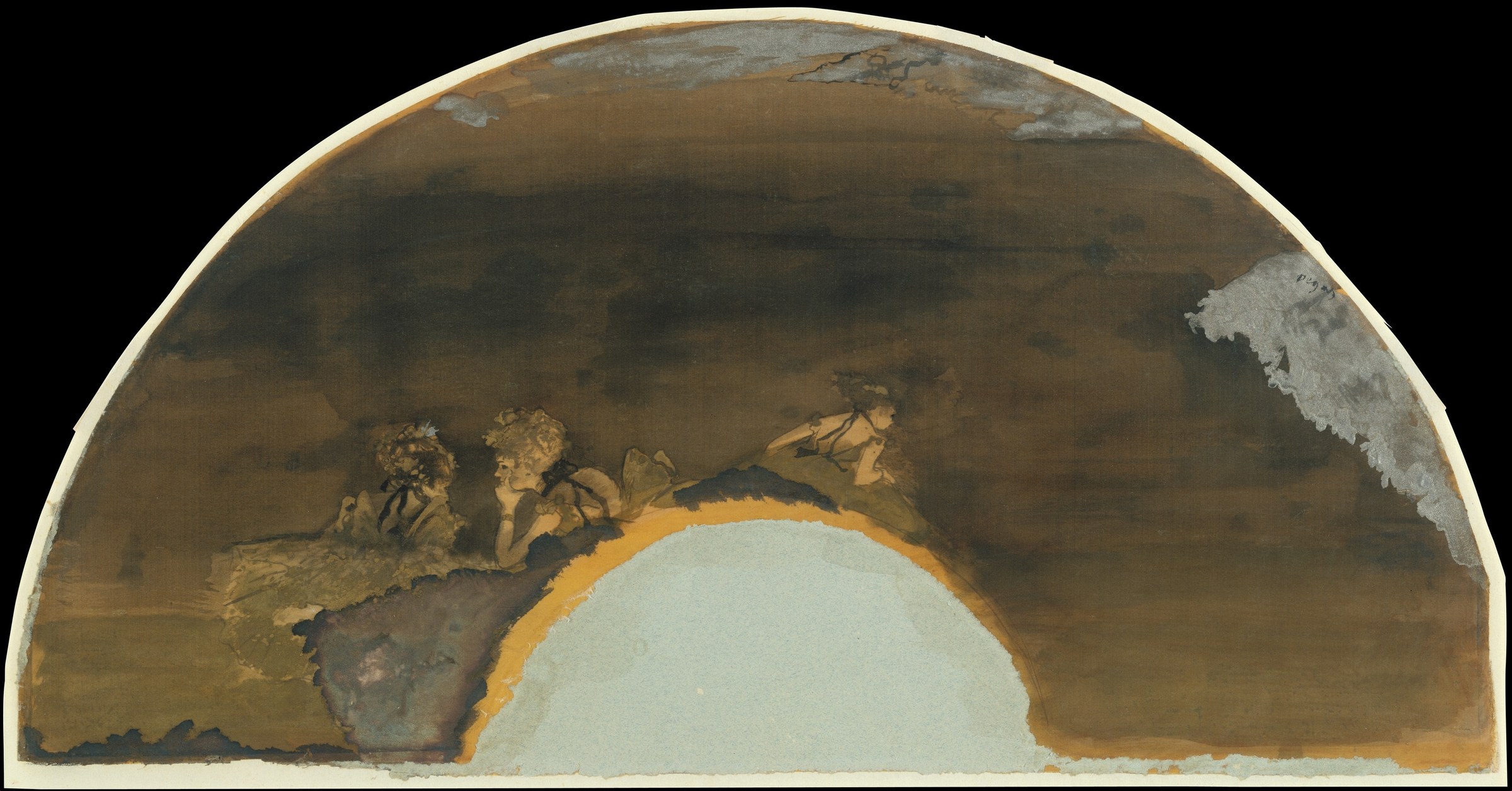
Fan Mount: Dancers
Edgar Degas
- Medium:
- Watercolor and metallic paint on silk
- Collection:
- European Paintings
- Source:
- The Metropolitan Museum of Art
- Rights:
- Public domain — free to use, share and adapt.
- Recorded as:
- CC0 (Public Domain)
This work documents how Romantic ballet—with its vocabulary of weightlessness, transcendence, and the supernatural—persisted in the imagination of a major artist well into the late nineteenth century, even as ballet itself was changing. It also reveals Degas's willingness to subordinate narrative specificity to pure formal beauty: the identity of these beings matters less than the arrested moment of their luminous poise. For historians of dance imagery, it shows how ballet vocabulary had become a universal language for depicting the ethereal and otherworldly.
What you are looking at
Three winged figures occupy a shallow rocky ledge against a dramatically darkened sky. The composition is a half-lunette, constrained and intimate despite its mythological subject. The foreground is dominated by a luminous white semicircular form—possibly a moon or divine light source—which creates a sharp golden-orange halo and throws the figures into silhouette and modeling light. The three dancers (or putti, if we are in Romantic allegorical territory) are arranged in profile and three-quarter view, their bodies angled toward and away from the light source. The leftmost figure crouches or kneels; the center figure rises on what appears to be tiptoe or elevated position; the rightmost figure reclines or leans backward. All three possess visible wings. The surrounding sky is rendered in warm browns and dark grays, suggesting either dawn, dusk, or a theatrical lighting effect. The composition suggests a moment of celestial or supernatural activity—these are not earthbound dancers.
The dancing
The three figures display balletic épaulement and port de bras characteristic of mid-nineteenth-century academic ballet vocabulary. The elevated center figure suggests relevé (rising onto the balls of the feet), with arms positioned in a raised, ethereal port de bras; the supporting leg appears engaged and the free leg extended or held in classical position. The leftmost figure's pose suggests a preparation or recovery from movement, with the torso angled forward. The rightmost recumbent figure suggests either a final pose or repose. All three bodies maintain a lightness and verticality aligned with ballet's aspiration to weightlessness, reinforced by the visible wings.
The dance depicted
This work depicts a Romantic ballet scene, most likely representing supernatural or allegorical beings—possibly sylphs, spirits, or celestial attendants familiar from the Romantic ballet repertoire of the 1830s–1840s. The ethereal character, the wings, the use of relevé, and the pale, delicate physiques all point to the *Ballet blanc* or white ballet tradition, in which corps de ballet dancers in tutus portrayed sylphs, undines, or shades. The moment appears to be a sustained pose or tableau rather than a mid-step action; the lighting and composition suggest a revelation or epiphany. Without a clearer inscription or provenance, we cannot identify the specific ballet, but the stylistic vocabulary suggests a work from the Romantic era or its late nineteenth-century revival.
How it was made
This is a watercolor and metallic paint on silk, which is a distinctly luxurious and refined support. Silk's smooth surface and luminous character allowed Degas to build glazes of transparent color and exploit the ground's reflectivity; the metallic paint (likely gold or bronze) creates the brilliant halo around the central light source. The half-lunette format (fan-shaped) suggests this may have been designed as a decorative object—a hand fan, a fireplace ornament, or a costume design. Watercolor on silk was a technique favored for intimate, precious objects intended for wealthy patrons; its fluidity and translucency suit both the ethereal subject and the illusionistic light effects Degas achieved here. The technique's fragility and the work's small scale suggest a private commission rather than a public exhibition work.
About this work
This is a Romantic ballet tableau, executed by Edgar Degas in watercolor and metallic paint on silk in 1879. It depicts three winged celestial or supernatural figures poised on a moonlit or divinely illuminated ledge, their bodies arranged in classical ballet positions—the center figure in relevé with raised arms, flanked by a kneeling figure and a reclining one. The work exemplifies the *Ballet blanc* aesthetic that dominated mid-nineteenth-century European ballet: weightlessness, ethereality, and the representation of the unreal or supernatural through the vocabulary of academic ballet.
This fan-mount painting sits at the intersection of Degas's long engagement with ballet as a subject and his technical experimentation with watercolor on silk. By 1879, Degas was approaching his sixties and had already depicted dancers for four decades; this late work distills his accumulated knowledge into a single concentrated image. The luxurious materials and intimate scale suggest a gift or commissioned decoration rather than a finished painting for exhibition, yet it carries the full weight of Degas's understanding of balletic movement and the Romantic tradition.
How to look at it
Focus first on the central light source—the luminous semicircle—and how it structures the entire composition. Notice how the three figures are positioned to frame and react to this light: the kneeling figure looks toward it, the elevated figure rises into it, the reclining figure recedes from it. Observe the ballet positions: the center figure's relevé and port de bras are the most legible; the other two are less explicit about their dance vocabulary, allowing them to read as repose or recovery. The half-lunette format is crucial: it suggests looking up, as if at a ceiling fresco or a stage seen from below. The figure arrangement—three unequal bodies in a shallow space—recalls both Renaissance and Baroque compositions (the Holy Family, the Nativity), importing a sense of timelessness and reverence to what is ostensibly a secular theatrical subject.
The artist
Edgar Degas (1834–1917) was obsessed with ballet from the 1860s onward, producing hundreds of drawings, pastels, paintings, and prints depicting dancers in rehearsal, performance, and rest. Unlike the Impressionists, Degas was trained in academic drawing and maintained a classical sensibility; his ballet scenes combine precise anatomical observation with a draftsman's reverence for line and composition. By the 1870s and 1880s, Degas was experimenting with unusual media and supports—pastels on monotype, tempera, watercolor on silk—partly to achieve effects unavailable in traditional oil painting, and partly as a response to his failing eyesight. His ballet works were not always finished pictures for exhibition; many were independent studies, gifts, or explorations of technique. This watercolor on silk belongs to that experimental practice.
The period
In 1879, Romantic ballet was in its twilight. The golden age of works like *La Sylphide* (1832) and *Giselle* (1841) had passed, but their aesthetic—the ethereal corps de ballet, the supernatural subject, the emphasis on airiness and illusion—remained the dominant visual language of ballet. Degas himself had begun his career as a painter of historical and religious subjects before turning to ballet and modern life. By 1879, Impressionism was established and Post-Impressionism emerging; Degas occupied a position between tradition and modernity, valuing classical draftsmanship while embracing experimental technique. The 1870s saw an upsurge in decorative arts and the cult of the precious object; fan-mounts and watercolors on silk were fashionable among wealthy collectors. Degas's ballet subjects had become increasingly rarified and poetic, less concerned with the social realities of the Opéra than with the eternal forms of dance itself.
Where it lives
This work is held in the European Paintings collection of The Metropolitan Museum of Art, New York, and is documented in their public collection database. The fan-mount format and the precious materials suggest it was a bespoke commission or gift. Its acquisition history and previous ownership are not indicated in the record provided here.
Dance in this work
Questions about this work
What is a 'fan mount'?
A fan mount is a decorative composition designed to be painted or affixed to the leaf of a hand fan—a common luxury object in the eighteenth and nineteenth centuries. The half-lunette or fan-shaped format you see here is the precise shape of the folded fan leaf. Fan mounts ranged from simple watercolor sketches to elaborate miniatures, and commissioning one from a known artist was a mark of taste and wealth. Degas created several fan mounts, particularly in his later career.
What ballet is this from?
The work is not inscribed or documented to a specific ballet, and the composition is too generalized to permit certain identification. The three winged figures and the ethereal aesthetic suggest a work from the *Ballet blanc* tradition—ballets like *La Sylphide*, *Giselle*, or *Les Sylphides* in which supernatural beings, sylphs, or shades appeared. But Degas may have invented the scene or synthesized motifs from multiple ballets he had observed over decades.
Why are the figures painted in silhouette?
The strong backlighting effect—the radiant white-and-gold semicircle at the composition's center—naturally throws the figures into silhouette and semi-silhouette. This technique makes the figures read as ethereal and otherworldly; their bodies seem to be translucent or immaterial, catching only the edges of the divine light. It also unifies the composition: all spatial and narrative interest is drawn toward that central luminous form.
Is this a finished work or a study?
It is ambiguous. The materials (watercolor and metallic paint on silk) and the fan-mount format suggest it was intended as a complete, autonomous object—a precious gift or decorative piece. But Degas often worked on such studies for their own sake, without exhibition in mind. Whether it was ever actually mounted as a functional fan leaf is unknown; it exists now as an independent artwork, a complete thought rather than a preliminary sketch.
More dance artwork





