49 works in this view — arrow keys or swipe to move between them.
Dance in Art
Circus Sideshow (Parade de cirque)
Georges Seurat
- Medium:
- Oil on canvas
- Collection:
- European Paintings
- Source:
- The Metropolitan Museum of Art
- Rights:
- Public domain — free to use, share and adapt.
- Recorded as:
- CC0 (Public Domain)
This work is essential for understanding how dance and acrobatics entered avant-garde art in the late 19th century, and how new painting techniques were developed partly to capture movement and light in performance. The painting also documents the aesthetic and physical vocabulary of circus acrobatics at a moment when those traditions were being professionalized and refined.
What you are looking at
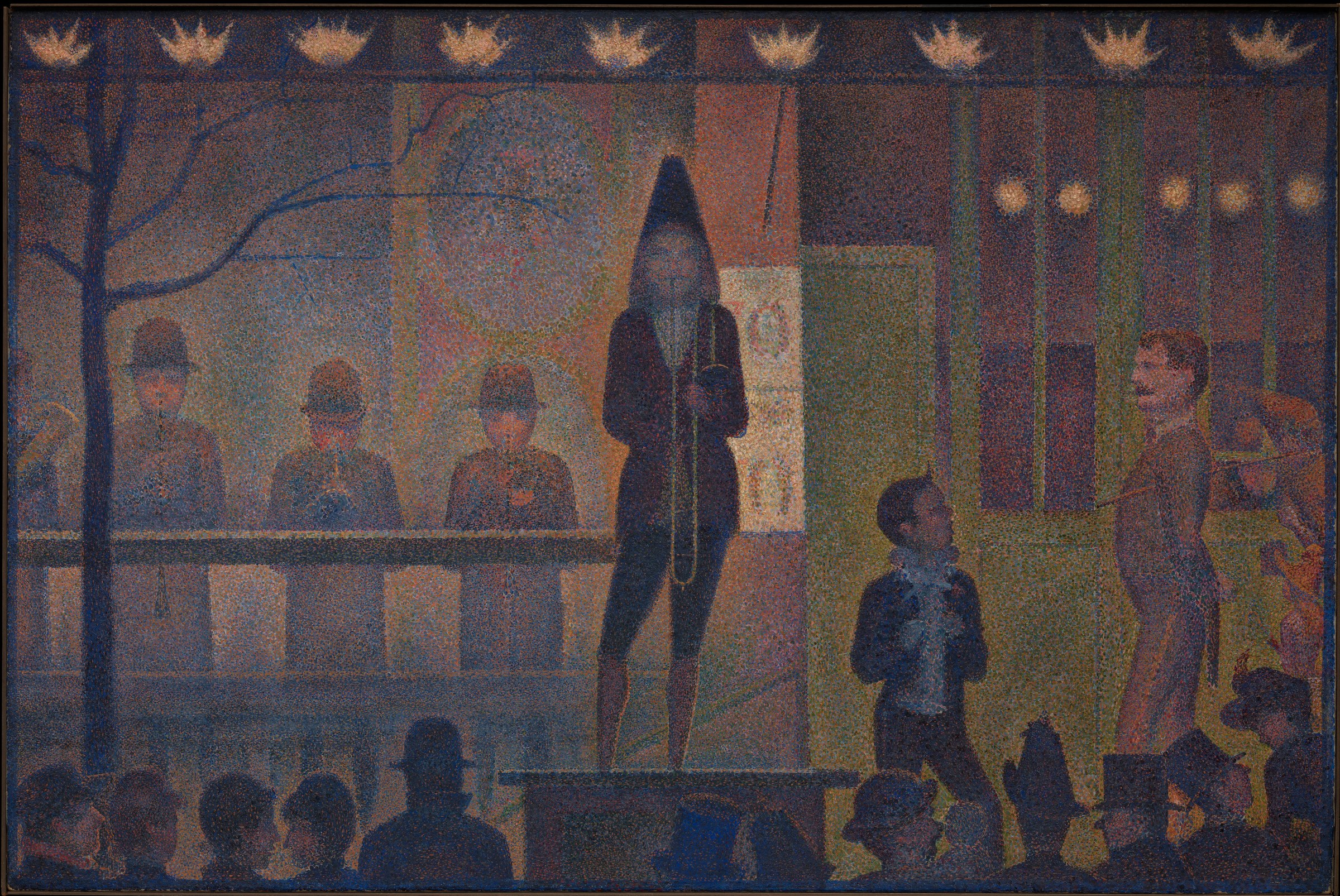
A circus performance unfolds in a shallow, theatrically lit interior space. At center, a tall acrobat in dark clothing stands on a raised platform, arms extended, caught mid-movement in an elegant pose. Around this central figure, audiences sit in tiered rows—some in the foreground rendered as dark silhouettes, others in the middle distance watching from what appear to be balcony levels, their faces and forms suggested rather than detailed. The setting is divided by vertical architectural elements: striped pillars or stage divisions in muted greens, browns, and golds. Above, a decorative frieze of repeated golden crown or leaf motifs runs the width of the composition. The color palette is characteristically Pointillist—composed of small touches of complementary hues (blues, oranges, purples, yellows) that optically blend rather than mix, creating an atmospheric, almost dreamlike quality. Warm amber light pools on the platform and figures; cooler tones dominate the surrounding architecture and crowd. The whole scene has the quality of modern theatrical spectacle, formal yet intimate, with the solitary performer holding the gaze of an unseen but densely populated audience.
The dancing
The central acrobat displays an extended, balletic posture—both arms held upward and outward in a graceful asymmetrical frame, the torso engaged and lifted. The stance suggests control and balance rather than dynamic force; the figure appears to be either poised at the apex of a movement or holding a sustained position. The surrounding spectators are rendered as fragmentary forms—heads, shoulders, silhouettes—creating a strong visual contrast between the singular, sharply defined performer and the diffuse, almost abstract crowd. Their gazes converge on the central figure, establishing a clear hierarchy of attention.
The dance depicted
This is circus acrobatics, most likely adagio or partner acrobatics, though the image shows a solo presentation moment. The pose—elevated, balletic, emphasizing line and extension—reflects the influence of classical ballet vocabulary on circus training, particularly the late-19th-century practice of incorporating balletic grace into acrobatic display. The figure's stillness and elongated frame are characteristic of adagio work, where the acrobat moves with deliberate, sustained control. The circus sideshow context (as the title indicates) places this within the popular entertainment and spectacle culture of the 1880s, when such performances combined athleticism with aesthetic presentation.
How it was made
This is oil on canvas executed in the Pointillist or Divisionist technique pioneered by Seurat. Rather than mixing pigments on a palette, the artist applied small, distinct touches of pure color side by side, allowing the viewer's eye to blend them optically at a distance. This labor-intensive method served both formal and conceptual purposes: it created a shimmering, luminous surface and embodied a scientific approach to color and light. For this work, the technique was particularly suited to rendering the artificial theater lighting and atmospheric depth of an indoor entertainment venue, and the method's deliberate, almost mechanical precision contrasts expressively with the fluid, organic movement of the performer.
About this work
Seurat's *Circus Sideshow* is a monumental exploration of modern spectacle and visual perception painted at the height of Pointillism's development. The work combines his technical innovation with a subject drawn directly from contemporary popular culture—the circus and cabaret performances that fascinated fin-de-siècle Paris. The acrobat at the center, suspended in balletic grace and caught in theatrical light, becomes both a study of human movement and a vehicle for investigating how color, light, and spatial composition create optical and emotional experience. The painting is among Seurat's largest and most ambitious, marking his engagement with modern leisure and entertainment as worthy of the same formal rigor previously reserved for historical or mythological subjects.
How to look at it
Watch how Seurat builds the acrobat's body and the surrounding light through small touches of contrasting color rather than line or tonal modeling. From a distance, the figure reads as unified and luminous; closer inspection reveals that the illusion is constructed entirely through optical mixing. Notice how the audience is defined almost entirely by silhouette and position rather than individual detail—this creates a powerful sense of focused attention and collective spectatorship. The vertical divisions of architecture, the horizontal ledge of the stage, and the single vertical figure at center create a rigorously composed, almost austere geometry that contrasts with the organic flow of the performer's pose.
The artist
Georges Seurat (1859–1891) was a French painter and founder of Pointillism (also called Divisionism or Chromoluminarism), a technique based on optical color theory and scientific principles of light perception. Working in Paris during the 1880s, Seurat moved away from Impressionism's spontaneous brushwork toward a more systematic, disciplined approach. His subjects ranged from landscapes to urban leisure scenes—parks, bathing beaches, nightlife venues—all rendered with the same meticulous Pointillist method. *Circus Sideshow* (1887–88) and *Circus* (1891) are among his most celebrated works, demonstrating his ambition to apply his optical innovations to dynamic, modern subjects.
The period
The 1880s in Paris saw the rise of cabaret, café-concerts, and circus performances as sites of artistic and social innovation. The Moulin Rouge opened in 1889, and popular entertainment became a subject of intense artistic interest—not as low or vulgar, but as embodying modern experience and visual stimulation. Simultaneously, acrobatics and circus arts were undergoing professionalization and refinement; acrobats trained with ballet masters and incorporated classical body positions and aesthetic principles into their practice. In visual art, Impressionism had opened the door to contemporary subjects and fleeting effects of light; Seurat's Pointillism represented a more systematic, scientific response to similar concerns, attempting to develop a 'grammar' of optical perception.
Where it lives
The work is held in the European Paintings collection at the Metropolitan Museum of Art, New York, where it is one of the institution's most celebrated examples of late 19th-century French art.
Dance in this work
Questions about this work
Is this a real circus performance or an imagined one?
The painting depicts a type of performance—circus acrobatics—that was real and popular in Paris during the 1880s. Seurat attended such performances and sketched them, so the general scene reflects actual entertainment practices. However, this is not a portrait of a specific event; it is a composed studio work that distills and reorganizes what the artist observed in order to explore light, color, and spectatorship.
Why is the painting made of so many small dots?
Seurat used Pointillism, a technique based on the theory that colors placed side by side are perceived more vibrantly by the eye than colors mixed on a palette. He applied tiny touches of pure color—orange next to blue, for instance—so that your eye blends them into a richer, more luminous hue. This method was labor-intensive but allowed him to control the optical effect with scientific precision, making it ideal for capturing the artificial theater lighting.
What is the acrobat doing?
The acrobat is posed in a balletic, extended position—arms raised and held open, body lifted and controlled. This is likely adagio or exhibition acrobatics, a style that emphasized grace, balance, and line as much as strength. The pose is frozen at its apex, capturing a moment of poise rather than dynamic motion.
More dance artwork