49 works in this view — arrow keys or swipe to move between them.
Dance in Art
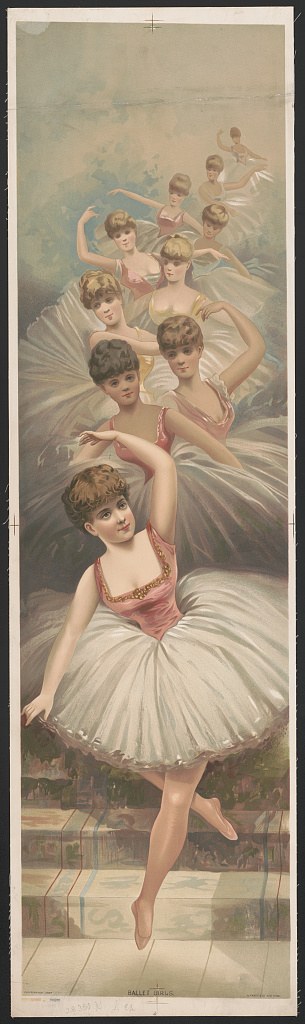
Ballet girls
Unknown artist
- Collection:
- Prints & Photographs
- Source:
- Library of Congress
- Rights:
- Rights vary by item — check the source record before reusing this image. Source record ↗
- Recorded as:
- Library of Congress — no known restrictions (verify per item)
This work documents the aesthetic ideology of late-nineteenth-century ballet at a moment when the form was at the height of its cultural prestige and its investment in spectacle and visual illusion. For dancers and historians, it is evidence of costume, grouping conventions, and the composition of the corps de ballet in this era—a snapshot of theatrical practice and expectation. The image also reveals how ballet was marketed and consumed as a visual commodity, offering insight into gender representation and the commodification of the female body in commercial theatre.
What you are looking at
A vertical composition showing multiple female ballet dancers arranged in a cascading diagonal line that recedes into the distance, creating a sense of spatial depth. The foreground figure is positioned lower left, gazing directly outward with a composed expression, wearing a fitted pink or coral bodice with a voluminous white tulle skirt and pink ballet pointe shoes. Her body is held in an elegant contrapposto, one leg extended. Behind and above her, successive dancers are arranged diagonally upward, each progressively smaller and more distant, creating a rhythmic repetition of the tulle skirts and pale skin tones. The background is misty and atmospheric, rendered in soft greens and grays, suggesting a stage or dream-like space rather than a specific location. The lighting is diffuse and flattering, casting soft shadows that model the dancers' forms and create luminosity in the white fabrics. The overall effect is ethereal and romantic—a chorus or vision rather than a narrative scene.
The dancing
Each dancer exhibits the upright carriage and elongated line characteristic of classical ballet. The foreground figure's posture shows weight settled onto the supporting leg with the free leg softly extended, the arms held gracefully in a relaxed position. The successive figures repeat this stance with subtle variations—some with arms raised, others held at the sides—creating visual rhythm through repetition. All dancers maintain the turned-out hip alignment and lifted torso of ballet training. The heads are gently tilted and expressions are serene. Approximately eight to ten dancers are visible, though the exact count is difficult due to the atmospheric recession; each is rendered in decreasing scale and clarity to enhance perspective.
The dance depicted
This appears to be Romantic ballet imagery, most likely from the 1880s theatrical tradition depicting either a corps de ballet in a group variation or a choreographic vision sequence common to ballets of this era—scenarios involving sylphs, spirits, or supernatural beings arranged in ethereal tableaux. The uniform dress, identical poses, and arranged composition suggest a formal stage picture rather than spontaneous movement. The tulle skirts, pointe shoes, and classical carriage are consistent with the Romantic and early Classical ballet repertory of the late nineteenth century. The artist has captured the aesthetic ideal of the period: pale, ethereal, weightless femininity suspended in space, which was as much about visual design and atmosphere as about the mechanics of dance technique.
How it was made
This is a chromolithograph, a color printing process that allowed rich gradation of tone and subtle color effects—evident in the soft greens and misty grays of the background and the luminous white of the tutus. The technique is admirably suited to capturing the atmospheric and romantic mood sought by the artist and was a commercial and accessible way to distribute theatrical imagery to a broad audience. The work appears to be a theatrical print or poster, likely a promotional image for a ballet production or a souvenir. The composition and subject matter suggest it was produced in the context of popular theatre imagery rather than fine art, making it a document of performance taste and expectations of the period.
About this work
This chromolithograph depicts a vision of classical ballet aesthetics at the height of the Romantic period—a moment when the art form was concerned with transcendence, weightlessness, and the representation of supernatural or idealized feminine beauty. The cascading arrangement of dancers, their ethereal tutus, and the soft atmospheric setting embody the visual language that defined ballet on the commercial stage of the 1880s. The print circulated as theatre ephemera, shaping and reflecting contemporary ideas about what ballet was and what it meant to watch it. It is as much a record of theatrical design and production values as it is of dance itself, showing how dancers were packaged and presented to audiences, and what visual fantasy was being sold.
How to look at it
Attend to the compositional device of recession—how the artist has created depth and atmosphere through the repetition and gradual diminishment of the figure. Notice how the foreground dancer anchors the image while the eye is drawn upward and backward through the successive figures into misty space. The handling of the tutus is worth studying: the artist has differentiated between the crisp, sculptural quality of the fabric in the foreground and its increasing softness and transparency as distance increases. Observe also the consistency of pose and carriage across all figures—this is not spontaneous movement but a formal arrangement designed to create a visual rather than kinetic experience. The print is about presence and image as much as about dance.
The artist
The artist is not recorded in the catalogue. However, the style, subject matter, and printing technique are consistent with the work of commercial theatrical lithographers active in the 1880s–1890s, particularly those producing promotional and souvenir imagery for ballet and opera performances. Such prints were often unsigned or attributed generically to the printing house rather than to an individual designer, as they were considered commercial commodities rather than fine art objects. The quality of the chromolithographic work and the sophistication of the composition suggest a professional theatrical illustrator working within established commercial conventions.
The period
In 1889, classical ballet was in a period of consolidation and international expansion. The Romantic era's preoccupation with supernatural and exotic themes had given way to a renewed interest in pure classical technique, though the ethereal aesthetic and visual spectacle remained paramount. The 1880s saw the rise of the 'ballet à grand spectacle' in Europe, particularly in Paris and St. Petersburg, where elaborate sets, costumes, and large corps de ballet ensembles created immersive theatrical experiences. The popularity of chromolithographic theatrical prints and posters had created a mass market for ballet imagery, disseminating the visual ideals of the form to audiences who might never attend a live performance. The representation of ballet dancers in prints and photographs of this period consistently emphasized grace, beauty, and weightlessness, reinforcing cultural ideas about femininity and artistic aspiration.
Where it lives
Held by the Library of Congress Prints and Photographs collection. This is a commercial theatrical print or poster, part of the visual ephemera of the nineteenth-century stage, and belongs to the documentary record of how dance was represented and circulated in mass culture.
Dance in this work
Questions about this work
What is a chromolithograph?
A color printing process developed in the nineteenth century that uses multiple stone plates, each inked with a different color, to produce richly colored images. It allowed affordable mass production of theatrical posters, prints, and promotional imagery. The process requires significant skill to manage color registration and tonal gradation, and the resulting prints could rival watercolor or oil painting in visual effect.
Why are all the dancers in the same pose?
This is a formal theatrical composition, not a snapshot of movement. The identical pose creates visual unity and rhythm, emphasizing the beauty of the line and the ethereal quality the artist sought. In Romantic ballet, corps de ballet ensembles were often arranged in symmetrical or repeating formations to create visual spectacle and to emphasize the idealized beauty of the form rather than individual expressiveness.
Is this a real ballet or an imagined scene?
It is likely based on real ballet choreography—either a specific vision sequence from a known ballet or a generic image representing the ideal of ballet spectacle. The composition and subject are consistent with formal ballet arrangements of the period, particularly the 'apotheosis' or finale scenes common to grand spectacle ballets, where dancers were arranged in ascending or cascading formations to create visual climax.
What does the atmospheric background suggest?
The misty, dreamlike setting suggests a supernatural or imagined space rather than a real stage—the realm of spirits, sylphs, or other-worldly beings. This was a common visual convention in Romantic ballet imagery, reinforcing the association of ballet with the ethereal and the transcendent. The soft focus and pale colors create a romantic mood that aligns with the aesthetic values of the period.
More dance artwork





