49 works in this view — arrow keys or swipe to move between them.
Dance in Art
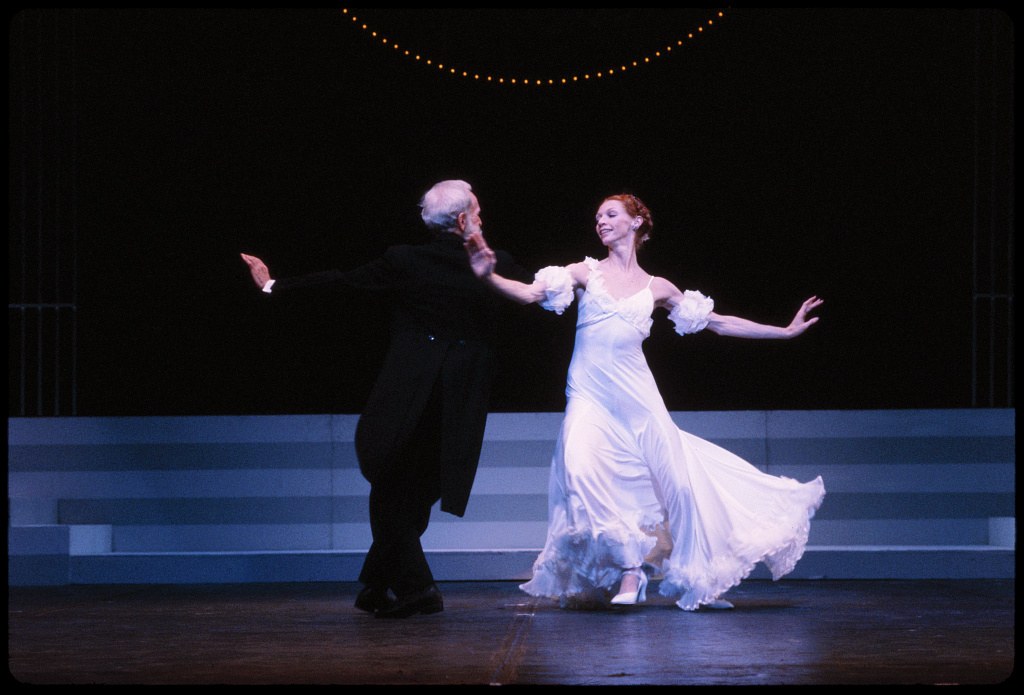
"Astaire," Ballets Canadiens
Unknown artist
- Collection:
- Prints & Photographs
- Source:
- Library of Congress
- Rights:
- Rights vary by item — check the source record before reusing this image. Source record ↗
- Recorded as:
- Library of Congress — no known restrictions (verify per item)
This image is a primary document of how ballet companies in Canada presented themselves and their art in the early 1980s. For dancers and historians, it shows the continuity of the Romantic ballet aesthetic—the emphasis on the woman's ethereal quality, the formality of male partnering, the white gown and stage machinery—and how that aesthetic was sustained by regional companies decades after its invention. Stage photography serves as the only complete record of ephemeral performance; this image is what remains of a moment that will never be performed again in exactly this way.
What you are looking at
A man and woman dance together on a stage lit in cool blue tones, set against a backdrop of horizontal blue bands with a scalloped border of gold lights at the top. The woman wears a flowing white gown with puffed sleeves and a full skirt caught mid-swirl; the man is in formal black tails. They are positioned in a moment of open connection—the man's arm extended toward the woman's outstretched hand, their bodies angled in complementary directions. The woman's expression is bright and engaged, her head turned toward her partner. The stage floor is a warm honey tone, creating sharp contrast with the cool set behind them. The composition captures a moment of courtship and elegance, with the dancers' extended limbs and the woman's billowing skirt creating a sense of buoyant movement frozen in time.
The dancing
The man leads from a position slightly behind and to the side of the woman, his right arm raised and hand meeting hers in a gentle clasp. The woman stands with her weight forward, arms extended in an open, welcoming frame—her left arm toward her partner, her right arm raised in a sweeping arc. Both dancers are vertical and upright, with no bent knees or lowered center visible. The man's posture is formal and restrained; the woman's carriage is light and buoyant. Their relative positions suggest a moment between steps—neither in a closed ballroom hold nor fully separated, but in a staged gesture of connection.
The dance depicted
This appears to be a classical or romantic-era ballet pas de deux, most likely from a 19th-century work. The white pointe-shoe ballet gown, the formal male costume, the stage lighting, and the courtship narrative conveyed through gesture all point to theatrical ballet. The open frame, the emphasis on the woman's extension and lightness, and the man's role as supporting partner are consistent with Romantic ballet conventions. The title 'Astaire' suggests a reference to Fred Astaire, the legendary ballroom and theatrical dancer, though the costuming and technique depicted here are distinctly classical ballet rather than Astaire's own style. This may be a production featuring a dancer with the stage name Astaire, or a work titled in homage to that tradition.
How it was made
This is a color photograph, likely a stage photograph taken during a live performance or dress rehearsal. The photographer has captured the moment with clarity despite the theatrical lighting, using the blue stage wash to create a cohesive, almost dreamlike background. The photograph's depth of field is shallow enough to keep the dancers sharp while the backdrop remains in softer focus. Stage photography of this era would have required fast film stock and careful positioning to capture movement under colored lights; the image's quality suggests professional documentation of a major ballet company's production.
About this work
This is a stage photograph documenting a moment from a ballet performance titled 'Astaire' by the Ballets Canadiens, dated 1983. It captures the aesthetics and technique of classical ballet as practiced by a Canadian professional dance company in the early 1980s—a period when classical ballet was the dominant theatrical dance form in North America, performed by regional companies that maintained the vocabulary and standards of European tradition. The photograph documents not just a dance but a theatrical moment: the artifice of stage lighting, costume, and scenic design combined with the dancer's control and expression. It belongs in a gallery of dance because it shows how ballet was made visible and preserved in its own time—through the photograph as a record of live performance.
How to look at it
Attend to the moment the photographer chose: not a moment of maximum extension or turning, but a moment of connection and emotional transaction between the dancers. Notice how the woman's skirt is caught in motion, adding visual dynamism, while the dancers' upper bodies remain composed. Observe the staging: the cool blue wash and the scalloped light border at top create a fairy-tale or dream quality typical of Romantic ballet sets. The photograph's lighting is theatrical, not neutral—the dancers are lit from the front and slightly above, modeling their faces and bodies, while the backdrop remains cool and abstract. This is how ballet audiences experienced the performance, and the photographer has preserved that full visual envelope.
The artist
The photographer is not recorded in the catalogue. Stage photography of ballet in the 1980s was typically conducted by company-commissioned photographers who worked from the house during performances or dress rehearsals. These photographers needed to understand dance, timing, and stage lighting in order to capture performers in moments of visual clarity and narrative significance. The image's technical quality and compositional care suggest professional training and familiarity with theatrical lighting.
The period
In 1983, classical ballet was at a stable plateau in North America. The major traditions—Balanchine technique, Royal Academy of Dance, Vaganova—were codified and widely taught. Regional companies like Ballets Canadiens existed to maintain these standards outside New York City Ballet and other flagship institutions. Simultaneously, contemporary ballet and modern dance were growing as alternative traditions. The photograph's aesthetic—the romantic gown, the courtship narrative, the male-female partnering—reflects the conservative, narrative-centered ballet that still dominated regional companies' repertories, even as avant-garde choreographers elsewhere were dismantling these very conventions.
Where it lives
This photograph is held by the Library of Congress in the Prints & Photographs Online Catalog (PPOC), indicating it entered the national documentary record as a significant image of American (or North American) dance history. It is catalogued as part of a larger collection, suggesting it may be one of many photographs from this production or company archive acquired by the library.
Dance in this work
Questions about this work
Who were Ballets Canadiens and what did they do?
Ballets Canadiens was a classical ballet company based in Canada, active in the mid-to-late 20th century. Like many regional companies, it maintained and performed the classical ballet repertory—works based on the Romantic and Neoclassical traditions—and provided ballet performance and training outside the major urban centers. By the 1980s, such companies were essential to sustaining ballet as a living practice across North America.
What does 'Astaire' as a title mean for a ballet?
The title most likely refers either to a ballet work titled in honor of Fred Astaire, the legendary dancer and choreographer, or to a production performed by a dancer with the stage name Astaire. The costuming in the photograph—the white Romantic tutu and formal male costume—does not reflect Astaire's own style, which was modern ballroom and tap. The work is likely a classical or Romantic ballet bearing his name as tribute or attribution.
How do we know what steps or technique they are doing from a still photograph?
A still image cannot document footwork or the full line of a sequence, but it does preserve the frame, the carriage, the quality of the dancers' bodies, and the moment of connection chosen by the choreographer and photographer. From this image, we can read the dancers' alignment, weight distribution, arm position, and the narrative content of the moment. A series of such photographs would tell more; a single image is a window into one instant.
Why is this in a gallery of dance rather than a photography collection?
Stage photography is dance documentation. Its subject is the dance performance, not the photographic medium itself. This image matters because it shows us what a ballet looked like, how it was staged, and what skill and artistry went into it. It is evidence of dance history, preserved in photographic form.
More dance artwork





