49 works in this view — arrow keys or swipe to move between them.
Dance in Art
Ballets Canadiens, "Tellurien"
Unknown artist
- Collection:
- Prints & Photographs
- Source:
- Library of Congress
- Rights:
- Rights vary by item — check the source record before reusing this image. Source record ↗
- Recorded as:
- Library of Congress — no known restrictions (verify per item)
The image records an art practice—partner acrobatics in contemporary ballet—that would become central to late-twentieth-century theatrical innovation. Ballets Canadiens was a crucial node in the network of experimental dance makers who refused the boundary between classical and contemporary, between balletic refinement and acrobatic risk. For anyone studying the history of Canadian dance, the expansion of ballet technique, or the role of Montreal as a creative center in this period, this photograph is primary evidence.
What you are looking at
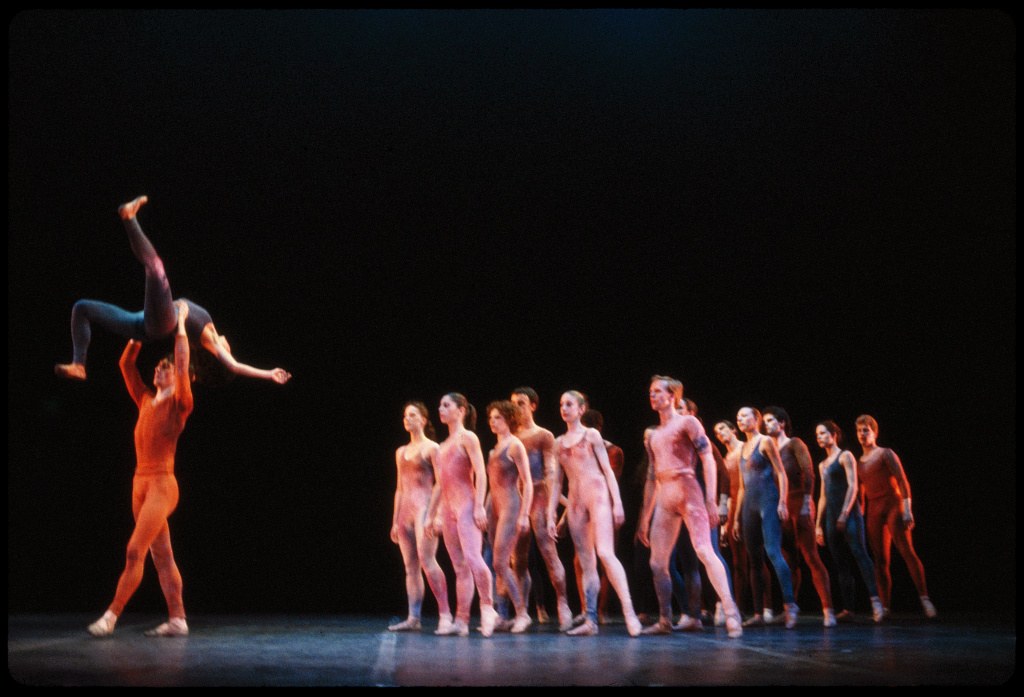
A contemporary ballet ensemble fills the stage against a black background, creating stark visual drama through costume and lighting. At left, a single male dancer in burnt orange sustains an acrobatic pose—his body arched backward, one leg extended high, his torso almost parallel to the ground—held aloft by an unseen partner below the frame. At right, a chorus of approximately fourteen dancers stands in loose formation, dressed in a gradient of warm tones from coral to deep burgundy, with some wearing blue. The ensemble holds a contemplative, almost ceremonial stillness, their bodies upright and shoulders relaxed, creating a visual counterpoint to the dynamic lift. The stage floor reflects light coolly, emphasizing the depth and the isolation of the figures against the void. The composition suggests a moment of ritual or revelation, with the acrobatic display functioning as a kind of sacred center and the chorus as witnesses.
The dancing
The lifted male dancer demonstrates partner acrobatics (adagio) in its most dramatic form—full inversion and extension, demanding precise weight transfer and control from both the base and the flyer. His body is fully extended, suggesting strength and precision. The ensemble maintains vertical spinal alignment and relatively neutral arm carriage, standing in loose spatial relationship rather than tight formation. The contrast between the dynamism of the lift and the repose of the group suggests a choreographic structure that alternates between virtuosic display and contemplative presence, a hallmark of mid-century contemporary ballet.
The dance depicted
This is contemporary ballet, likely from the early 1980s Quebecois avant-garde. The acrobatic lift indicates influence from theatrical-ballet innovation that incorporated circus and modern-dance physicality. The work appears to be *Tellurien* ("Earthling" or relating to the earth), performed by Ballets Canadiens, a Montreal-based experimental troupe active in this period. The vocabulary—partner acrobatics integrated with ensemble work and dramatic lighting—reflects the post-Forsythe impulse to expand classical ballet's range. The muted, earthy costume palette and ritualistic grouping suggest thematic content, possibly environmental or metaphysical.
How it was made
This is a color photograph, likely chromogenic (Kodachrome or Ektachrome), made during live performance. The image captures theatrical lighting design as much as choreography: the overhead spot isolates the lifted dancer in warm amber while throwing the ensemble into cooler shadow. Photography as a documentation medium freezes a single instant that exists for only a fraction of a second on stage, collapsing the temporal flow of movement into a single powerful composition. The photographic record thus becomes a curatorial act—this moment, among thousands, is chosen as representative.
About this work
This is a documentation photograph of *Tellurien*, a contemporary ballet work by Ballets Canadiens, performed in 1983. The work represents a moment when classical ballet was opening its vocabulary to include acrobatics, partnering innovations, and modern-dance influence, particularly within the experimental Quebecois dance scene. The image captures the tension between individual virtuosity and collective presence, between the extremes of classical technique and the expanded physicality of late-twentieth-century theatrical dance. Ballets Canadiens was part of a broader North American movement toward postmodern ballet, less interested in narrative spectacle than in bodies, risk, and the aesthetics of radical lift.
The photograph itself is a primary historical record—both as performance documentation and as a moment of artistic innovation. It belongs in this collection because it shows not what ballet was, but what ballet was becoming, and specifically what Canadian dance artists were making of it in real time.
How to look at it
Notice first the acrobatic inversion: the male dancer's body is nearly horizontal, held by partner(s) outside the frame, a moment of absolute commitment and precision. This is not a pose the body naturally sustains; it is pure partnership and control. Then look at the ensemble—their stillness is not empty or passive, but grave and concentrated, as if they are witnessing or participating in something ceremonial. The lighting design reinforces this: the warm spot on the lifted dancer against the cool darkness of the stage and the cooler tones of the ensemble creates a visual hierarchy. The photograph asks you to see the virtuosity not as flourish but as labor, and the group not as chorus but as community. The moment chosen—the hold at full extension—is the moment of maximum commitment and maximum visibility of the partnering structure.
The artist
Ballets Canadiens was an experimental dance company based in Montreal, active primarily in the late 1970s and 1980s. The company was committed to creating new choreography that honored classical ballet technique while incorporating contemporary movement vocabularies, particularly from modern dance and circus arts. The troupe existed in the orbit of other avant-garde collectives in Quebec during a period of significant cultural ferment and institutional innovation. The specific choreography and artistic direction of *Tellurien* is not recorded in the available documentation.
The period
In 1983, ballet was undergoing a significant expansion. William Forsythe's deconstructionist work at Stuttgart and Frankfurt was redefining what ballet bodies could do; contemporary artists were exploring partnering beyond classical vocabulary; and regional companies outside New York were establishing themselves as sites of innovation. In Canada specifically, the 1970s and 1980s saw the emergence of a vital independent dance scene in Montreal, with artists pushing against both the conservative classicism of the National Ballet of Canada and the New York-centered discourse of contemporary dance. *Tellurien* sits within this context—using classical training as a foundation while integrating acrobatics, ritual, and ensemble-based choreography that owes as much to modern dance and theater as to ballet tradition.
The photograph itself is a product of late-twentieth-century arts documentation—the moment when performance became collectible and analyzable through still images, before the digital archive. Color performance photography like this was expensive and labor-intensive, suggesting institutional support or committed documentation by independent photographers.
Where it lives
This photograph is held by the Library of Congress Prints & Photographs collection and was sourced from the Library of Congress. It documents a performance by Ballets Canadiens and serves as evidence of the company's artistic practice and the state of experimental ballet in Canada in the early 1980s.
Dance in this work
Questions about this work
What is the acrobatic hold and why is it important?
This is partner acrobatics, or adagio—a partnering technique in which one dancer fully inverts and extends their body while another dancer (or dancers) provides the base and support. It requires extraordinary trust, precise weight transfer, and strength from both parties. In classical ballet, adagio typically means a slower, supported duet; in contemporary practice, it has expanded to include dramatic inversions and near-extreme extensions. This image shows how late-twentieth-century ballet was integrating circus-level acrobatics into its vocabulary.
Who were Ballets Canadiens and what made them important?
Ballets Canadiens was an experimental ballet company based in Montreal in the late 1970s and 1980s. They were part of a broader movement of regional dance makers who refused to accept the distinction between classical ballet and contemporary dance, and who saw ballet training as a foundation for exploring new movement vocabularies. They contributed to establishing Montreal as a vital center for dance innovation during a period when much attention was focused on New York.
What does the ensemble do in this image?
The ensemble holds a quiet, upright formation that contrasts visually with the dynamic lift. Rather than serving as passive backdrop, they appear to function as witnesses or participants in a kind of ritual or revelation. Their costume, positioning, and the visual weight given to them by the photographer suggests they are integral to the work's meaning, not supplementary.
How does this photograph document the work?
The photograph captures a single instant of performance, freezing movement that exists in time and space only briefly. It serves as historical record—evidence of what was choreographed, how bodies moved, what the aesthetic priorities of the company were. Because live performance is ephemeral, photographs become primary source material for dance history, particularly for experimental works that were not filmed or widely documented.
More dance artwork





