49 works in this view — arrow keys or swipe to move between them.
Dance in Art
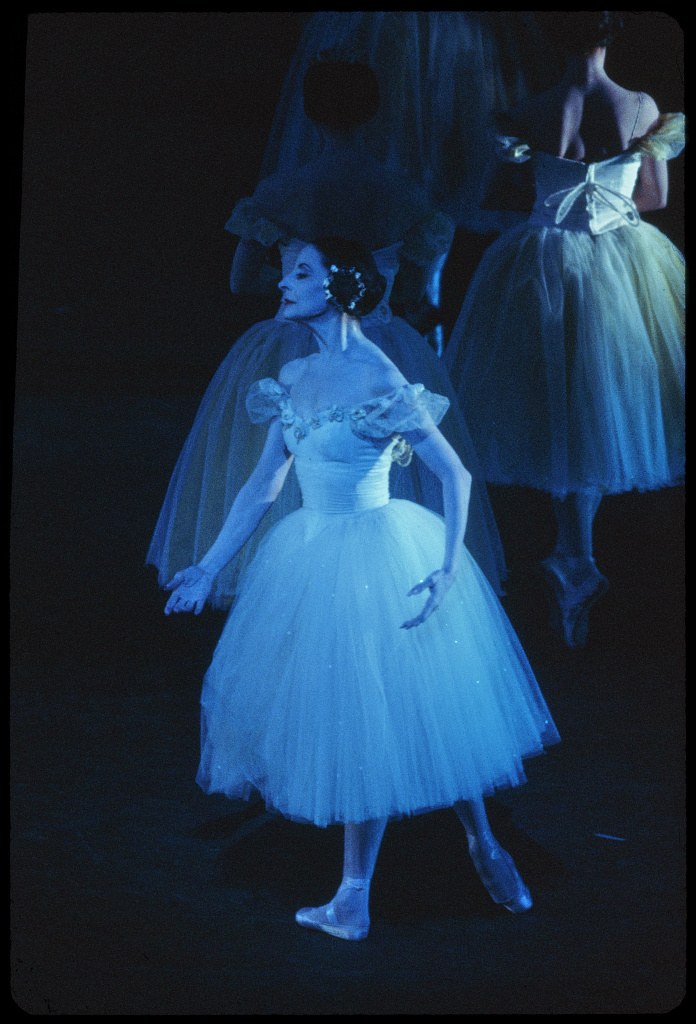
Alicia Alonso [ballet]
Unknown artist
- Collection:
- Prints & Photographs
- Source:
- Library of Congress
- Rights:
- Rights vary by item — check the source record before reusing this image. Source record ↗
- Recorded as:
- Library of Congress — no known restrictions (verify per item)
Alicia Alonso was a groundbreaking dancer whose career spanned from the 1930s through the 1980s, and who represented a non-European tradition of classical ballet mastery at the height of the Cold War—a significant fact given that she remained based in Cuba despite the revolution. This photograph captures her in her prime (she was 39 in 1960) and preserves the visual reality of how classical ballet was actually staged and lit in the mid-twentieth century, beyond the myths that surround these works.
What you are looking at
A soloist in a pale tulle skirt stands center-stage against deep shadow, her body turned three-quarter to camera with her gaze directed away. She wears a fitted bodice with a sweetheart neckline and an off-shoulder arrangement; her dark hair is pinned up with what appears to be decorative combs or ornaments catching stage light. Behind her, two or three additional figures in darker tutus are barely visible, emerging from shadow in the upper portion of the frame. The lighting is theatrical and precisely focused, with cool blue-tinted illumination rendering the soloist's skirt luminous against the black background. Her posture suggests a moment of stillness or repose rather than dynamic movement—the weight appears centered, the arms relaxed at her sides, suggesting a pause in the narrative or a contemplative emotional beat.
The dancing
The primary dancer stands in an upright, formal carriage with neutral arm placement; her weight appears evenly distributed, neither in a turnout position nor in motion. The positioning is frontal and presentational, inviting the viewer's gaze. Her facial expression and body orientation—looking away, slightly introspective—convey emotional content rather than technical display. The secondary figures visible in shadow are too obscured to read clearly, but their presence and the soloist's isolation suggest a group scene or ensemble context where she is momentarily spotlit.
The dance depicted
This appears to be a moment from a classical ballet, most likely Romantic ballet given the tulle skirt, the pale color palette, and the emotional register of stillness and inwardness. The catalogue identifies the dancer as Alicia Alonso, the Cuban prima ballerina who was celebrated internationally for her roles in Swan Lake, Giselle, and Sleeping Beauty. The image captures what may be a scene from one of these major classical works—the pale tutu, the contemplative moment, and the presence of ensemble suggest a key dramatic or lyrical passage. Alonso was known for her technical precision and dramatic intensity; this photograph seems to emphasize the latter, capturing a moment of emotional rather than virtuosic import.
How it was made
This is a color photograph, most likely a stage photograph taken during performance or a dress rehearsal, using theatrical lighting and film stock sensitive to the cool blue gels typical of mid-twentieth-century stage photography. The color saturation and the grain visible in shadow areas are consistent with Kodachrome or similar professional color film stock of the 1950s–60s. The technique allows the photographer to preserve the exact quality of stage light and costume color—the luminosity of the tulle and the distinction between the soloist's pale costume and the darker tutus behind her would be invisible in black-and-white. This suggests the image was made for documentation, publicity, or archival purposes by a professional theater photographer.
About this work
This is a stage photograph of Alicia Alonso, one of the twentieth century's greatest classical ballet dancers, captured in a moment of stillness and introspection during what appears to be a major classical ballet role. The image dates to 1960 and is held by the Library of Congress. Alonso, born in Havana in 1921, was a virtuoso technician who maintained an international career despite partial blindness, and she was a crucial figure in establishing Cuban ballet as a world force. The photograph documents not a moment of technical display but of emotional and narrative intensity—the kind of acting within dance that was central to the Romantic and classical traditions she embodied. For dancers and historians, it is a record of how a major dancer of the mid-twentieth century inhabited these roles, and a document of the theatrical apparatus that framed them.
How to look at it
Pay attention to the moment the photographer chose: not a leap or a turn, but a moment of composure and stillness, lit to emphasize the soloist's isolation and inwardness. This reflects a choice about what constitutes the essential content of classical ballet—not always the virtuosic passages, but the dramatic and emotional beats that give them meaning. Notice also how the stage light and the photographer's use of color create the composition: the soloist's pale skirt is luminous because of the lighting design and because the photographer was able to capture it in color. In black-and-white, this image would be far less legible and far less evocative.
The artist
The photograph is uncredited, which was common for theater documentation of the period. It was likely taken by a professional photographer employed by the ballet company or venue where Alonso was performing, as part of routine stage photography documentation. Such images were made for archives, publicity, and the dancer's own records.
The period
In 1960, classical ballet was at a moment of international expansion. Balanchine had redefined neoclassical ballet in America; the Bolshoi and Kirov were rising in prominence in the Soviet Union; and dancers from outside Europe were beginning to claim the great classical roles as their own. Alonso's career was emblematic of this shift—a Cuban dancer of European training who became celebrated in the roles that had been the province of European and Russian companies. Stage photography in color was still relatively new and expensive; when a company invested in color documentation, it was usually for major productions or prominent dancers.
Where it lives
The photograph is held by the Prints & Photographs division of the Library of Congress, which collects documentation of American cultural life including theater and dance. The image is identified as a theater photograph, most likely taken during performance or rehearsal in 1960, though the specific venue and production are not recorded in the catalogue.
Dance in this work
Questions about this work
What ballet is Alicia Alonso performing in this photograph?
The catalogue record does not specify the work. Based on the costume and lighting, it is likely one of the major classical roles Alonso danced—Swan Lake, Giselle, Sleeping Beauty, or Cinderella—but without additional documentation, the specific production cannot be determined. If you know the source, the Library of Congress may be able to add that information.
Why is the photograph so blue?
The cool blue color comes from stage lighting gel, which was (and is) standard for creating atmospheric or melancholic moods in classical ballet. The photographer's color film captured this lighting exactly as it appeared on stage. This is not a technical artifact but a record of the theatrical design.
Was Alicia Alonso Cuban or European?
Alonso was born in Havana, Cuba in 1921, and trained in ballet in both Cuba and the United States. She was an international dancer who performed with major companies worldwide, but she returned to Cuba and founded the Ballet Nacional de Cuba, which became her primary company from 1959 onward. She represented a crucial shift in classical ballet away from European and Russian exclusivity.
Why are there other dancers visible in shadow behind her?
This appears to be a moment from a group scene or ensemble passage in a classical ballet, where the soloist is momentarily spotlit while the corps de ballet remains in relative darkness. This staging device—isolating one dancer for dramatic focus—is common in classical narrative ballets.
More dance artwork





