49 works in this view — arrow keys or swipe to move between them.
Dance in Art
Alicia Alonso [ballet]
Unknown artist
- Collection:
- Prints & Photographs
- Source:
- Library of Congress
- Rights:
- Rights vary by item — check the source record before reusing this image. Source record ↗
- Recorded as:
- Library of Congress — no known restrictions (verify per item)
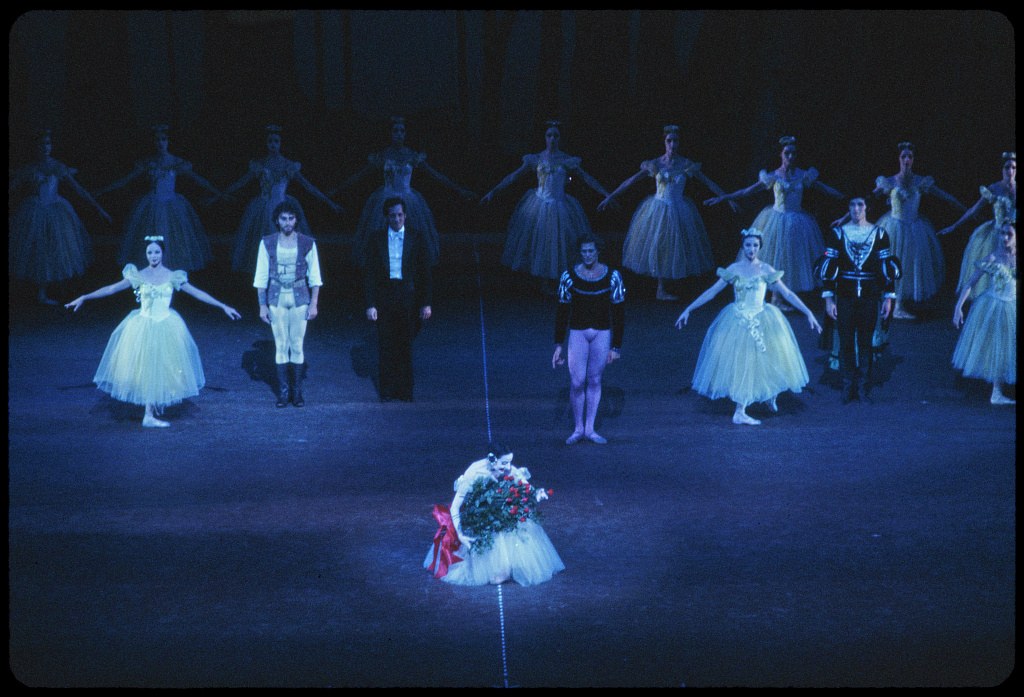
This photograph documents the curtain call ritual of classical ballet performance, a crucial but ephemeral moment in theatrical practice. It preserves the formal conventions of mid-twentieth-century ballet theater—the hierarchy of the ensemble, the presentation of the principal dancer, the ceremonial use of flowers—which would otherwise exist only in memory. The image captures how classical ballet was staged, lit, and witnessed at a specific historical moment.
What you are looking at
A classical ballet company takes its curtain call on a darkened stage lit by a single spotlight. Center stage, a prima ballerina in a white tutu and pointe shoes stands alone, holding a large bouquet of flowers tied with a red ribbon, her arms extended in the classical pose of acknowledgment. She faces the audience while behind her, arranged in a semi-circle, stand the ensemble dancers in pale blue tutus with their arms linked, creating a formal backdrop. To either side of the prima ballerina stand male dancers in dark period costumes—doublets and hose suggesting a classical or romantic-era narrative—their posture upright and formal. The entire ensemble maintains the stillness of a posed finale, the composition symmetrical and ceremonial. The lighting is theatrical, with a deep blue-black surrounding the stage and the dancers illuminated against it, emphasizing the formality of the moment.
The dancing
The prima ballerina stands in a classical, upright frame with her weight centered and arms in an open position receiving the flowers—a pose of classical composure rather than active movement. The ensemble dancers behind her maintain linked arms in a line, their bodies aligned and still. The male dancers beside her stand in formal balletic posture with their arms at their sides or slightly opened. All figures are vertical and symmetrical, with the corps de ballet in unison formation typical of classical ballet ensemble work. The composition prioritizes hierarchical arrangement and classical line over the depiction of active dance movement.
The dance depicted
This is a curtain call from a classical ballet, almost certainly from a full-length romantic or classical ballet given the formal narrative costumes and the classical tutu worn by the prima ballerina. The image captures the post-performance ritual rather than choreography itself—the acknowledgment of the principal dancer before the assembled company. Based on the costume style and the formal arrangement, this appears to be from a mid-20th-century production of a classical standard (Swan Lake, Giselle, or similar). The solemnity of the pose and the presentation of flowers is characteristic of the European classical ballet tradition, particularly the Russian Imperial Ballet tradition that Alonso would have inherited.
How it was made
This is a color photograph, likely a theatrical production still taken during an actual performance or curtain call. The photograph captures stage lighting as it was actually seen by an audience—the deep saturation of the blue-black void and the selective spotlighting—which indicates a professional theater photographer working from the house during the performance itself. The color saturation and quality suggest this is a transparency or high-quality color film stock from the 1960s, typical of archival theater photography of the era.
About this work
This is a curtain-call photograph from a classical ballet performance, dated 1960 and held by the Library of Congress. The image documents a moment outside the narrative of the ballet itself—the formal acknowledgment ritual that concludes each performance—yet it is deeply informative about the dancer, the production style, and the classical ballet tradition in mid-twentieth-century theater. The single spotlight on the prima ballerina and the formal arrangement of the ensemble reflect the hierarchies and aesthetics of mid-century classical ballet performance.
The photograph is significant as a record of professional ballet practice in 1960, capturing not the choreography itself but the rituals and presentation conventions that frame the performed work. The formal poses, the narrative costumes, and the classical tutu all situate this within the tradition of full-length classical ballets. The image demonstrates the visual language of classical ballet performance as it was presented to audiences at this historical moment.
How to look at it
Notice the absolute stillness and formal symmetry of the composition—the photographer has captured the ensemble in perfect geometric arrangement, not in the midst of movement. Observe how the spotlighting isolates the prima ballerina while the ensemble recedes into the background, literally and figuratively. The deep blue of the stage and the darkness beyond emphasize that this is a moment of formal presentation rather than active dancing. Look at the posture of each dancer: completely vertical and composed, with no sense of the effort or momentum that would be present in actual choreography.
The artist
The photographer is not recorded in the catalogue. The image entered the Library of Congress collection, suggesting it was either a professional theater photograph commissioned during a performance or a publicity photograph produced for circulation. The professional quality and theatrical lighting indicate work by a trained photographer with access to the stage during performance.
The period
In 1960, classical ballet had become the dominant mode of concert dance in the United States and Europe, particularly through the influence of Russian Imperial Ballet training transmitted through emigre teachers and dancers. The full-length classical ballet—with its narrative structure, classical tutus, and formal ensemble work—was the prestige form of ballet performance. Mid-century ballet photography was increasingly professionalized, with high-quality color film allowing for more accurate record of stage lighting and costume detail than earlier photographic methods had permitted.
The curtain call itself was a formalized ritual by mid-century, particularly in classical ballet companies influenced by Russian Imperial Ballet practice. The presentation of flowers to the principal dancer, the formal arrangement of the ensemble, and the spotlight isolation of the prima ballerina all reflect conventions that had been established in Imperial Russian ballet and transmitted to Western companies through dancers and teachers who had trained in Russia.
Where it lives
The photograph is held in the Prints & Photographs Online Catalog of the Library of Congress, entered as part of their general theatrical photography collection. The source and production details of the photograph are not recorded, but its presence in the Library of Congress suggests it was either a professional archival document or a publicity image produced for distribution.
Dance in this work
Questions about this work
What is a curtain call and why is it part of ballet?
A curtain call is the formal acknowledgment that follows a completed performance, in which dancers step forward to bow and receive applause. In classical ballet, the curtain call is a structured ritual that reveals the hierarchy of the company—the principal dancers appear last and longest, often receiving flowers. It is a moment outside the narrative of the ballet itself, a transition between the performed fiction and the ordinary social world of the theater.
How do we know what ballet this is from?
We do not know definitively from the image alone. The costume style, the classical white tutu, the narrative male costumes, and the formal ensemble arrangement are all consistent with any number of classical full-length ballets—Swan Lake, Giselle, The Sleeping Beauty, or others. The title reference to Alicia Alonso suggests this is from a performance in which she danced, but the specific ballet is not recorded.
Who was Alicia Alonso?
Alicia Alonso (1920–2019) was a Cuban prima ballerina and choreographer, one of the most important classical ballet dancers of the twentieth century. She was particularly celebrated for her interpretations of Giselle and Swan Lake. She trained in the Russian Imperial Ballet tradition and became a major figure in bringing classical ballet to Cuba, where she founded the Ballet Nacional de Cuba.
What does the blue lighting mean?
The deep blue stage lighting was a standard convention in mid-twentieth-century theater, used to create visual distinction between the stage and the auditorium, and to enhance the sense of formal, elevated spectacle. In classical ballet, blue lighting often accompanied scenes coded as romantic, ethereal, or dreamlike. Here it creates a nocturnal or otherworldly atmosphere appropriate to the formal ritual of the curtain call.
More dance artwork





