49 works in this view — arrow keys or swipe to move between them.
Dance in Art
Ballet
Unknown artist
- Collection:
- Prints & Photographs
- Source:
- Library of Congress
- Rights:
- Rights vary by item — check the source record before reusing this image. Source record ↗
- Recorded as:
- Library of Congress — no known restrictions (verify per item)
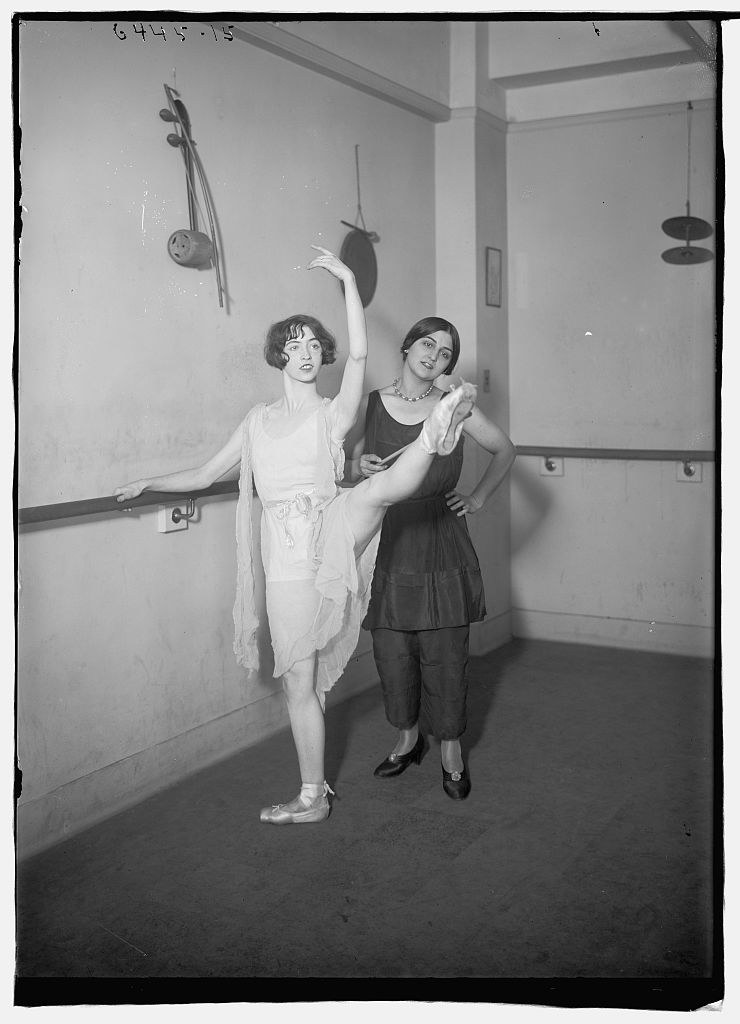
This photograph provides direct visual evidence of how classical ballet technique was taught and demonstrated in the early 20th century, at a moment when ballet was undergoing reform and codification. The spare setting and documentary approach offer a counterpoint to theatrical imagery, showing ballet as a discipline of the body practiced in institutional spaces.
What you are looking at
Two women stand in a spare, institutional interior with plain walls, a low wainscoting, and geometric ceiling beams. The woman on the left wears a pale sleeveless tunic or chemise with a long gauze scarf or shawl trailing from her raised right arm; her left arm extends to the side at shoulder height. She stands en relevé on pointe, her left leg extended behind or to the side. The woman on the right, dressed in a dark sleeveless dress, stands beside her with her right arm raised and bent, her body angled toward her companion. Both women gaze upward. Behind them hang three objects on the wall—stringed instruments (a lute or similar) and what appear to be metal discs or cymbals. The lighting is even and shadowless, flattening the forms in the manner of early flash photography. The setting suggests a practice or exhibition space rather than a stage.
The dancing
The dancer on the left demonstrates a lifted, extended arabesque or allongé pose with the upper body held upright and arms in an open frame—the classic balletic carriage. She is en relevé (on the balls of the feet), indicating trained technique. The woman on the right adopts a supporting or participating pose, her arm raised in a gesture that mirrors the verticality of her companion's raised arm. The two figures are close but not in direct contact, positioned as if in a pas de deux or demonstration.
The dance depicted
The posture, the relevé position, the arm extension, the tunic-like costume, and the evident technical training all point to classical ballet training of the early 20th century. The pose resembles an arabesque or attitude derrière, foundational positions in Romantic and Classical ballet vocabulary. The institutional setting, the plain costume, and the presence of a second figure suggest this may document a ballet lesson, rehearsal, or demonstration rather than a theatrical performance. The informal setting and documentary quality suggest pedagogical rather than public exhibition.
How it was made
This is a black-and-white photograph, identifiable by the sharp detail, the even surface lighting characteristic of early flash photography, and the fine tonal gradations across the wall and figures. The photograph captures a moment indoors under artificial light, suggesting studio or practice-space documentation rather than theatrical performance photography. Early 20th-century photographic technique allowed such images to be reproduced and distributed, making them accessible as pedagogical records or evidence of balletic practice.
About this work
This photograph documents two dancers in a ballet practice or demonstration, likely from the early 1900s. The woman on the left performs an extended arabesque or similar classical position en relevé, wearing a simple tunic and a flowing scarf, while her companion stands beside her in a supporting attitude. The stark institutional setting—empty walls, exposed ceiling, hung instruments—frames this as a record of technique and training rather than public spectacle. The image belongs in the gallery because it captures ballet at the moment of pedagogy and private practice, revealing how the dance was transmitted and preserved outside the theatre.
How to look at it
Attend to the precise angle of the arabesque—the raised arm, the extended leg line, the upright carriage of the torso. These details reveal what the photographer (and the dancers) considered essential to document. Notice the supporting role of the second figure; this may be a teacher-student relationship or a paired demonstration. The objects on the wall—the instruments—suggest that this space served multiple purposes or that the photographer chose to include them as context for understanding the cultural milieu. The flat, even light and careful composition indicate that this was a deliberate record, not a candid moment.
The period
The image dates to approximately 1900, a pivotal moment in European ballet. Diaghilev's Ballets Russes would debut in 1909, bringing radical choreographic innovation; this photograph sits just before that watershed. The early 1900s saw growing interest in balletic pedagogy, systematic training methods (the Cecchetti method gained prominence in this period), and photographic documentation of dance. The institutional setting and emphasis on technique reflect the era's investment in dance as a disciplined, teachable practice rather than pure spectacle.
Where it lives
The image is held in the Library of Congress Prints & Photographs collection. It is catalogued with minimal additional information, making the photograph itself the primary evidence for interpretation. Early 20th-century photography from institutional collections often represents commissioned documentation or collected ephemera.
Dance in this work
Questions about this work
Is this classical ballet or contemporary ballet?
The technique and costume belong to classical ballet of the early 1900s. The arabesque position, the relevé stance, the simple tunic, and the overall aesthetic are entirely consistent with turn-of-the-century academic ballet training and the Romantic ballet tradition that preceded it.
Where was this taken and who are the dancers?
The catalogue record provides no attribution or location. The bare institutional setting suggests a practice studio or teaching space rather than a theatre, but the specific location and identities of the dancers are unknown. The photograph may have been part of a larger documentation project or collection.
Why are there musical instruments on the wall?
The purpose of the instruments in the background is unclear from the photograph alone. They may indicate that the space served multiple functions (music and dance instruction together), that they belonged to the institution, or that they were included by the photographer to provide cultural context.
More dance artwork





