49 works in this view — arrow keys or swipe to move between them.
Dance in Art
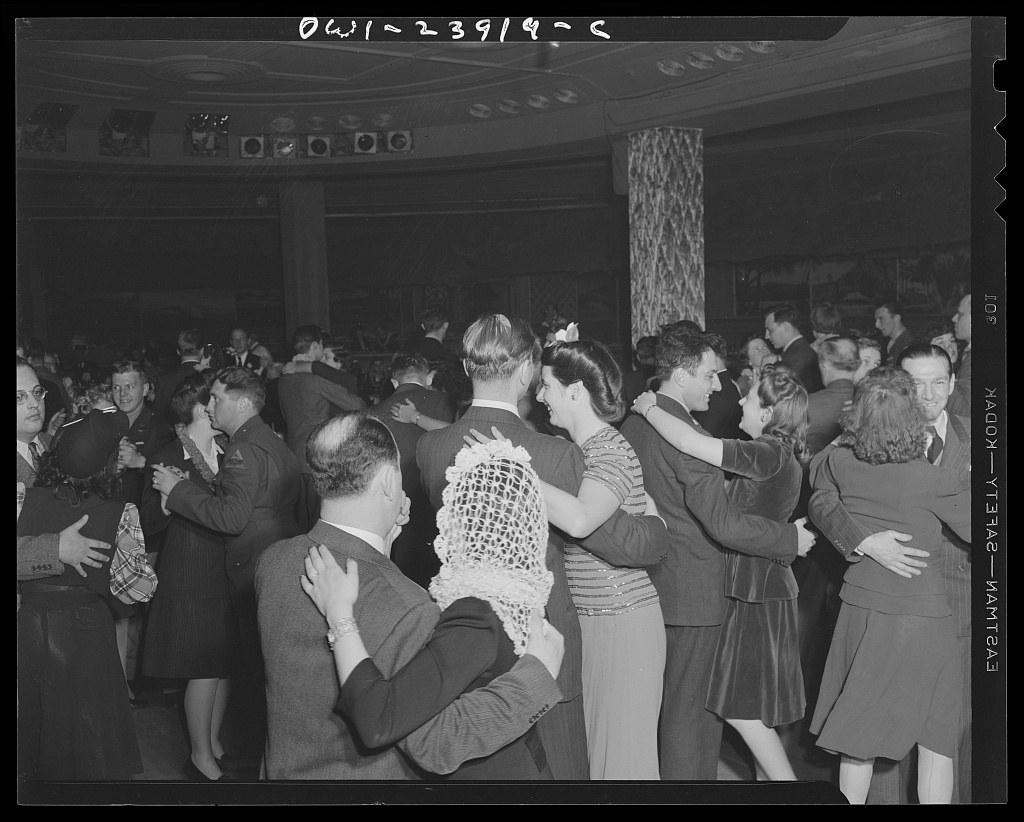
New York, New York. Dance floor scene at the Hurricane Ballroom
Unknown artist
- Collection:
- Prints & Photographs
- Source:
- Library of Congress
- Rights:
- Rights vary by item — check the source record before reusing this image. Source record ↗
- Recorded as:
- Library of Congress — no known restrictions (verify per item)
This is one of the few photographs of everyday swing-era ballroom dancing in a real venue, showing how people actually moved together in the packed conditions of a working nightclub. It contradicts the polished, staged image of 1940s dancing and reveals the close-partnered, body-connected style of vernacular swing as lived practice. For dancers and historians of the period, it is irreplaceable evidence of social dancing culture.
What you are looking at
A crowded ballroom scene photographed in black and white, capturing a moment of intense social dancing at the Hurricane Ballroom in New York. The image is densely packed with couples and individual dancers, many in close physical proximity, suggesting a packed Friday or Saturday night. The composition is dense and slightly chaotic—bodies overlap, arms intertwine, and the crowd fills the frame edge to edge. Dress is mixed: men wear dark suits and fedoras or hats; women wear dresses of various styles, many with patterned fabrics, some with elaborate hairstyles pinned or netted. The lighting is flat, suggesting indoor venue lighting of the 1940s. A large ornamental column appears in the background, and what may be band or stage equipment is visible at the top of the frame. The photograph captures not a posed moment but a slice of actual dancing—people mid-turn, mid-hold, mid-conversation, creating an impression of fluid, energetic social movement.
The dancing
The dancers are almost entirely in closed partnered positions—men with right hand at the woman's back, left hand holding her right hand at frame height. Most are in upright frame with slight forward lean into the partner. Bodies are close, some couples nearly pressed together. A few dancers are stepping side-to-side; others appear to be turning or moving forward through the crowded floor. Weight is shifting continuously. The frame is social and intimate rather than technically formal, suggesting dancers prioritize connection and proximity over extended lines or lifted posture.
The dance depicted
This is social ballroom dancing of the swing era, most likely swing or foxtrot, danced in the close, body-connected style of 1940s New York nightclubs. The Hurricane was a real Harlem venue open 1930–1962, and this photograph likely documents a typical night of partner dancing in a mixed or integrated setting. The style is vernacular swing—social rather than performance, improvised rather than choreographed, emphasizing the joy of packed-floor dancing in a venue designed for exactly this kind of crowded intimacy. The closed position and the density of the floor suggest this is smooth, flowing movement rather than the flashier lindy hop aerials that were also happening in New York at the time.
How it was made
This is a black-and-white gelatin silver print, a documentary photograph taken with natural or available venue light. The film speed and exposure allow sharp focus on the nearest figures while slightly softening the background, typical of 1943 press or documentary photography. The technique—straight photography without manipulation—means this is a captured moment, not a posed studio scene. The image would have been intended for newspaper publication or a photo archive, and its presence in the Library of Congress collection suggests it was part of a journalistic or documentary project rather than commercial entertainment photography.
About this work
This is a documentary photograph of swing-era ballroom dancing at the Hurricane, a legendary Harlem nightclub, in 1943. It captures the lived social practice of partner dancing in the United States during the swing era, when ballrooms were central to popular leisure and courtship. The image is valuable precisely because it shows dancing as it happened—crowded, intimate, improvised, and integrated—rather than as it was performed on stage or taught in studios. The photograph documents a moment when social dancing was an ordinary, essential part of urban nightlife.
How to look at it
Focus on the density and the hold: notice how many couples are touching, how little space there is between dancers, and how the men's and women's bodies are oriented toward each other. The photographer has caught the moment mid-motion—people are stepping, turning, responding to their partners in real time. Look at the faces: many dancers are smiling, talking, engaged with their partner rather than with an audience or a mirror. This is not performance; it is presence.
The period
In 1943, swing dancing was at its height in the United States. The Hurricane was one of Harlem's most famous venues, and photographs of its interior are rare. By 1943, swing had moved from being a radical or transgressive form associated with youth and interracial mixing to a mainstream national phenomenon, though venues like the Hurricane still carried cultural weight as sites of African American social life and Black-white social interaction. Documentary photography of everyday life, including dance, was a priority for the Farm Security Administration and other New Deal agencies; this image may be part of that archival impulse.
Where it lives
This photograph is held by the Library of Congress, Prints & Photographs Online Catalog. The catalogue record is minimal, typical for archival photographs from this period. The image appears to be part of a documentary or journalistic project, though the specific photographer and source collection are not identified in the available record.
Dance in this work
Questions about this work
Is this the Hurricane Ballroom in Harlem?
The catalogue record identifies it as such. The Hurricane was one of Harlem's premier nightclubs from 1930 to 1962, known for hosting big bands and integrated audiences. The venue was a central site of swing-era social dancing and is now historically significant as a symbol of Black cultural life in New York during this period.
What style of dancing is this?
This is social swing-era ballroom dancing, most likely swing or foxtrot. The dancers are in closed position with close contact, moving fluidly through a crowded floor. This is vernacular social dancing, not choreographed performance or competition dancing.
Who took this photograph?
The photographer is not identified in the Library of Congress record. The image is catalogued only with the title and date. Without more information, the photographer cannot be determined from the photograph alone.
Why is this photograph historically important?
It documents the lived reality of ballroom dancing in a real venue during the swing era, showing how ordinary people danced together in close quarters. Most surviving images of 1940s dancing are either staged, posed, or from performance contexts; this is raw social dancing, and it reveals the intimacy and improvisation that characterized vernacular swing.
More dance artwork





