49 works in this view — arrow keys or swipe to move between them.
Dance in Art
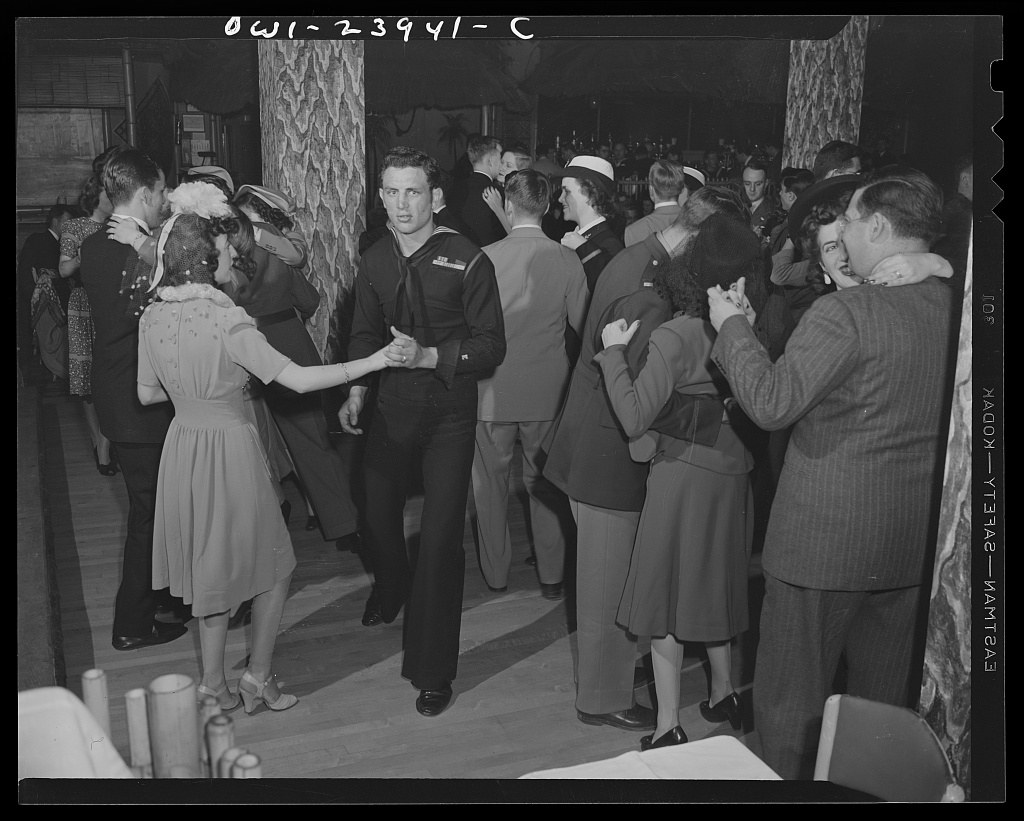
New York, New York. Dancers at the Hurricane Ballroom. They are dancing to the music of Duke Ellington and his orchestra
Unknown artist
- Collection:
- Prints & Photographs
- Source:
- Library of Congress
- Rights:
- Rights vary by item — check the source record before reusing this image. Source record ↗
- Recorded as:
- Library of Congress — no known restrictions (verify per item)
The photograph documents the social ballroom dancing practices and venues that shaped American culture during World War II, when Ellington and swing orchestras were central to morale and recreation. It provides visual evidence of the informality, gender dynamics, and mixed social composition of public swing dancing in the 1940s, a foundational moment for American social dance. The specificity of the venue and the presence of the military makes this a rare documentary record of how dance functioned as wartime socializing.
What you are looking at
A crowded interior dance venue, the Hurricane Ballroom, filled with servicemen in Navy uniforms and civilians in 1940s dress. The photograph captures a moment of social dancing during what appears to be a wartime morale or recreation event. In the foreground, a sailor in dress uniform stands among couples and groups of civilians—women in modest day dresses and coats, men in suits and hats. The space is densely packed with figures; a large decorative column is visible on the right. The lighting is even and bright, characteristic of documentary photography, and the image has the grain and tonal quality of a black-and-white photograph. The scene conveys the informality and energy of swing-era social dancing, with multiple pairs and clusters of dancers at different depths in the frame.
The dancing
The dancers are in close social proximity, many in or near standard ballroom closed positions—the visible pair on the left show the man's hand on the woman's back and her hand on his shoulder. Bodies are upright and closely held. The crowd is so dense that it is difficult to discern complete figures or specific footwork, but the posture and arm positions suggest standard American ballroom frame for the period. Most dancers appear to be in conversation or watching others, suggesting this is a social gathering as much as a performance moment.
The dance depicted
This is social ballroom dancing, most likely swing or foxtrot, at a public wartime dance venue. The setting and civilian-military mix suggest a United Service Organizations (USO) or similar morale event for servicemen. The informality, close quarters, and mixed age and status of dancers indicates vernacular American ballroom practice of the early 1940s rather than exhibition or competitive dancing. Duke Ellington's orchestra would have played jazz and swing standards suitable for both foxtrot and East Coast swing, the dominant partner dances of the era.
How it was made
This is a black-and-white documentary photograph, likely taken by a press or government photographer. The even lighting and sharp focus throughout the depth of field, achieved with documentary flash or bright ambient light, suggests professional news or archival photography. The grain and tonal range are consistent with acetate or gelatin silver print photography of the 1940s. As a documentary record, it would have circulated through government archives or newspaper distribution, making it a primary historical source on wartime recreation and social practice rather than an artistic interpretation.
About this work
This photograph documents a moment of social ballroom dancing at the Hurricane Ballroom during World War II, with servicemen and civilians dancing to Duke Ellington's orchestra. It captures the vernacular swing and foxtrot culture of the early 1940s American home front, when public dance venues were spaces of morale, courtship, and intermingling of military and civilian populations. The image belongs in a dance archive not as a masterwork of choreography or technique, but as evidence of how ordinary Americans danced together during a pivotal moment in the nation's history.
How to look at it
Observe the depth and density of the crowd—this is not a staged or exhibition dance, but a genuine social venue captured mid-event. Look at the postures and arm positions: they are relaxed versions of standard ballroom frame, adapted to the crowded space. Notice the mix of ages, uniforms, and civilian dress, which tells you something about the function of the space. The even, unshadowed lighting is typical of news photography and suggests this was shot for documentation rather than artistic effect; it captures the moment as it was rather than staging it.
The artist
The photographer is not recorded. The image is held in the U.S. Library of Congress Prints & Photographs collection, suggesting it was taken by or for a government agency or news organization during the war.
The period
In 1943, swing dancing was at its cultural peak in the United States. Duke Ellington was one of the most prominent figures in jazz orchestration, and his music was a staple of USO shows, servicemen's clubs, and public dance halls. The war years saw an explosion in public dance venues as a form of recreation and morale for both civilians and the military; the mixing of servicemen and civilian women at social dances was a distinctive feature of the period. The large, crowded ballroom setting reflects the democratization of ballroom dancing during the swing era, when the formal etiquette of earlier generations gave way to looser, more energetic social practice.
Where it lives
The photograph is held in the Prints & Photographs Online Catalog of the Library of Congress and is catalogued as part of the Library's archival collections. It functions as a documentary record of American social life and military recreation during World War II.
Dance in this work
Questions about this work
Who was dancing at the Hurricane Ballroom?
The photograph shows a mix of Navy servicemen in dress uniforms and civilians—men in suits and hats, women in day dresses and coats. The venue appears to have been used for wartime morale or recreation events, bringing together military personnel and the civilian public for social dancing.
What kind of dancing is this?
The postures and arm positions visible in the photograph indicate standard American ballroom dancing, most likely foxtrot or East Coast swing, the dominant partner dances of the swing era. Duke Ellington's orchestra would have played jazz and swing standards suitable for both styles.
Why is this photograph important to dance history?
It documents the vernacular social ballroom culture of the early 1940s American home front, when swing dancing was a mass recreational practice and public venues like the Hurricane were spaces of courtship, morale, and social mixing across military and civilian lines. It shows how ordinary people danced together during the war.
What does the crowded setting tell us?
The density of the crowd and the informal, close proximity of dancers reflects the character of wartime public dance venues—busy, mixed-age, democratic spaces rather than formal ballrooms. Dancers adapted classical ballroom frame to tighter quarters, and the event functioned as much as a social gathering and morale booster as a dance performance.
More dance artwork





