49 works in this view — arrow keys or swipe to move between them.
Dance in Art
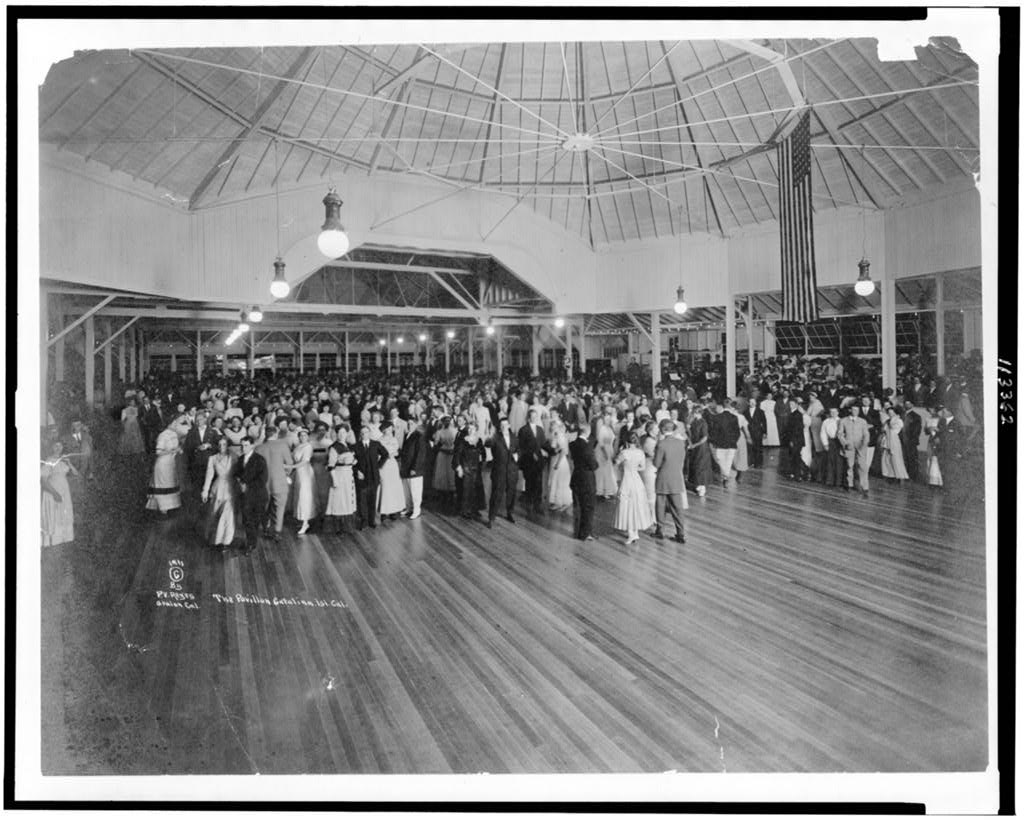
[Couples on dance floor at the Pavilion, Catalina Island, California]
Unknown artist
- Collection:
- Prints & Photographs
- Source:
- Library of Congress
- Rights:
- Rights vary by item — check the source record before reusing this image. Source record ↗
- Recorded as:
- Library of Congress — no known restrictions (verify per item)
The photograph documents the lived, ordinary practice of social ballroom dancing in early twentieth-century America at a specific, identifiable place and time, rather than an idealized or theatrical interpretation. It shows that ballroom dancing was not a minority pursuit or a performance art, but a mainstream leisure activity for resort guests, with dozens of couples dancing simultaneously in a purpose-built venue. For choreographers, historians, and dancers seeking to understand how the dances of this era were actually performed and experienced, this photograph provides authentic evidence unavailable in other visual sources.
What you are looking at
A large, crowded ballroom scene under a distinctive ribbed dome ceiling with electric pendant lights strung across the interior. The pavilion, identified as being on Catalina Island, California, is filled with well-dressed couples in formal attire—men in dark suits and women in white or light-colored dresses, many with long skirts falling to ankle length. The floor is polished wood, reflecting light from the overhead fixtures. The couples are distributed across the space in no rigid formation; some stand close together, others are mid-movement, creating a sense of fluid social mingling rather than organized performance. The architectural setting is utilitarian but elegant, with visible structural supports and what appears to be a large central support column. The photograph captures a moment of leisure and courtship in the early twentieth century, when resort pavilions hosted popular dance and social gatherings.
The dancing
The dancers are in informal social arrangement rather than strict ballroom positions. Most visible couples show close proximity typical of early 1900s social dancing—women generally positioned to the right of and slightly forward of their male partners. Arm positions are varied and partially obscured by the crowd; some figures appear to be in a loose closed hold, others more open. The women's long skirts dominate the visual field, and their posture suggests weight held upright and centered. Men and women are approximately equal in number and distributed throughout the frame. The overall deportment is upright and formal, consistent with the dress codes and social conventions of the era.
The dance depicted
This is a social ballroom gathering from the Gilded Age, most likely featuring the One Step, Two Step, waltz, or foxtrot—the standard couple dances of American resort culture in 1911. The pavilion setting and date strongly suggest the popular leisure-dance environment in which these dances flourished. The proximity of couples, their formal dress, and the mixed-gender social composition all confirm this as social ballroom dancing rather than theatrical performance. The photograph documents everyday social practice rather than professional dance, making it valuable evidence of how Americans actually danced at the turn of the century.
How it was made
This is a black-and-white photograph, likely gelatin silver print, showing excellent tonal range and fine detail despite the large interior space and moving figures. The photographer has captured sufficient light and clarity to render the dome structure, individual dress details, and the spatial relationship of dozens of figures—suggesting professional equipment and skill, or a well-lit venue. The print's size and distribution through the Library of Congress collections indicates it was produced for documentary or commercial circulation, possibly as a souvenir or press image of the popular Catalina Island resort destination. The photographic medium allowed for the rapid capture of authentic social activity without the distortion or staging implied by painted or drawn representations.
About this work
This 1911 photograph documents a night of social ballroom dancing at the Pavilion on Catalina Island, a popular California resort destination. The image captures dozens of couples in formal dress dancing under an electric-lit dome, preserving a moment of early twentieth-century American leisure culture when resorts and pavilions hosted public dance as a primary social activity. The photograph is neither a theatrical performance nor a staged portrait, but rather evidence of how ordinary Americans of means danced together in the years before World War I.
For historians of dance and American social life, the photograph is invaluable as documentation of the spatial, sartorial, and corporeal realities of ballroom dancing in this period. It shows the scale at which dancing happened, the ratio of men to women, the actual positioning of bodies, and the informality underlying the formal dress code. It is a record of a vernacular social practice, not a curated performance.
How to look at it
Attend to the sheer number of couples and the spatial density of the dance floor—this was not an exclusive or rare activity, but a crowded, popular one. Notice the consistency of formal dress across the crowd, and how the women's long skirts create a visual field of white and pale tones against the darker suits. Look at the posture: despite the crowd and informality, the dancers maintain upright carriage and centered weight. The dome ceiling and electric lights signal modernity and investment in leisure infrastructure. Finally, observe that the photograph captures a moment of social mingling and movement, not a posed group portrait—figures are in various positions and stages of stepping, giving the image a sense of temporal fluidity unusual in photographs of this era.
The period
In 1911, social ballroom dancing was at its height in America. The early years of the twentieth century saw a democratization of dance forms previously associated with upper-class balls: the waltz, polka, and quadrille were joined by newer American dances—the One Step and Two Step—that required less formal training and were taught at dance halls and resorts across the country. Catalina Island, off the coast of California, was an increasingly fashionable destination, and the Pavilion was one of many resort venues where visitors of the middle and upper-middle classes could engage in dancing as leisure. Photography itself was becoming a common medium for documentary recording of social events, and resort photographers captured these gatherings both as souvenirs and as evidence of the destination's attractions. The formal dress visible here—long skirts, suits, and hats—was still obligatory for respectable social dancing, a convention that would begin to relax in the 1920s.
Where it lives
The photograph is held by the Library of Congress Prints and Photographs Division. The inscription and identification as Catalina Island suggest it may have been produced for the resort itself, distributed as a souvenir, or collected as documentation of California leisure culture. The archival source and the presence of a Library of Congress catalog number indicate it entered the public record as an object of historical interest.
Dance in this work
Questions about this work
What dances are being performed here?
Based on the date (1911) and the informal couple formation, these are most likely the One Step, Two Step, waltz, or foxtrot—the standard social ballroom dances of the era. The photograph does not show enough close detail of footwork or frame to identify a specific dance with certainty, but the upright posture, close proximity of couples, and mixed-gender social setting all point to these ballroom forms rather to folk, theatrical, or novelty dances.
Why are all the women wearing long dresses?
In 1911, long skirts to the ankle were obligatory for respectable women in public, especially at a formal social event. Dance costumes and everyday dress were not sharply distinguished; women danced in their regular social wear. This formal dress code persisted until the 1920s, when hemlines began to rise and dance clothing became somewhat more practical.
Is this a professional dance performance?
No. This is a social gathering at a resort, not a theatrical performance. The people here are guests dancing for pleasure and social interaction, not professional dancers performing for an audience. The informal distribution of couples and the mix of ages and body types all indicate amateur, social dancing rather than trained professional performance.
Was Catalina Island a famous resort?
Yes. In the early twentieth century, Catalina Island, off the coast of southern California, was an increasingly fashionable weekend and vacation destination for wealthy and middle-class Americans. The island's resorts and pavilions, including this one, were known for their entertainment and social dancing. Photography of resort social events was common, both as souvenirs for guests and as publicity for the destination.
More dance artwork





