49 works in this view — arrow keys or swipe to move between them.
Dance in Art
Dances, Ladakh
Unknown artist
- Collection:
- Prints & Photographs
- Source:
- Library of Congress
- Rights:
- Rights vary by item — check the source record before reusing this image. Source record ↗
- Recorded as:
- Library of Congress — no known restrictions (verify per item)
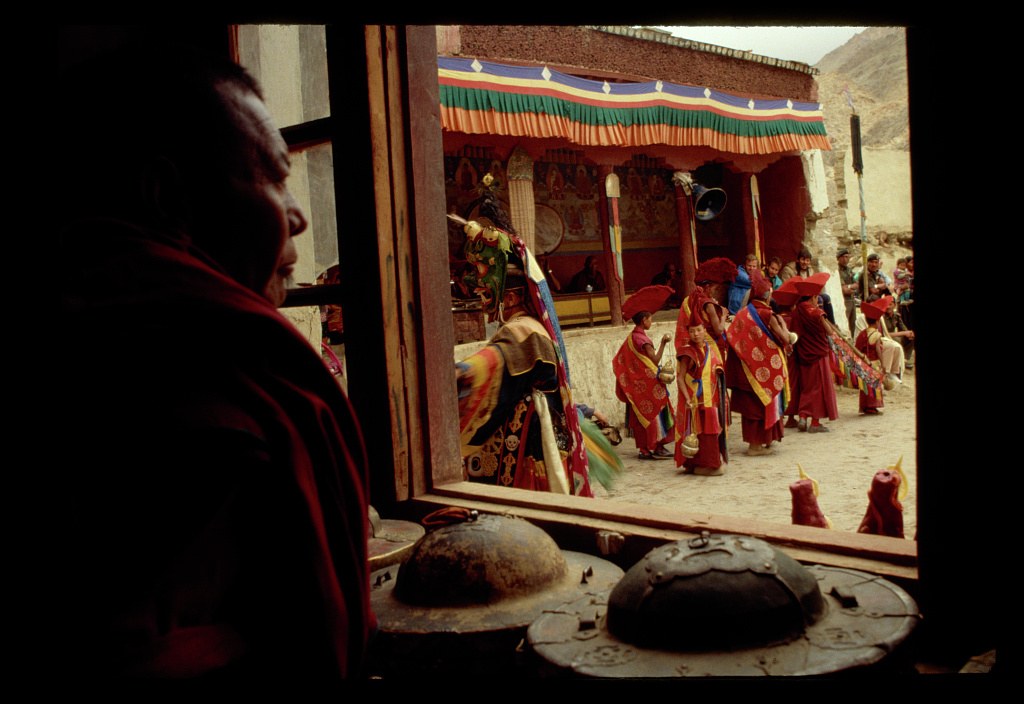
Cham dances are living rituals of Tibetan Buddhism, combining masked character performance with sacred music and communal participation. This photograph documents an authentic ceremonial context in Ladakh at a specific historical moment, showing how masked dance functions not as theatrical spectacle but as religious practice embedded in monastery, community, and landscape. For historians of Asian ritual performance and Himalayan culture, it is direct evidence of performance practice and participation patterns.
What you are looking at
A photograph taken from inside a darkened monastery or temple interior, looking out through an open window onto a sun-bright courtyard where a ceremonial dance procession unfolds. The window frame darkens the foreground, silhouetting two large brass or copper vessels (likely ritual objects) on the sill. Beyond, in brilliant daylight, rows of Buddhist monks in deep red and maroon robes stand in formation, facing a raised platform or stage draped with ornate textiles—a striped canopy in orange, green, and blue with decorative white fringe. The platform contains seated figures and what appears to be religious iconography. The landscape beyond the courtyard shows dry, rocky mountains characteristic of high-altitude terrain. The composition creates a stark tonal and spatial contrast: the cool, shadowed interior foreground and the warm, exposed ceremonial gathering outside, suggesting the viewer is a privileged witness to a sacred event.
The dancing
The dancers (or ritual participants) in the courtyard stand upright in loose ranks, their bodies oriented toward the central platform. From this distance and angle, individual footwork and arm positions are not clearly legible, but the overall posture suggests formal, processional standing rather than active movement through space. The monks' robes fall in heavy folds, obscuring the lower body. The gathering appears stationary or moving very slowly—a ceremonial assembly rather than an animated performance.
The dance depicted
This appears to document a Buddhist ritual ceremony in Ladakh, likely a sacred masked dance or festival gathering (such as a Cham dance festival). Cham dances are annual religious ceremonies performed by Tibetan and Ladakhi Buddhist monasteries, combining sacred ritual, masked performance, and community gathering. The image captures the assembled community and priesthood during a formal moment—possibly before or between performances, or during a procession. The formal dress, raised stage, religious iconography, and monastery setting are consistent with Cham tradition, though the distance and angle prevent identification of specific masked characters or movement vocabulary.
How it was made
This is a color photograph, most likely Kodachrome slide film or similar color transparency stock typical of 1988 documentation. The saturated colors, the way the bright daylight is rendered without blown highlights, and the color fidelity suggest professional or semi-professional color film stock. The photograph was taken from inside the monastery looking outward, framing the sacred space through an architectural threshold. The technical choice to shoot from interior shadow looking toward bright exterior creates compositional depth and suggests intentional documentary framing rather than casual snapshot.
About this work
This is a documentary photograph of a Ladakhi Buddhist ceremonial gathering, probably a Cham dance festival, captured in 1988. It records not the masked dances themselves but the ritual assembly and processional moment—the community, the monks, the sacred stage, and the mountain landscape that frames Ladakhi religious life. The photograph is valuable as evidence of how these ceremonies were performed and witnessed in the late 20th century, and of the integration of masked performance into monastic and community practice in the Ladakh region of Indian-administered Kashmir.
How to look at it
The photograph captures a threshold moment: the viewer, positioned inside the monastery, looks outward at the assembled ritual community. Notice the tonal contrast between the cool interior and the bright courtyard—this is not incidental but compositionally deliberate, emphasizing the sacred interior space from which the ceremony unfolds. Attend to the formal arrangement of the monks: their stillness and ordered spacing suggest ritual protocol rather than spontaneous gathering. The decorated platform and textile hangings indicate that performance moments will follow; this image documents the ceremonial preparation and assembly that frames the masked dances themselves.
The period
In 1988, Ladakh was undergoing rapid modernization while maintaining strong Buddhist monastic traditions. Cham festivals were—and remain—annual events central to Ladakhi religious and cultural life, combining elements from pre-Buddhist Himalayan shamanism with Tibetan Buddhist practice developed over centuries. The photograph documents this tradition at a moment when such practices were increasingly subject to external documentation and scrutiny by photographers, anthropologists, and tourists. Ladakh itself was opening to outside visitors during this period, making such photographs part of a broader archive of Himalayan culture.
Where it lives
This photograph is held in the Library of Congress Prints & Photographs collection, part of a broader documentation of world cultures and religious practices. It is catalogued as part of a series on Ladakh, suggesting it was part of intentional documentary work rather than an isolated image.
Dance in this work
Questions about this work
What is a Cham dance?
Cham is a masked ritual dance performed by Tibetan and Himalayan Buddhist monasteries, usually annually during religious festivals. Dancers wear elaborate masks representing Buddhist deities, protective spirits, and mythological characters, and perform elaborate choreography accompanied by sacred music and chanting. The dances are religious rituals believed to have protective and purifying power, not theatrical entertainments, though they are witnessed by the community.
Where is Ladakh and why does it matter for dance history?
Ladakh is a high-altitude region in the Himalayas, now part of the Union Territory of Ladakh in India. It has been a center of Tibetan Buddhism for over a thousand years, and its isolated position preserved monastic traditions and masked dance practices that developed differently from those in central Tibet. Ladakh's Cham dances are distinctive expressions of Himalayan Buddhist culture and are important evidence of how masked performance functioned in religious and social life.
What year was this taken and why does that matter?
The photograph was taken in 1988, a moment when Ladakh was becoming more accessible to outside documentation while its monastic traditions remained largely continuous. This date places the image at a specific point in the modernization and globalization of Himalayan regions, making it valuable evidence of how these traditions were practiced before digital photography, mass tourism, and contemporary cultural change.
More dance artwork





