49 works in this view — arrow keys or swipe to move between them.
Dance in Art
Ballerina
Unknown artist
- Collection:
- Prints & Photographs
- Source:
- Library of Congress
- Rights:
- Rights vary by item — check the source record before reusing this image. Source record ↗
- Recorded as:
- Library of Congress — no known restrictions (verify per item)
This photograph documents the visual language of classical ballet at a moment when the Romantic tutu had become standard theatrical wear, but before modern dance and experimental photography would begin to challenge the primacy of the formal portrait. For historians of dance photography and the commercialization of dance performance, it is evidence of how dancers' bodies were framed, lit, and presented to public audiences in the early 20th century.
What you are looking at
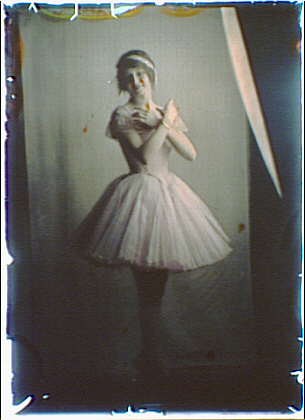
A single female dancer stands in a frontal pose against a plain, pale backdrop with soft directional lighting from the left. She wears a classical ballet costume: a fitted bodice with short puffed sleeves and a full skirt of graduated layers that extends to mid-calf, typical of mid-19th-century Romantic ballet. Her posture is upright and formal, with her arms held in a classical frame—the right arm extended to the side at shoulder height, the left arm lower and curved. Her head is tilted slightly, her gaze directed toward the viewer. The photograph captures a moment of stillness and composure rather than mid-movement, presenting the dancer as a studio portrait in full costume.
The dancing
The dancer displays the controlled, verticalized frame characteristic of classical ballet training. Her weight appears evenly distributed, her torso lifted, and her arms held in what appears to be a port de bras between positions—one raised, one lower. There is no evidence of elevation or the dynamic asymmetry of a mid-phrase moment; instead, the pose reads as a formal presentation of the costumed figure. The body is centered in the frame, frontal, and composed for direct address to the camera.
The dance depicted
This is a portrait of a classical ballet dancer in costume, almost certainly documented in a theatrical context. The silhouette and construction of the skirt—gathered tiers falling from a fitted waist—is consistent with the Romantic ballet silhouette that dominated European and American theatrical dance in the 1830s–1860s. The pose suggests either a moment of stillness within a choreographed solo or a formal costume study for documentation or publicity purposes. Without additional information on the dancer's identity or the work depicted, we cannot identify the specific role or ballet.
How it was made
This is a photograph on a light-sensitive paper or glass plate, likely a gelatin silver or albumen print given the date of 1906 and the soft tonal gradation visible. The lighting is carefully controlled studio photography, with a single light source creating gentle modeling on the figure and an even background. The photograph has been hand-tinted or colored—a common practice for theatrical and portrait photography of the period to restore the visual reality of stage costume. This technique allowed mass reproduction and distribution of images of celebrated dancers to theaters, audiences, and the public.
About this work
This is a studio portrait photograph of a classical ballet dancer, documented in costume during the early years of the 20th century. It belongs to a large genre of theatrical portraiture that emerged in the mid-19th century and flourished as photography became the dominant medium for capturing and circulating images of famous performers. The work represents both the technical sophistication of Edwardian photography and the commercial machinery of international theatrical celebrity that surrounded professional ballet by 1906.
The image is a valuable record of early-20th-century ballet costume and the presentation of the dancer as public figure. It offers insight into how companies and theaters documented their performers for advertising, archives, and souvenirs. The simplicity of the pose and the directness of the presentation reflect the conventions of professional theatrical portraiture rather than the choreographic documentation practices that would emerge later in the century.
How to look at it
Look at the stillness of the pose and the formal frontality of the address to the camera—this is not a moment stolen from choreography, but a deliberate presentation of the costumed dancer as a public figure. Notice the careful lighting on the fabrics of the costume, which gives form to the skirt's construction and volume. The clarity and detail visible in the photograph—the weave of the bodice, the individual layers of the skirt, the tilt of the head—reflect the technical sophistication of early-20th-century studio photography and the care taken to create a marketable image of a professional performer.
The period
In 1906, classical ballet was firmly established in the repertories of major European and American theaters, and the Romantic-era silhouette—tutu, pointe work, ethereal narrative—remained the dominant visual language of theatrical ballet. The Ballets Russes had not yet challenged European ballet conventions; that disruption would come in 1909. Photography had become the primary medium for documenting and promoting theatrical performers, and hand-colored studio portraits of dancers in costume were mass-produced for sale to audiences, theater archives, and international circulation. This was the golden age of the theatrical publicity photograph, before film and mass-media reproduction would change the economics and aesthetics of performer documentation.
Where it lives
The work is held in the Prints & Photographs collection of the Library of Congress and was sourced from their collections. It is catalogued as a photograph from 1906, though the specific photographer, dancer, and theatrical context are not recorded in the available metadata.
Dance in this work
Questions about this work
Is this a painting or a photograph?
This is a photograph, almost certainly an albumen or gelatin silver print with hand-coloring applied. The soft tonal gradations and the precise detail in the fabrics are characteristic of studio photography from this period. The hand-coloring was standard practice for theatrical photographs, which would otherwise have been in black and white.
What ballet is this dancer performing?
The photograph does not provide enough information to identify a specific ballet or role. The costume is consistent with the classical Romantic ballet silhouette that was standard in theaters across Europe and America in the 19th and early 20th centuries. Without a caption, signature, or other identifying marks, we cannot determine which work is represented.
Why is the dancer just standing still?
This is a formal costume portrait, not a documentation of choreography. Theatrical photographers of the period posed dancers in controlled studio settings to create marketable images of performers in their stage costumes. The stillness and formal pose are conventions of the portrait genre, designed to showcase the costume and the dancer's appearance rather than to capture movement.
What does the costume tell us about the date?
The silhouette—fitted bodice, short puffed sleeves, and full graduated skirt to mid-calf—is the classical Romantic ballet silhouette that emerged in the 1830s and remained standard throughout the 19th and into the early 20th century. The photograph is dated 1906, and nothing in the costume contradicts that date. The style would have been recognizable to audiences of that era as the conventional dress of a classical ballet dancer.
More dance artwork





