49 works in this view — arrow keys or swipe to move between them.
Dance in Art
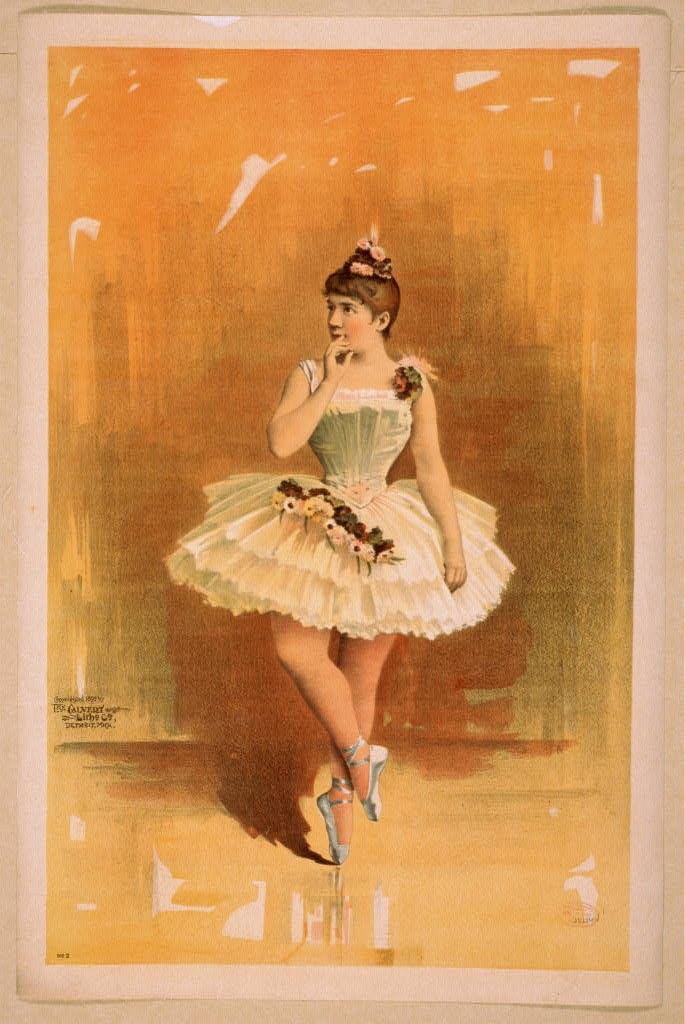
[Ballerina in white costume with flowers in dance pose]
Unknown artist
- Collection:
- Prints & Photographs
- Source:
- Library of Congress
- Rights:
- Rights vary by item — check the source record before reusing this image. Source record ↗
- Recorded as:
- Library of Congress — no known restrictions (verify per item)
This work captures the visual language and physical vocabulary of classical ballet at a moment of codification and international standardization—the late 19th century when academies across Europe were converging on a shared technique and aesthetic. For dancers and teachers, it is a primary historical record of how the classical form was actually understood and performed; for art historians and cultural historians, it reveals how women's bodies, movement, and artistic achievement were packaged and sold to a mass audience in the age of mechanical reproduction. The work exemplifies the visual culture of theater in the Gilded Age and shows how dance—an ephemeral art form—was captured, commodified, and circulated as a portable object.
What you are looking at
A young female dancer in a cream and pale green costume stands alone against a warm golden-ochre background. She poses in a classical ballet attitude, weight lifted on her right leg en pointe in a pale satin pointe shoe, the left leg bent and drawn up in a graceful line. Her tutu—a short, layered bell skirt in ivory silk with scalloped edges—is caught mid-movement, lifting away from her body. She wears a fitted corset bodice in soft green with a white chemisette front, and a small floral garland or corsage adorns her right shoulder. Her dark hair is pinned up in the fashion of the 1890s, and she gazes slightly over her shoulder with the refined composure expected of a prima ballerina of the era. The background is bare and atmospheric, rendered in warm washes that suggest stage lighting rather than a specific place. The entire composition is formatted as a vertical portrait poster, with a cream border containing the work.
The dancing
A single dancer occupies the frame. Her weight is fully transferred to her right leg, held in a controlled rise on pointe with excellent turnout from the hip. Her left leg bends at the knee and draws up behind her body in a classical attitude position—the foot raised but not passed, the knee turned out and slightly lower than the hip, creating the characteristic backward curve. Her torso remains upright and engaged, shoulders level and pulled back. Her right arm curves gently at her side; her left arm extends with a soft, rounded port de bras, the elbow slightly bent and the hand at approximately shoulder height. The position demonstrates strong technical control and the refined, contained style of classical academic ballet of the late 19th century.
The dance depicted
This is unambiguously a representation of classical Romantic or late Classical ballet as it was performed and taught in the 1890s. The pointe work, the tutu form, the attitude position, the turnout, and the overall aesthetic are all defining features of theatrical ballet at the end of the Victorian era, specifically what would be termed Romantic or Classical ballet depending on the precise choreographic context. The presence of the floral corsage and the graceful, ethereal quality of the pose align with the sentimental, female-centered aesthetics of Romantic ballet, though the technical clarity and the precision of the position itself reflect the rigorous Classical training that dominated European academies by the 1890s. This appears to be a studio or promotional image of a professional dancer, possibly a soloist or principal performer from a major European ballet company.
How it was made
This is a chromolithograph or color lithographic print, a commercially viable reproductive medium that was standard for theatrical promotion and popular cultural imagery in the 1890s. The soft, luminous quality of the background and the careful modulation of the skin tones and fabrics suggest the refined color register possible with multi-stone lithography. The technique allowed for the wide circulation of idealized images of celebrated performers, making this the visual equivalent of a theatrical poster or promotional card. The work's format as a vertical portrait suited both framing in a home and display in theater lobbies or artists' studios, indicating it was aimed at middle-class collectors and ballet enthusiasts as well as professionals.
About this work
This is a chromolithographic portrait of a classical ballet dancer from the 1890s, presenting a moment of controlled elegance captured in the most technically refined pose of the era's vocabulary. The image celebrates both the physical virtuosity of the performer—the pointed feet, the sustained turnout, the lifted carriage—and the ethereal aesthetic that Romantic and Classical ballet cultivated: the illusion of weightlessness, grace, and refinement. It is a document of how ballet was visually marketed and consumed at the end of the 19th century, when the art form had become a respectable and celebrated form of high culture across Europe, performed in prestigious opera houses and admired by audiences across the social spectrum. The poster-like format and the quality of the printing suggest this was a valued and collectible object, a way for admirers to own an image of their favorite performer or simply to possess a beautiful object celebrating the art form they loved.
How to look at it
Notice the precise position of the supporting leg and hip: the dancer's weight is not centered or static, but transferred fully onto the right leg in a risen position, with the foot articulated at the ankle and arch. The left leg's position is the key to reading the genre: it is not extended into the air (which would indicate an arabesque or développé), but bent and lifted behind in a contained, graceful backward curve—the attitude position, one of the vocabulary's cornerstone positions. Observe the relationship between the dancer's torso and her legs: her upper body is held upright and quiet, while her lower body does the expressive work. The artist has frozen a moment of balance and control that speaks to the dancer's technical ability and the demands of her training. The floral corsage and the soft, luminous rendering of the fabrics emphasize the femininity and delicacy that were central to how ballet was promoted and understood in this era.
The period
The 1890s were a period of technical refinement and international standardization in ballet. The Russian Imperial Ballet, under the direction of Marius Petipa, had become the dominant force in European ballet, and its vocabulary and aesthetic were being adopted by companies and academies across the continent. Simultaneously, the development of lithographic printing had created a booming market for theatrical imagery, promotional cards, and posters. Young women from the middle and upper-middle classes increasingly attended ballet as spectators and students, creating demand for idealized images of dancers. The aesthetic of the image—the emphasis on the tutu, the pointe shoe, the graceful port de bras, the refined facial expression—reflects the heavily feminized, sentimental vision of ballet that had emerged during the Romantic era (1830s–1840s) but was now being refreshed through a lens of technical virtuosity and academic precision.
Where it lives
This chromolithograph is held in the Prints & Photographs collection of the Library of Congress, a repository that holds hundreds of thousands of theatrical prints, posters, and promotional images from the 19th and early 20th centuries. It is a commercial print, one of many thousands produced in this era to commemorate performers and to serve as souvenirs for theater-goers.
Dance in this work
Questions about this work
What position is the dancer in?
The dancer is performing an attitude position: one leg is extended behind her, the knee bent, creating a graceful backward arc. The supporting leg is fully extended and turned out, with the foot rising onto the point of the toe in a pointe shoe. This is one of the fundamental positions in classical ballet vocabulary and was as central to the repertoire in the 1890s as it is today.
Is this a real person or an idealized image?
This is most likely a portrait of a real dancer—theatrical prints of this era were usually commissioned to commemorate specific performers—but the image is highly idealized. The lighting, the rendering of the fabrics, and the perfection of the pose are all products of the lithographic process and the artist's hand, not a direct reproduction of a photograph or life study.
What is the green garment underneath the tutu?
That is a fitted corset bodice, the upper part of a classical ballet costume. The white panel at the front is a chemisette, a decorative insert. Ballet costumes of this era consisted of separate pieces: the corset provided structure and support for the torso, while the tutu—the lightweight, layered skirt—was attached at the waist and provided freedom of movement for the legs and hips.
What is the floral thing on her shoulder?
That is a corsage or garland of flowers, typically made of silk or fresh flowers and pinned to the costume. In the 19th century, it was customary for audience members to present flowers to celebrated dancers after a performance, and dancers also wore floral ornaments as part of their formal costume, signaling elegance, femininity, and the 'civilized' context of the theatrical performance.
More dance artwork





