49 works in this view — arrow keys or swipe to move between them.
Dance in Art
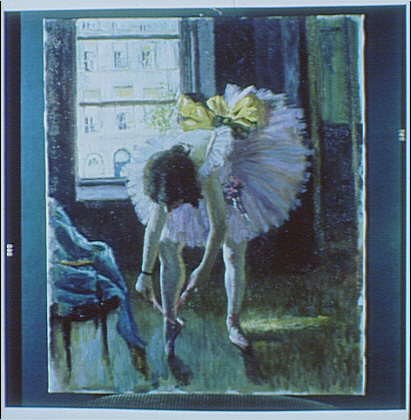
Photograph of a painting of a ballerina lacing her slippers
Unknown artist
- Collection:
- Prints & Photographs
- Source:
- Library of Congress
- Rights:
- Rights vary by item — check the source record before reusing this image. Source record ↗
- Recorded as:
- Library of Congress — no known restrictions (verify per item)
The image documents the material reality of ballet practice—the pointe shoe itself as a technological and physical foundation—in a period when ballet imagery typically focused on performance and the mythical ballerina. It also captures the gendered isolation and absorption that characterized early 20th-century ballet culture, showing the dancer alone with her craft rather than in the social frame of the stage.
What you are looking at
A young ballerina sits alone in a dimly lit interior, bending forward intently to lace her pointe shoes. She wears a pale tutu with a full skirt caught in graceful folds around her seated form, and her dark hair is pulled back. The setting appears to be a dressing room or studio corner: behind her, a window with panes of blue-grey light, and what may be a notice board or mirror on the wall. The lighting is cool and intimate, casting the dancer in a pool of attention while the background dissolves into shadow and architectural detail. The moment is one of preparation—the private, concentrated work before performance.
The dancing
The dancer's posture is bent forward at the waist in the attitude of securing her shoe, her back curved and her hands engaged in the practical work of lacing. Her legs are extended or folded beneath her as she sits. The body language is absorbed and purposeful rather than graceful: this is labor, not display. The single figure dominates the composition, isolated and self-contained, without the formal frame or partner hold of classical ballet in motion.
The dance depicted
This depicts a moment from theatrical ballet, specifically the backstage preparation of a ballerina. The pointe shoes—the white satin slippers with reinforced toe boxes—are the essential technology of classical ballet, and their lacing was (and is) a ritual of preparation essential to performance. The image shows not the dance itself but the dancer's private work before stepping onto stage. This is a Romantic or early 20th-century ballet aesthetic, when the ballerina's isolation and ethereal fragility were central to the art form's ideology.
How it was made
This is a photograph of a painting, evidenced by the visible brushwork, soft color blending, and the particular quality of light and shadow characteristic of painted rather than directly photographed imagery. The photographer has documented a canvas with cool-toned palette—blues, greys, creams—using a process that itself dates to the early 20th century. The grain and slight color distortion visible in the photograph indicate archival age and the limitations of early color or color-adjacent photographic reproduction.
About this work
This work captures a fleeting moment of private ritual that ballet audiences never see: the ballerina at her dressing table, securing the tools of her art. It belongs to a tradition of backstage or rehearsal imagery that emerged in the late 19th and early 20th centuries, when painters and photographers became fascinated by dancers' preparation and the theatre off-stage. The image romanticizes this moment of work, casting the solitary figure in cool, contemplative light—treating the practical act of lacing shoes as worthy of the same aesthetic attention as the performance itself. This reflects a broader cultural shift toward showing dancers as workers and artists, not merely as ethereal stage presences.
How to look at it
Attend to the way the artist has chosen the moment of practical work rather than virtuosity. The ballerina is not posed; she is absorbed in her task, and the composition honors that absorption. Notice the cool light from the window and the way it isolates the figure, making the act of preparation monumental. The painting's restraint—the limited palette, the spare setting—suggests that this is a moment worthy of contemplation in itself, not merely a prelude to performance.
The period
In the early 20th century, backstage and rehearsal scenes became a significant subject in European and American art. Painters including Degas, Toulouse-Lautrec, and others had pioneered interest in the ballet studio and dressing room as sites of artistic labor and beauty. By 1906, this genre was well established, and the image of the ballerina in intimate, preparatory moments—not in performance—conveyed authenticity and psychological depth. The cool, observational tone of this work reflects Symbolist and early Modernist aesthetics, where interior light and solitary figures carried emotional weight.
Where it lives
The work is held in the Prints & Photographs collection of the Library of Congress, indicating it entered an institutional archive as a photographic object—a reproduction or documentation rather than the original artwork. Its designation as a photograph of a painting suggests it was catalogued by its form as received rather than by its origin.
Dance in this work
Questions about this work
What are pointe shoes and why is she lacing them?
Pointe shoes are reinforced ballet slippers with a hard box at the toe that allows dancers to balance on the tips of their toes. Securing them with ribbons and laces is essential to safety and control. The lacing ritual was—and remains—a crucial part of ballet preparation, and the shoes themselves are one of the most recognizable symbols of classical ballet.
Why did artists paint ballerinas preparing rather than dancing?
Backstage and preparation scenes offered artists a chance to show dancers as workers and thinking beings, not just graceful stage illusions. These intimate moments also allowed for psychological depth and human vulnerability that formal performance poses could not convey. By the early 20th century, this 'real life' imagery had become as valued as depictions of the stage itself.
What period of ballet is this?
Based on the pointe shoe design, the tutu style, and the aesthetic approach, this is early 20th-century Romantic or transitional ballet—not the more heavily structured Classical or Modern forms that came later. The ballerina's solitary, introspective pose reflects Romantic ideals of the ethereal, isolated dancer.
More dance artwork





