49 works in this view — arrow keys or swipe to move between them.
Dance in Art
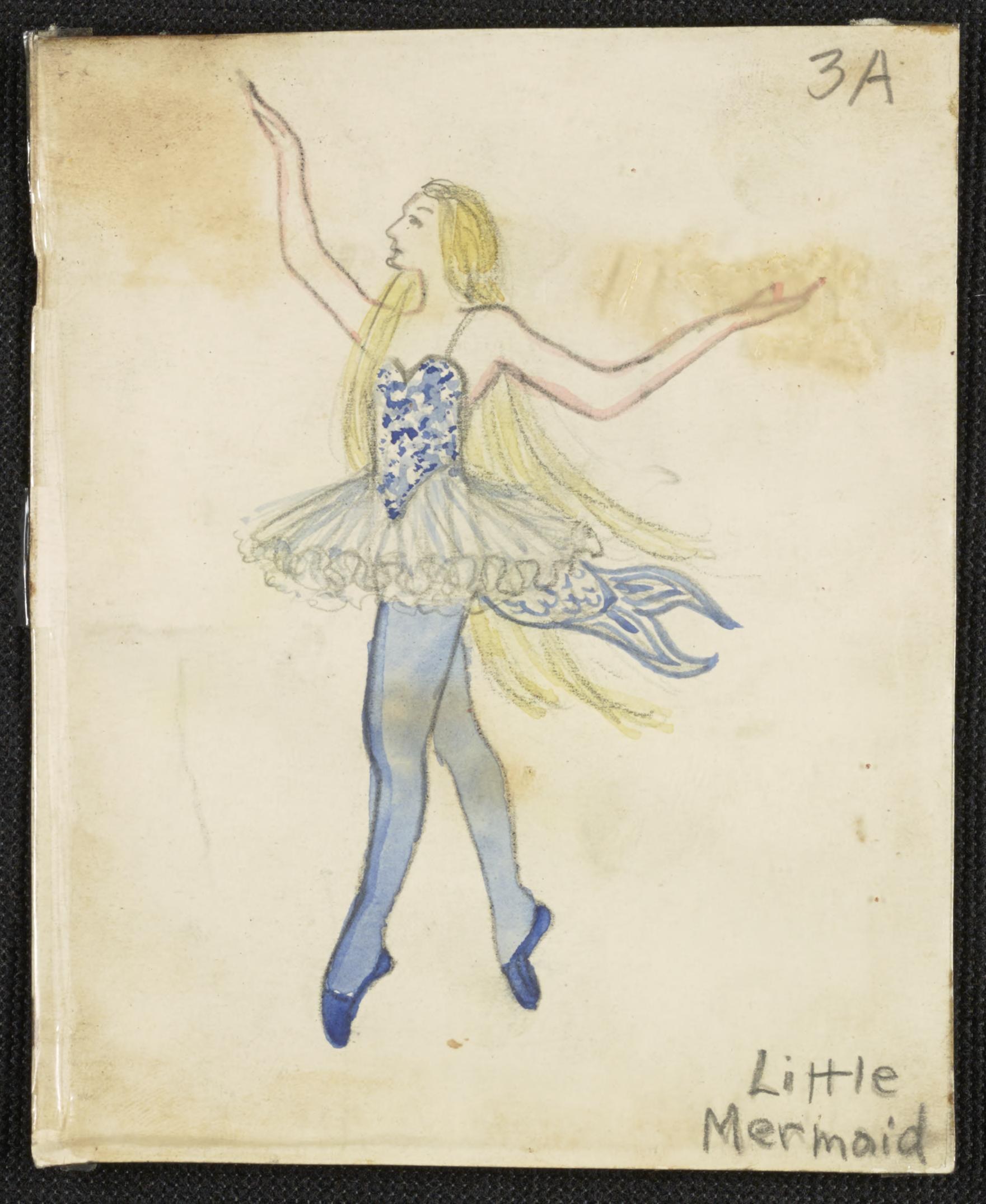
[The Little Mermaid: Little Mermaid blue ballerina costume with tail]
Unknown artist
- Collection:
- Prints & Photographs
- Source:
- Library of Congress
- Rights:
- Rights vary by item — check the source record before reusing this image. Source record ↗
- Recorded as:
- Library of Congress — no known restrictions (verify per item)
This sketch reveals the practical business of costume design for professional ballet at a moment when the medium was becoming increasingly visual and spectacular. It documents the classical ballet tradition's engagement with literary fantasy—a genre that shaped public taste and dancer training throughout the twentieth century. For anyone interested in how dance, theatre, and design intersect, it shows the designer's hand at work solving the problem of how to make a mermaid balletic.
What you are looking at
A single figure in mid-leap dominates the composition. The dancer, rendered in profile facing left, is captured at the apex of a jump with both feet well clear of the ground. She wears a short, ruffled tutu in pale cream or white with a fitted bodice patterned in deep cobalt blue. Her legs are extended in a gesture suggesting classical ballet movement, clad in blue tights and blue pointe shoes. Two pairs of large, delicate wings—patterned in blue and gold—extend from her shoulders and hips, establishing the fantastical marine identity. Her blonde hair is styled in a long braid, and one arm reaches upward in a graceful arc while the other extends outward. The figure is set against a plain, cream-colored background with subtle watercolor wash, creating an intimate study rather than a narrative scene. The inscription "Little Mermaid" appears at the lower right.
The dancing
The dancer displays the lifted, elongated line characteristic of classical ballet technique: her torso is upright, shoulders held back, and her extended legs show strong turnout. Her elevated arm position and the arc of her body suggest a moment of repose or suspension rather than dynamic movement. The pointe shoes indicate training in academic ballet vocabulary. The body weight appears properly centered and lifted, with no visible strain—the artist has understood the basic mechanics of balletic carriage.
The dance depicted
This is a ballet fantasy figure, most likely designed as a costume study or character design for a theatrical ballet adaptation of Hans Christian Andersen's *The Little Mermaid*. The hybrid costume—combining classical ballet dress with fantastical marine accessories—suggests a romantic or early twentieth-century theatrical interpretation in which mythological and literary characters were conventionally adapted into ballet form. The pointe shoes, tutu, and balletic posture confirm training in classical technique, while the wings and aquatic references signal the genre of fairy-tale or supernatural ballet popular in theatrical dance of this era.
How it was made
The work is a watercolor and pencil study on paper, likely a costume or character design sketch. The medium's translucency allows for delicate layering of color: the blue patterning on the bodice and wings shows careful detail work, while the body is rendered with light watercolor wash to create volume and form. The technique—economical but assured—is consistent with early twentieth-century theatrical design practice, where such studies served as working documents for seamstresses, set painters, and dancers preparing for production.
About this work
This is a costume design study for a ballet character, most likely created in the 1930s as preliminary material for a theatrical production. The work sits at the intersection of literary adaptation, costume practice, and classical ballet aesthetics: it documents how early twentieth-century dance transformed a Romantic narrative into visual form. The image shows both the technical knowledge expected of a designer and the cultural appetite for fairy-tale ballets that dominated theatrical dance between the wars. For dance historians, it is a primary document of how classical ballet vocabulary was applied to fantastic subjects, and of the design process behind theatrical dance production.
How to look at it
Look first at the moment the artist chose: not a dramatic leap or turn, but a moment of suspension—a pause. The dancer is held aloft, weightless, which is exactly right for a creature of the sea. Notice how the wings are integral to the design, not an afterthought; they balance the composition and suggest the hybridity the designer was working out. The color choices matter: the deep blue of the bodice and tights grounds the figure in an aquatic palette, while the pale tutu connects her to the classical ballet tradition. The pencil work is confident and economical—the artist was not uncertain about ballet anatomy.
The artist
The artist is not recorded in the catalogue. The style and execution suggest a trained theatrical designer working within professional dance production—someone with anatomical knowledge, familiarity with ballet costume conventions, and access to production systems. The assured line work and color sense indicate professional training, though the sketch's informal scale and paper format suggest it was a working document rather than a display piece.
The period
The 1930s saw a global boom in fairy-tale and literary ballets, driven by the success of Russian Imperial Ballet tradition and by the rise of national ballet companies seeking repertory. Ballets based on Andersen's tales were particularly popular; several *Little Mermaid* adaptations appeared in European dance houses during this decade. The costume style—the ruffled tutu, the precise pointe shoes, the Romantic-era silhouette—reflects early twentieth-century revival of Romantic ballet aesthetics, a trend that intensified after the 1909 Diaghilev season brought Russian Imperial technique to Western Europe. The watercolor technique was standard for theatrical design documentation of the period.
Where it lives
The work is held in the Prints & Photographs Collection of the Library of Congress, catalogued as item 3A. It is identified as a design study from 1934, suggesting it may have been part of a theatrical production archive or a designer's portfolio that entered the institution's collection.
Dance in this work
Questions about this work
Was there actually a ballet called *The Little Mermaid* in the 1930s?
Several stage and dance adaptations of Andersen's tale existed by this period, though the most famous is the 1948 Danish ballet choreographed for the Royal Danish Ballet. This 1934 sketch suggests at least one theatrical production was in development or performance during the 1930s, though the specific production has not been identified from the catalogue record alone.
Why does the costume combine a classical tutu with wings and a fish tail?
Early twentieth-century theatrical ballet used costume as the primary tool for narrative and character identification. Wings signaled the supernatural or magical; the tutu signaled ballet training and nobility of movement. The designer was solving a practical problem: how to make a creature of folklore look both balletic and fantastical within the visual language of the stage.
What can this tell us about how dancers were trained?
The sketch confirms that even in fantasy roles, classical ballet technique and the pointe shoe were non-negotiable. A dancer cast as the Little Mermaid was expected to move in the vocabulary of academic ballet—to turn out, to extend, to carry herself with the carriage of a trained ballet dancer. The supernatural elements were added through costume and staging, not through a change in fundamental technique.
More dance artwork





