49 works in this view — arrow keys or swipe to move between them.
Dance in Art
Fanny Elssler
Unknown artist
- Collection:
- Prints & Photographs
- Source:
- Library of Congress
- Rights:
- Rights vary by item — check the source record before reusing this image. Source record ↗
- Recorded as:
- Library of Congress — no known restrictions (verify per item)
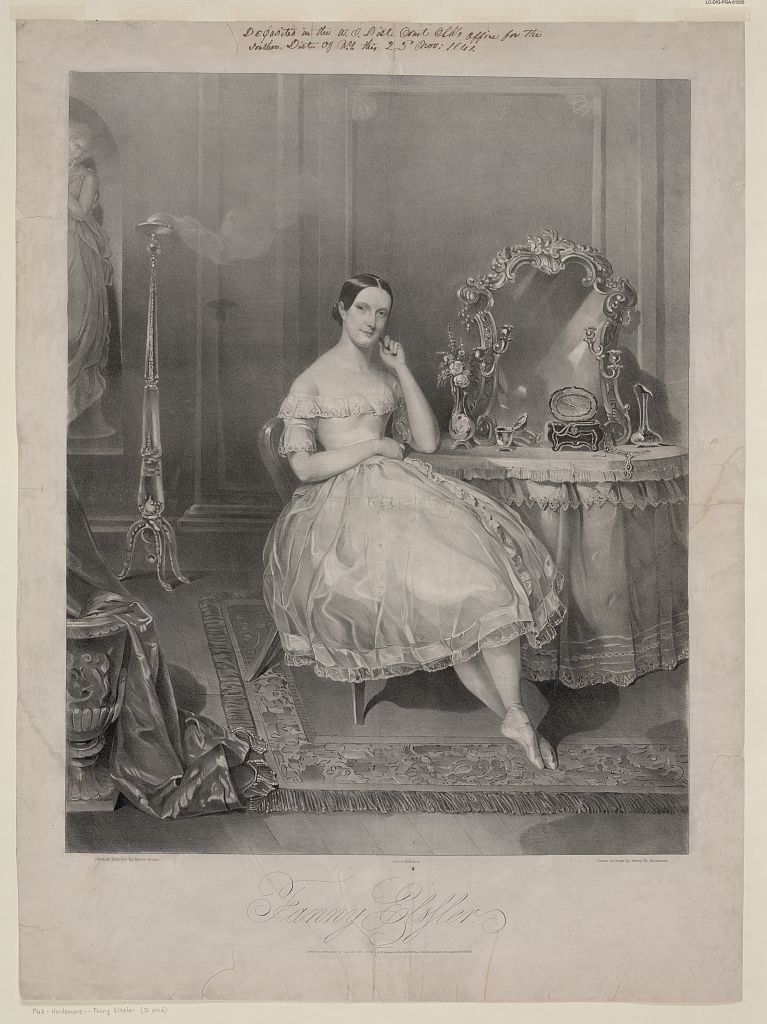
Fanny Elssler was one of the most influential dancers of the 19th century, and this portrait is a primary document of her celebrity and the conventions of representing professional female dancers during the Romantic period. The image shows how ballet dancers of this era were portrayed—not in action, but as refined, wealthy, and intimate figures—and how reproductive prints served as a major medium for disseminating the cult of the dancer to the public.
What you are looking at
A young woman in an elaborate white ball gown sits at a dressing table in a richly appointed interior, her posture and gaze suggesting a moment of intimate contemplation. She wears an off-shoulder dress with a deep ruffle at the hem, her dark hair arranged in the fashionable style of the 1840s. Before her stands an ornate mirror with elaborate carved frame, and the table holds various toiletries and accessories. To the left, a tall candlestick with a draped cloth is visible, while classical drapery and panelled walls suggest an aristocratic chamber. The lighting is soft and diffused, characteristic of the romantic aesthetic of the period. A statue or sculpture is faintly visible in the background, and the floor is richly carpeted. The overall mood is one of quiet elegance and preperformance preparation—the woman appears to be a dancer preparing for an evening.
The dancing
The figure is seated, leaning forward slightly with her right elbow resting on the table and her hand raised to her chin or ear in a pose of gentle reverie. Her left arm rests across her lap. The posture is graceful and composed, with the weight of her torso supported by the furniture rather than held in active balance. There is no dynamic movement visible; instead, the artist has captured a moment of stillness and introspection typical of Romantic-era portraiture. The costume—a professional dancer's ball gown—and the dressing-table setting establish her identity and role.
The dance depicted
This is a portrait of a professional dancer in her dressing room rather than a scene of dance itself. Fanny Elssler (1810–1884) was one of the most celebrated dancers of the Romantic era, known for her technical virtuosity and her prominent roles in narrative ballets. The image documents the material and social world of professional dance in the 1840s—specifically, the glamorous persona and refined presentation expected of a prima ballerina. The dressing table, mirror, luxurious dress, and carefully arranged hair all communicate status and professionalism. This is iconography of theatrical celebrity rather than documentation of choreography or movement.
How it was made
This is a steel engraving, a reproductive printmaking technique that allowed wide circulation of images in the 19th century. The medium is evident from the fine parallel lines creating tone and shadow, the crisp definition of detail, and the delicate handling of fabric texture. Steel engravings were labor-intensive but produced impressions of high quality and longevity; they were the premium format for disseminating portraits of celebrated performers to the paying public and a broader audience. This work would have circulated as a print to be collected, framed, or bound into albums—a form of fan merchandise and cultural documentation.
About this work
This is a portrait engraving of Fanny Elssler, the preeminent dancer of the Romantic ballet era, shown in her dressing room in a moment of private composure before performance. Rather than depicting dance itself, the work documents the professional identity and material luxury associated with being a prima ballerina in 1840s European high society. Elssler was celebrated for her interpretations of roles in ballets such as *La Sylphide* and *Giselle*, and her fame was such that her image was widely reproduced and circulated. This print is an artifact of the star system and the visual culture of Romantic ballet—evidence of how dancers of the era were marketed, consumed, and remembered by contemporaries.
How to look at it
Attend to the careful construction of the dressing room as a space of private luxury and professional preparation. The mirror is a key element—it is ornate, it reflects the dancer's image back to herself (and to us), and it is a tool of narcissistic self-regard central to the Romantic image of the prima ballerina. The pose of contemplation—hand to face, gaze inward—is not accidental; it conveys both the sensitivity and the self-absorption associated with the artistic temperament of the era. The rendering of the white fabric of the dress shows the engraver's skill and emphasizes the immaculate, ethereal quality Romantic aesthetics demanded of the female dancer.
The artist
The artist is not recorded in the catalogue. However, the engraving appears to have been produced by one of the skilled reproductive engravers working in Paris or London in the 1840s, likely based on a painting or drawing. The style and format are consistent with the commercial portrait-engraving industry of the period, which created prints after paintings of celebrities for mass distribution. Such prints were typically issued by publishing houses as loose sheets or in collected albums.
The period
The 1840s were the height of Romantic ballet, an era in which narrative, spectacle, and the cult of the prima ballerina dominated European dance. Dancers like Elssler, Marie Taglioni, and Carlotta Grisi achieved international celebrity status. The period saw the consolidation of ballet as an elite theatrical art form, with stars commanding high fees and their images widely reproduced in prints, lithographs, and later photographs. The Romantic aesthetic privileged the ethereal, the emotional, and the feminine—qualities that ballet was understood to embody. Visual representation of dancers became a major genre of both fine art and popular commercial culture.
Where it lives
This is a steel engraving held by the Library of Congress in its Prints & Photographs collection. The inscription at the top of the sheet references a salon date of 1841, suggesting the work was exhibited or published in that year. It is a reproductive print—a mass-market object designed to circulate widely.
Dance in this work
Questions about this work
Was Fanny Elssler a real person?
Yes. Fanny Elssler (1810–1884) was an Austrian dancer and one of the most celebrated prima ballerinas of the Romantic era. She performed throughout Europe and the Americas, and was known for her technical precision, dramatic ability, and star power. She was a rival of Marie Taglioni and took leading roles in the major ballets of the period, including *Giselle* and *La Sylphide*.
Is this engraving based on a painting or photograph?
Almost certainly a painting. The soft, intimate lighting and romantic composition suggest a portrait painting that was then reproduced as an engraving for mass circulation. Photography existed in 1841, but was still rare and technically crude; the style and technique of this work are consistent with the painted-and-engraved tradition.
What does the dressing table tell us about 19th-century dance?
The luxurious dressing room signals that ballet was an elite art form and that successful dancers were wealthy celebrities. The mirror, cosmetics, and jewelry document the material and aesthetic preparation required of a professional dancer. This was part of the public image: dancers were not just athletic performers, but refined, beautiful, fashionable women who embodied Romantic ideals.
Why don't we see her dancing?
Portrait engravings of celebrities typically showed the subject in a private, intimate moment rather than in performance. This emphasized their human personality and off-stage refinement. The context (dressing room, mirror, costume) makes clear that this is a dancer, but the pose conveys inner life and sensitivity—qualities Romantic aesthetics valued in artistic performers.
More dance artwork





