49 works in this view — arrow keys or swipe to move between them.
Dance in Art
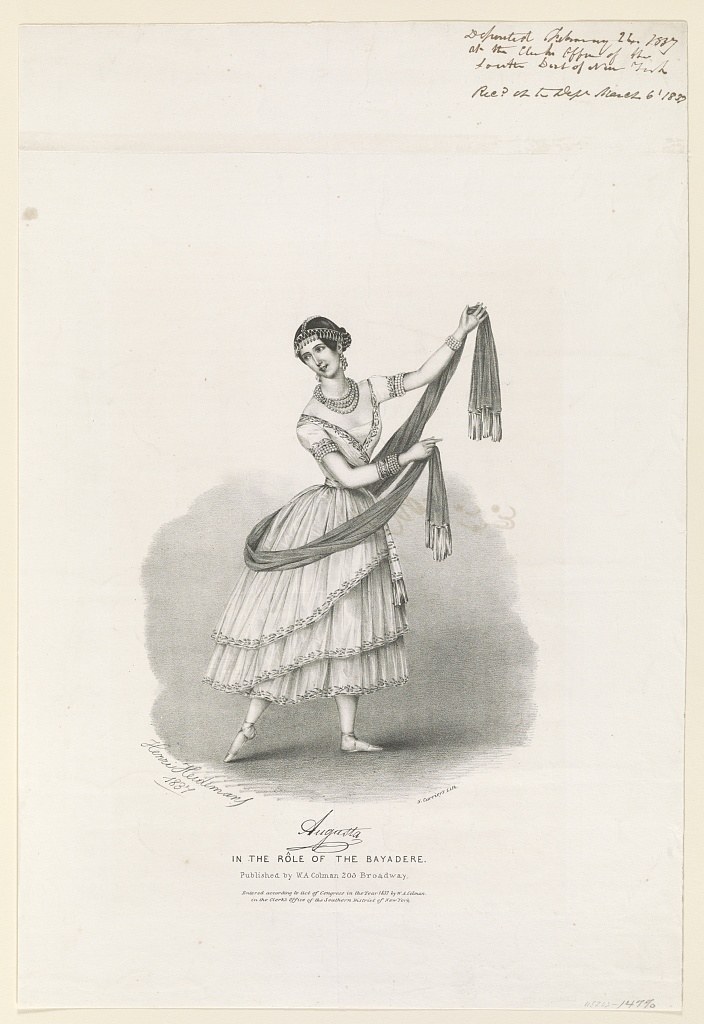
Augusta in the rôle of the Bayadere
Unknown artist
- Collection:
- Prints & Photographs
- Source:
- Library of Congress
- Rights:
- Rights vary by item — check the source record before reusing this image. Source record ↗
- Recorded as:
- Library of Congress — no known restrictions (verify per item)
The bayadère role was foundational to Romantic ballet's visual language and remained in the repertory for over a century; this print is evidence of how the role looked on stage and how it was marketed to audiences. It also documents the real person—Augusta—who embodied the type, bridging the gap between historical record and theatrical fantasy. For anyone studying 19th-century ballet aesthetics, Orientalism in performance, or the material culture of dance, this image is primary evidence.
What you are looking at
A woman in early 19th-century dress stands in a dramatic pose, her weight shifted to one leg with the other extended. She wears a high-waisted white muslin dress with a fitted bodice and elaborately layered skirt with deep flounces or scalloped hem decoration. A patterned shawl or scarf drapes diagonally across her body and extends from her raised arm, the fabric caught mid-gesture and flowing away from her frame. She wears a decorative headpiece and jeweled ornaments at the wrists and neck. The figure is rendered in classical engraving technique against a simple ground with soft shading that creates depth; the composition isolates her against a neutral background, focusing entirely on the body and costume.
The dancing
A single standing female dancer in a pose of dynamic asymmetry: one leg bears weight while the other is lifted or extended, creating a diagonal line through the body. The upper body is lifted and rotated, with one arm raised to shoulder height or above, holding and displaying the shawl. The pose suggests controlled balance and elongation rather than forceful motion—the body is extended but not rigid, the arm position elegant rather than dramatic. The gesture is presentational: the dancer displays herself and the fabric to an imagined audience.
The dance depicted
This depicts a bayadère, a French theatrical type that mimicked or fantasized about Indian temple dancers. The pose and costume belong to Romantic-era ballet spectacle, where bayadère roles required a synthesis of real or imagined South Asian movement vocabulary with European classical technique. The woman identified as "Augusta" is performing for an audience, not in a scene of dramatic action; the engraving captures the moment of display, which was central to the role. The shawl-work and the balance on one leg suggest vocabulary drawn from or claimed to derive from Indian dance, though filtered through European aesthetic conventions.
How it was made
This is an engraving, almost certainly a steel or copper engraving given the fine detail and the date. The artist has used crosshatching and parallel lines to create tone and volume, particularly visible in the shading around the figure and the folds of the dress. The precision of the line and the capacity to render intricate detail in the embroidered or patterned elements of the costume—the headpiece, the shawl design, the dress decoration—are hallmarks of fine engraving. The technique was ideal for circulation as a print: inexpensive to reproduce, portable, and shareable among the middle-class theatre audience and ballet enthusiasts of the period.
About this work
This is a theatrical portrait print, a common merchandise by-product of 19th-century ballet. It documents a specific performer—Augusta—in a specific role: the bayadère, a fantasy Oriental type that became a staple of European Romantic ballet. The print was published in 1837 (or shortly after, given the handwritten inscription at top) by W.A. Colman, a Broadway publisher, suggesting this was tied to a performance in New York. The image serves as a record of how the bayadère was imagined, dressed, and performed for an American audience: not as ethnographic document but as theatrical spectacle. It belongs in a dance gallery because it reveals the visual and gestural vocabulary of a major 19th-century theatrical type, and because it shows how that type was commodified and circulated.
How to look at it
Attend to the pose: the one-legged balance and the diagonal extension of the supporting arm are the keynotes of the role's visual identity. Watch how the fabric of the shawl is made central—it is not incidental ornament but a tool that the dancer uses to create line and visual effect. Note the precision of the costume detail: the headdress, the pattern of the shawl, the flounces of the skirt. All of this is what an audience would have seen from the house, rendered here with the clarity of a printed image designed to preserve and reproduce the dancer's appearance. The simplicity of the background focuses the eye entirely on the body and its presentation.
The artist
The artist is not recorded. W.A. Colman was the publisher and is listed at 300 Broadway, New York. The engraving style and subject matter are consistent with commercial theatrical print production of the 1830s–1840s, a trade in which dozens of anonymous engravers produced portraits of celebrated performers. The handwritten inscription at the top of the sheet suggests this copy was retained or annotated by someone close to the production or the performer.
The period
The 1830s was the height of French Romantic ballet, a period in which European audiences were fascinated by exoticized representations of the Orient. The bayadère became a stock type in this era, appearing in major ballets and in the repertories of celebrated European dancers who toured the United States. The role synthesized European ballet vocabulary with fantasized Indian movement, creating a spectacle of lightness, balance, and ornament. Simultaneously, prints of famous dancers were booming as a commercial product: performers' images were sold to theatre-goers and collectors, creating a secondary market that subsidized ballet companies and made dancers into celebrities.
Where it lives
This print is held in the Prints & Photographs collection at the Library of Congress. The handwritten annotation at the top indicates it was dated in the hand of someone connected to the work: "St. Augustine, Florida 24th 1837 / at the St. Augustine Lyceum for one night / South Buffington Fla." This suggests the print documents a specific performance and may have been annotated by someone who witnessed it or was involved in its promotion.
Dance in this work
Questions about this work
What is a bayadère?
A bayadère was a theatrical type in 19th-century European ballet that represented an imagined or fantasized version of an Indian temple dancer. The role combined European classical ballet technique with costume and gestures claimed to be Oriental in origin. Bayadère roles became especially popular in the Romantic era and remained in the ballet repertory for over a century.
Who was Augusta?
The print identifies her only as "Augusta in the rôle of the Bayadère." Without additional records, it is difficult to identify her further. The handwritten inscription suggests she performed this role in Florida in 1837, but her full name and career details are not recorded in the print itself.
Why was shawl-work so important in the bayadère role?
The shawl allowed the dancer to create line, gesture, and visual design independent of the body. It extended the reach of the pose, added volume and movement to moments of stillness, and provided a tool for displaying the costume. The shawl-work was part of what made the bayadère visually distinctive and gave the dancer opportunity for ornamental display.
What do the handwritten notes at the top mean?
The annotations indicate when and where this performance took place: St. Augustine, Florida in 1837. The notes suggest this print was retained as a record of a specific performance, possibly by someone involved in the production or interested in documenting the dancer's appearances.
More dance artwork





