49 works in this view — arrow keys or swipe to move between them.
Dance in Art
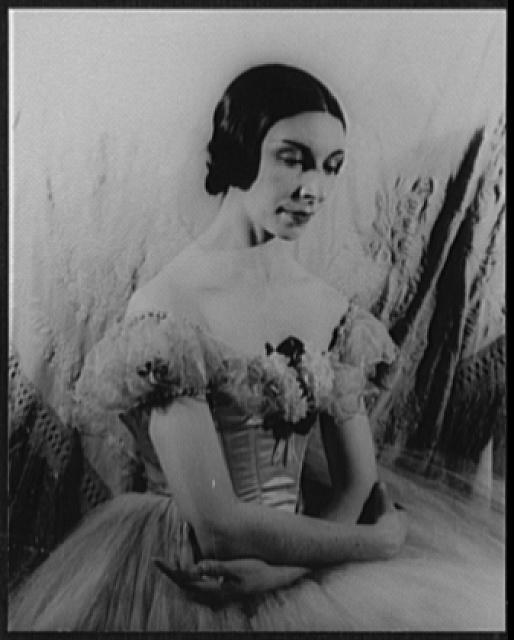
[Portrait of Alicia Markova, "Foyer de Danse"]
Unknown artist
- Collection:
- Prints & Photographs
- Source:
- Library of Congress
- Rights:
- Rights vary by item — check the source record before reusing this image. Source record ↗
- Recorded as:
- Library of Congress — no known restrictions (verify per item)
Alicia Markova was a bridge figure between the Ballets Russes era and the establishment of classical ballet as an American and British institution. This portrait is a record of how one of the twentieth century's most influential dancers presented herself professionally—the image around which her international reputation was built.
What you are looking at
A young woman in classical ballet costume poses three-quarter to the camera in what appears to be a studio or portrait setting. She wears a fitted bodice with short puffed sleeves edged in lace or tulle, and a full tulle skirt in the Romantic ballet style, positioned at approximately mid-calf length. Her dark hair is styled close to her head in the 1940s manner, with waves pinned at the sides. The photograph is taken against a plain, light backdrop with subtle draped fabric visible at the edges. The lighting is soft and diffused, characteristic of studio portraiture of the period. The dancer stands in a composed, frontal pose with her weight evenly distributed, her arms relaxed at her sides with hands visible, suggesting a moment of repose rather than active movement. The overall effect is one of classical elegance and formality, befitting a professional portrait of a leading dancer.
The dancing
A single female dancer fills most of the frame, positioned nearly centrally and facing the camera in a relaxed stance. Her posture is upright with shoulders back, the carriage of a trained classical dancer. Her arms hang naturally, hands visible and unclasped. The tulle skirt falls in a full bell shape from the waist, characteristic of Romantic ballet costume. Her weight appears evenly balanced, the pose neither static nor caught mid-movement—this is portraiture rather than action documentation.
The dance depicted
This is a portrait of a classical ballet dancer in full costume, almost certainly posed for a publicity photograph rather than a documentation of a performance moment. The tulle skirt, fitted bodice, and short sleeves are consistent with Romantic-era ballet vocabulary and the theatrical presentations of mid-twentieth century ballet. No specific choreography or movement can be identified from the pose; this is instead a formal presentation of a dancer as a professional performer. The catalogue identifies the subject as Alicia Markova, one of the most celebrated English ballerinas of the mid-twentieth century.
How it was made
This is a gelatin silver print, the standard photographic medium for studio portraiture from the 1920s onward. The soft focus and flattering lighting indicate professional studio work, likely made with large-format equipment and deliberate studio lighting setup. The tonal range and texture are consistent with prints from the 1930s–1940s. Such photographs served as publicity materials for dancers, circulated to press, theaters, and the public to establish and maintain a dancer's professional image.
About this work
This is a professional studio portrait of a classical ballet dancer in Romantic-era costume, identified as Alicia Markova, a principal dancer with major twentieth-century ballet companies. The photograph documents not a moment of choreography but rather a dancer's professional presentation—her costume, carriage, and formal bearing as a celebrated performer. Such portraits were essential tools of a dancer's public identity and career, particularly for principals who commanded international attention.
Markova was a foundational figure in twentieth-century ballet history: a principal dancer with the Ballets Russes, co-founder of Ballet Theatre (later American Ballet Theatre), and a key figure in establishing classical ballet in Britain and America. This portrait, dated 1940, coincides with a pivotal moment in her career during the early years of Ballet Theatre. It belongs in a gallery of dance imagery because it documents not just a costume or a moment, but the professional presentation through which a major historical figure claimed authority and presence.
How to look at it
Study the costume details: the fitted bodice and short puffed sleeves represent the Romantic ballet tradition, not contemporary 1940s fashion. Note the dancer's bearing and carriage—the straight spine, lifted sternum, and relaxed arms all communicate the physical discipline of classical training. This is a portrait made in the service of publicity and identity: observe how the photographer has positioned Markova to display both the costume and her own composed authority, her gaze steady and direct. The soft studio lighting and neutral background direct all attention to the dancer's form and presence.
The artist
The photographer is not recorded in the catalogue. Professional studio portraiture of leading dancers in the 1930s–1940s was produced by established theatrical photographers whose names often went unrecorded in archival systems. The quality and style of this print suggest a major theatrical photography studio, likely in London or New York where Markova was based during this period.
The period
In 1940, classical ballet was in the midst of a profound geographic and institutional shift. The Ballets Russes, which had dominated European ballet since 1909, was fragmenting under wartime conditions. Simultaneously, American and British ballet companies were establishing themselves as major cultural forces. Markova, having danced with the Ballets Russes under Diaghilev, was instrumental in this transition—she co-founded Ballet Theatre in 1940, the same year this portrait was likely made. The photograph documents a moment when classical ballet was being repositioned as a permanent, institutionalized art form rather than the exotic spectacle it had been under Diaghilev.
Where it lives
The print is held in the Prints & Photographs Online Catalog of the Library of Congress, a major repository of twentieth-century American cultural documentation. It was catalogued under the title 'Portrait of Alicia Markova, Foyer de Danse,' a subtitle possibly indicating the context in which the image was created or circulated, though this remains unclear from the record.
Dance in this work
Questions about this work
Who was Alicia Markova?
Alicia Markova (1910–2004) was a British classical ballet dancer and one of the most celebrated prima ballerinas of the twentieth century. She began her career with the Ballets Russes under Sergei Diaghilev, where she worked with choreographers including George Balanchine and Frederick Ashton. In 1940, she co-founded Ballet Theatre (later American Ballet Theatre) with Richard Pleasant, establishing herself as a key figure in bringing classical ballet to American audiences. She was also instrumental in founding and leading the Markova-Dolin Ballet and the London Festival Ballet.
What does 'Foyer de Danse' mean?
'Foyer de Danse' is French for 'dance foyer' or 'dance lobby'—a term historically used in ballet companies to refer to the social and rehearsal spaces where dancers gathered. The catalogue lists this as a subtitle, but its exact significance to this particular portrait is not clear from the archival record. It may indicate the context in which the photograph was commissioned, or it may be a traditional title for a certain type of dancer portrait.
What is the style of ballet costume shown here?
The costume is a Romantic ballet tutu—a full skirt of tulle, typically reaching mid-calf, paired with a fitted bodice and short sleeves. This style originated in the 1830s and 1840s with ballets such as La Sylphide and Giselle. Although Markova danced in twentieth-century works, this costume references that historical tradition, allowing her to perform roles in the Romantic repertory that remained central to ballet training and performance.
Was this photograph taken during a performance?
No. This is a studio portrait made for publicity and professional purposes. The neutral background, formal lighting, composed pose, and the fact that Markova is standing still rather than caught mid-movement all indicate this was a deliberate studio session. Such photographs were essential to a dancer's career: they circulated to the press, were used in programs, and established the public image of major performers.
More dance artwork





