49 works in this view — arrow keys or swipe to move between them.
Dance in Art
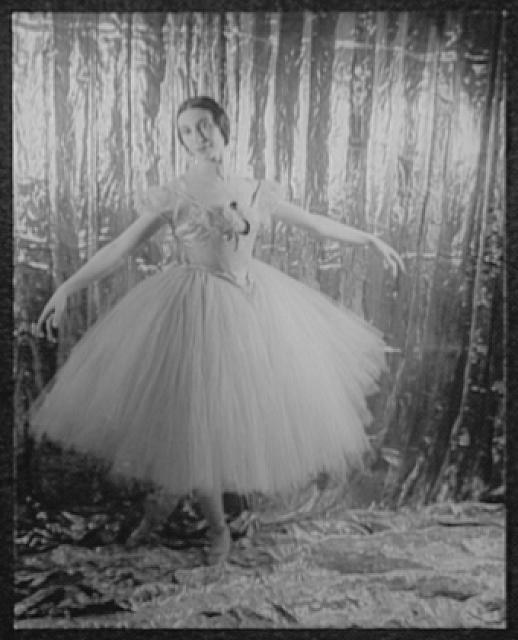
[Portrait of Alicia Markova, "Foyer de Danse"]
Unknown artist
- Collection:
- Prints & Photographs
- Source:
- Library of Congress
- Rights:
- Rights vary by item — check the source record before reusing this image. Source record ↗
- Recorded as:
- Library of Congress — no known restrictions (verify per item)
Markova was a towering figure in twentieth-century ballet, a founder of British classical ballet and a bridge between the Diaghilev era and postwar institutional ballet. This photograph documents her in her prime and captures the visual language through which classical ballet was promoted and understood in her era. It shows how the ballet world used photography as a tool of star-making and repertory documentation.
What you are looking at
A young woman in a full classical ballet tutu stands centered against a backdrop of vertical drapery suggesting a stage set. She wears a fitted bodice with short sleeves and a voluminous skirt of tulle or similar diaphanous fabric that extends to mid-calf, typical of mid-twentieth-century ballet practice dress. Her hair is styled in a neat chignon. The photograph is a formal studio portrait taken in black and white, with overhead lighting that casts gentle shadows and emphasizes the sculptural quality of the costume. The setting and pose suggest this is a professional documentation of a principal dancer, likely taken during or shortly after a performance.
The dancing
The dancer stands in an upright, formal pose with her arms extended to the sides at approximately shoulder height, elbows slightly bent, hands delicate and refined. Her weight appears centered and balanced, her torso erect. The pose is controlled and dignified rather than dynamic—a presentation stance rather than a moment caught mid-movement. Her legs are straight and aligned, feet positioned in what appears to be a neutral or closed position. The overall frame is symmetric and frontal, emphasizing the silhouette of the costume rather than the articulation of the body in motion.
The dance depicted
This is a portrait of a classical ballet dancer, almost certainly taken in the context of professional theater practice. The tutu, pointe-work readiness, and formal presentation all confirm training in classical ballet technique. The photograph documents a dancer of rank, posed in the tradition of theatrical portraiture common in early-to-mid twentieth century ballet. The catalogue identifies this as Alicia Markova, one of the most celebrated ballerinas of her era, and the title references the foyer de danse (rehearsal room), suggesting this may be documentation from a backstage or studio setting rather than mid-performance.
How it was made
This is a black-and-white photograph, likely a gelatin silver print, of professional studio quality. The technical control—sharp focus, careful lighting, formal composition—indicates professional photographic practice, possibly by a theater photographer or dance publicist. Photographs of this type were widely circulated to promote dancers and performances, reproduced in programs, press materials, and collected by fans. The medium's indexical quality—its direct capture of the subject before the lens—made it ideal for theater documentation and star publicity.
About this work
This is a formal studio portrait of a classical ballet dancer in full costume, almost certainly taken between performances or during a rehearsal period. The photograph documents the aesthetic of early-to-mid twentieth-century theatrical ballet: the precise silhouette of the tutu, the refined carriage, the controlled presentation of the dancer as both artist and visual spectacle. It belongs in a gallery of dance in art as both a record of how ballet was presented to audiences and a study in the conventions of dance portraiture—the moment chosen is not one of virtuosity or narrative drama, but of composed presence and costume display.
How to look at it
Look at how the tutu frames the body: the full horizontal bell of the skirt emphasizes the length of the torso and the erectness of the spine. Notice the formal frontality of the pose—the dancer does not turn away, lower the gaze, or suggest narrative drama, but instead presents herself directly to the camera as a figure to be admired. The vertical drapery behind her reads almost as architecture, stabilizing the composition and emphasizing the dancer's vertical axis. The photograph is not interested in the moment of movement, but in the codified visual presentation of classical ballet as a formal, composed art.
The artist
The photographer is not recorded in the catalogue. Given the professional quality and the subject matter, this is almost certainly the work of a theater photographer or studio photographer working in London's West End or Ballet Theatre circles in the 1940s. The style and technique are consistent with British dance photography of the period, when stars were routinely documented in publicity portraits for program covers, press releases, and fan circulation.
The period
In 1940, classical ballet in Britain and America was entering a period of institutional consolidation. Alicia Markova had recently departed from the Ballets Russes and was helping to establish classical ballet as a permanent part of British cultural life. The photograph dates to a moment when ballet was shifting from a continental European luxury to a transatlantic repertory tradition with permanent companies, published histories, and systematic training. Photographs like this one were central to that project: they circulated the image of the ballerina to audiences who might never see a live performance, and they documented the costume and aesthetic of the classical repertory for posterity.
Where it lives
This print is held in the Prints & Photographs collection at the Library of Congress. It is one of many theatrical photographs in the collection documenting American and British dance in the mid-twentieth century.
Dance in this work
Questions about this work
Is this a costume from a specific ballet?
The tutu and bodice are consistent with classical ballet conventions of the 1930s and 1940s but are not obviously a costume from a named role. This appears to be a formal portrait in dress appropriate to Markova's status as a classical ballet principal, rather than documentation of a specific performance.
Why are there curtains behind the dancer?
These are a studio backdrop, a standard feature of formal theatrical portraiture. The vertical drapes create a neutral, formal setting that does not distract from the dancer and costume, and they echo the drapery of theater itself—a fitting context for presenting a stage artist.
What is a 'foyer de danse'?
The foyer de danse is the rehearsal room and dancers' warm-up area in a ballet theater—a semipublic backstage space where dancers prepare before performance. The title suggests this photograph may have been taken in or near such a space, though the formal studio setting of the actual image suggests it was posed later.
More dance artwork





