49 works in this view — arrow keys or swipe to move between them.
Dance in Art
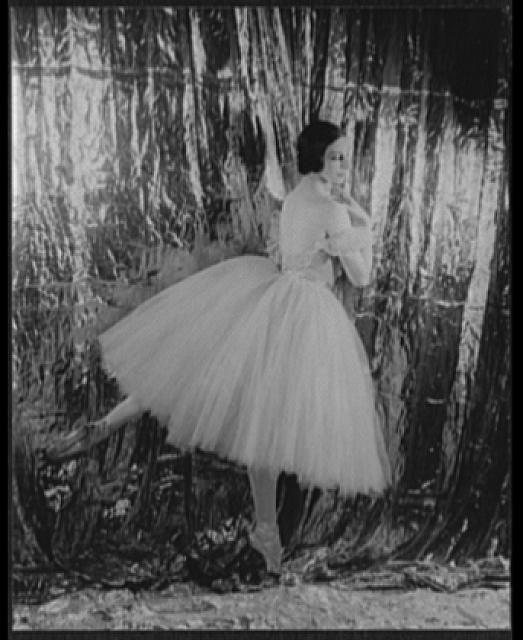
[Portrait of Alicia Markova, "Foyer de Danse"]
Unknown artist
- Collection:
- Prints & Photographs
- Source:
- Library of Congress
- Rights:
- Rights vary by item — check the source record before reusing this image. Source record ↗
- Recorded as:
- Library of Congress — no known restrictions (verify per item)
This photograph documents Alicia Markova, one of the most influential ballet dancers of the twentieth century, at a moment when she was reshaping the Classical and Romantic repertory. The informal setting and documentary style offer dancers and historians a rare view of the professional ballet world in the 1930s–1940s, capturing not the idealised moment of performance but the body, posture, and training of a major artist in her working environment. For students of twentieth-century ballet, this image is part of the visual record of how Romantic technique was embodied and transmitted.
What you are looking at
A solo female dancer photographed from behind stands in a narrow interior passage or corridor lined with draped fabric—likely a theatrical dressing room or backstage space. Her body faces away from the camera, turned slightly to one side. She wears a short classical ballet tutu in white or pale silk, fitted at the bodice with short sleeves, and her dark hair is pinned up. The dancer's posture is upright but relaxed, her weight settled on one leg, the other leg extended or held in readiness. The passage behind and around her is hung densely with what appears to be stage curtains, fabrics, and theatrical drapery, creating a sense of depth receding into shadow. The lighting is theatrical and dramatic, with bright areas contrasting sharply against deep blacks, characteristic of studio or backstage photography. The photograph captures an intimate, informal moment—not a staged pose but an observation of the dancer in the working theatre space.
The dancing
The dancer stands in a relaxed classical posture with one foot forward and the opposite hip dropped slightly—a natural alignment familiar to ballet training. Her arms are held with the elbows bent and forward, the right arm more prominent, suggesting either a position between movements or a moment of stillness in the theatre. Her upper back is straight, her head held in profile, and her gaze directed downward or into the space. There is no visible tension; the photograph captures the body in repose rather than in active dance. The scale of the figure relative to the corridor suggests a solitary moment, not a partnered or group composition.
The dance depicted
This is a photograph of a classical ballet dancer, likely in the Romantic or early twentieth-century tradition, identifiable from the short tutu, fitted bodice, and pointe-ready stance. The setting—a backstage or dressing-room space—is not the stage itself, so this captures the dancer in a moment between rehearsal or performance, a documentary observation rather than a record of a specific choreographic moment. If this is indeed Alicia Markova, as the title suggests, it documents her in the professional ballet world of the 1930s–1940s, a period when she was one of the leading classical dancers of her era. The informal nature of the photograph—not a formal studio portrait—suggests it may be from a theatre company's archival or press documentation.
How it was made
This is a black-and-white photograph, likely taken with available theatre lighting or a single studio light source. The high contrast, sharp focus on the dancer's form, and soft gradation into darkness suggest professional studio or theatrical documentary photography rather than an amateur snapshot. The technique allows the photographer to capture texture in the fabrics and definition in the dancer's musculature and posture with clarity. The composition and lighting strategy imply this was made for circulation—as a press or archival photograph—rather than as a personal document, consistent with its current holding in the Library of Congress Prints & Photographs collection.
About this work
This is a backstage photograph of a classical ballet dancer, titled as a portrait of Alicia Markova, made around 1940. It captures not a moment of performance but a quieter instant in the working theatre: a solitary figure in tutu and pointe-ready posture, framed by the theatrical drapery and lighting of the dressing-room or backstage space. The image sits at the intersection of dance history and theatre documentation, recording both a dancer's form and the material world of mid-twentieth-century professional ballet. Markova was a foundational figure in British ballet and a pioneer of the Romantic repertory revival; this photograph preserves her professional presence during a crucial period in her career.
How to look at it
Notice the dancer's posture and the weight distribution in her legs—the classical alignment is visible even in stillness. Observe how the theatrical drapery frames her figure and how the photographer has used light and shadow to isolate the dancer from the jumbled backstage environment. The slightly lowered gaze and relaxed arm position suggest a moment of interiority, not performance; this is an image of the dancer attending to herself in the working theatre. The choice to photograph from behind, showing the back and the profile, emphasizes the line of the spine and the disciplined carriage of the body, core values in Classical ballet training.
The artist
The photographer is not recorded. The image is held by the Library of Congress, suggesting it was likely made for press or archival purposes by a professional theatre or dance photographer of the era, possibly working for a ballet company or as a freelance documenter of the London or American ballet world.
The period
In 1940, Alicia Markova was at the height of her influence in Classical and Romantic ballet. She had danced with the Vic-Wells Ballet (later the Royal Ballet) and was a leading advocate for the revival of full-length Romantic works—especially Giselle and La Sylphide—in twentieth-century repertory. This period saw the consolidation of Cecchetti-influenced technical training across British ballet and the elevation of the Romantic tradition as a touchstone of Classical ballet identity. Backstage and documentary photography of dancers was becoming more commonplace in theatre publicity and archival practice, reflecting growing public and institutional interest in ballet as a modern art form.
Where it lives
This photograph is held by the Library of Congress Prints & Photographs Online Catalog. It is part of the institutional archive documenting twentieth-century theatre and dance, likely acquired as a press photograph or company documentation at or near the time of creation. No photographer is credited in the catalogue record.
Dance in this work
Questions about this work
Is this really Alicia Markova?
The catalogue record attributes it to Markova, but the photographer is unrecorded and no date is confirmed beyond circa 1940. The costume, posture, and technical training visible in the image are consistent with Markova's era and training, but the identification rests on the archive's attribution. You should treat it as a professional ballet photograph from the mid-twentieth century, attributed to Markova, without independent confirmation of either the sitter or the photographer.
What is the setting?
This appears to be a backstage or dressing-room space, hung with theatrical drapery and curtains. It is not a stage, studio, or outdoor setting, but the working theatrical environment. The dramatic lighting and composition suggest the photographer deliberately chose this location to create an artistic document of the dancer in her professional world.
Why photograph a dancer from behind?
Photographing from behind emphasizes the line of the spine and the carriage of the upper back—foundational in Classical and Romantic ballet training. It also creates a sense of interiority and observation rather than display. This compositional choice was common in dance photography of the era, particularly in documentary or archival work.
What kind of ballet is this dancer trained in?
The short tutu, fitted bodice, and posture indicate training in the Classical ballet tradition, likely incorporating Cecchetti or Vaganova methods. If this is Markova, she was known for her mastery of the Romantic repertory and her advocacy for the full-length classical ballets—Giselle, Swan Lake, and others.
More dance artwork





