49 works in this view — arrow keys or swipe to move between them.
Dance in Art
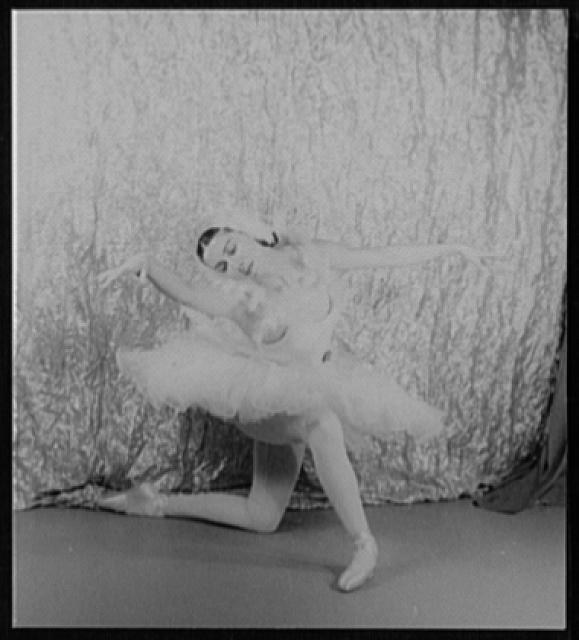
[Portrait of Alicia Markova, "The Dying Swan"]
Unknown artist
- Collection:
- Prints & Photographs
- Source:
- Library of Congress
- Rights:
- Rights vary by item — check the source record before reusing this image. Source record ↗
- Recorded as:
- Library of Congress — no known restrictions (verify per item)
The Dying Swan became the role that defined modern ballet's emotional range and the dancer's individual interpretation of it. Markova's photograph preserves not only her understanding of the role but also the visual language of mid-twentieth-century ballet publicity—the way the dance was presented to the public and how its emotional content was communicated through still images. For anyone studying either Markova's legacy or the cultural life of *The Dying Swan*, this photograph is primary evidence.
What you are looking at
A solo female dancer in a white tutu is captured in a posed moment against a backdrop of heavy curtains in a neutral interior setting. She is photographed from the front, kneeling on the stage floor with her body arched backward in a deeply expressive curve. Her head tilts back with eyes closed in an attitude suggesting pathos or resignation. The photograph is black and white, lit from the front to emphasize the line of her body and the folds of her tutu. The composition isolates her figure against the dark, textured curtains, focusing all attention on her posture and emotional register. The image appears to be a professional studio or theatrical photograph, likely a publicity still or archival documentation of a specific performance moment.
The dancing
The dancer is positioned on her knees, her torso tilted backward in a dramatic arc with her head dropped and eyes closed. Her arms extend along her body with a relaxed, resigned quality. The pose emphasizes vertical line and emotional content over technical display. Her weight is settled onto her knees rather than en pointe, suggesting a moment of vulnerability or collapse rather than active movement. The tutu, which appears to be a romantic-length classical ballet costume, spreads around her as she arches, creating visual support for the backward line of her body.
The dance depicted
This is a portrait of Alicia Markova in the famous solo *The Dying Swan*, a one-act choreographic masterpiece created by Michel Fokine for Anna Pavlova in 1905 and subsequently danced by many of the twentieth century's greatest ballet dancers. The pose captured here—kneeling with the body arched in retreat—represents the climactic moment of the dance, the swan's final surrender before death. Markova, a British prima ballerina who danced with the Ballets Russes and founded her own company, was celebrated for her interpretation of this role. The photograph documents not a narrative arc but a single crystalline moment of theatrical pathos, the kind of image that made the dance famous beyond its original performance context.
How it was made
This is a black and white studio photograph, likely gelatin silver print or a similar photographic process from the 1940s. The technical excellence of the lighting and composition suggests professional theatrical documentation rather than casual photography. The photograph would have been printed and distributed as a publicity still or archival record, circulating within the dance world, theatrical press, and the collections of dance enthusiasts. Its clarity and composed quality indicate studio conditions rather than performance documentation, positioning it as a carefully crafted portrait of Markova in role rather than a candid stage capture.
About this work
This is a photograph of British prima ballerina Alicia Markova performing in Michel Fokine's *The Dying Swan*, the canonical solo that transformed dance history after its creation for Anna Pavlova in 1905. The image captures the dance's most emotionally charged moment—the swan's final arch of surrender—and exemplifies how Markova carried forward one of ballet's most iconic roles into the mid-twentieth century. The photograph is not merely a record of performance; it is a carefully composed statement about what the solo meant: pathos, inevitability, the body's capacity to express an inner life. It belongs in a dance image collection because it documents both a specific artist's practice and a pivotal work in ballet's repertory.
How to look at it
Look at the arch of the dancer's spine and the tilt of her head—this is the image that audiences carried away from the theater. The photograph shows not a moment of technical display but a moment of maximum emotional exposure, the instant the choreography requires the dancer to appear most vulnerable. Notice how the tutu and the lighting work together to emphasize the backward line of the body, making the pose both visually beautiful and dramatically legible. The closed eyes and the relaxation of the arms are what make the moment readable as resignation rather than mere flexibility.
The artist
The photographer is not recorded, but the image was taken during Markova's peak years as a soloist and company director. Markova was known for her interpretive depth and her commitment to preserving and promoting the classical ballet repertory, particularly roles associated with the Ballets Russes era. She performed *The Dying Swan* throughout her career and passed the role to younger dancers through her own companies.
The period
The photograph dates to 1948, well into the period when *The Dying Swan* had become the most celebrated solo in ballet outside the full-length classics. Fokine's four-minute dance, created as a showpiece late in Pavlova's career, had by the 1940s become a role danced by nearly every major ballerina as a standard part of the repertory. Photography had become the primary means by which ballet was documented and circulated to a wide public, since film and television coverage of dance was still limited. Publicity photographs like this one shaped the public image of dancers and roles far more than actual performance attendance did for most people.
Where it lives
The photograph is held in the Prints & Photographs collection of the Library of Congress. It is a professional studio or publicity photograph from the theatrical and dance world, the type that would have been produced and distributed by Markova's companies or agents during her active career.
Dance in this work
Questions about this work
Who was Alicia Markova?
Alicia Markova (1910–2004) was a British prima ballerina who danced with the Ballets Russes and was a founding member of what became the English National Ballet. She was celebrated for her interpretations of roles in the classical and early modern repertory and was one of the great interpreters of *The Dying Swan*. She also founded and directed her own companies, helping to establish ballet infrastructure in Britain.
What is *The Dying Swan*?
*The Dying Swan* is a four-minute solo choreographed by Michel Fokine in 1905 for the Russian prima ballerina Anna Pavlova. It depicts a swan's final moments before death and became one of the most performed solos in ballet history. The role is relatively short, contains minimal technical display, and relies entirely on the dancer's ability to communicate emotional content through movement and presence. It has been danced by virtually every major ballerina since Pavlova.
Why is this pose significant?
This is the final position of *The Dying Swan*—the moment when the swan collapses onto the stage, exhausted and dying. It is the emotional climax of the dance and the image most strongly associated with the solo in public memory. For the dancer, reaching this pose with genuine pathos and ease is the entire point of the role.
Is this a stage photograph or a studio portrait?
This appears to be a studio or controlled theatrical photograph rather than a candid stage capture. The lighting, backdrop, and composition are too carefully arranged for performance documentation. It is a publicity or archival portrait—the kind of image made to represent the dancer and role to the public and to preserve the image of the performance for history.
More dance artwork





