49 works in this view — arrow keys or swipe to move between them.
Dance in Art
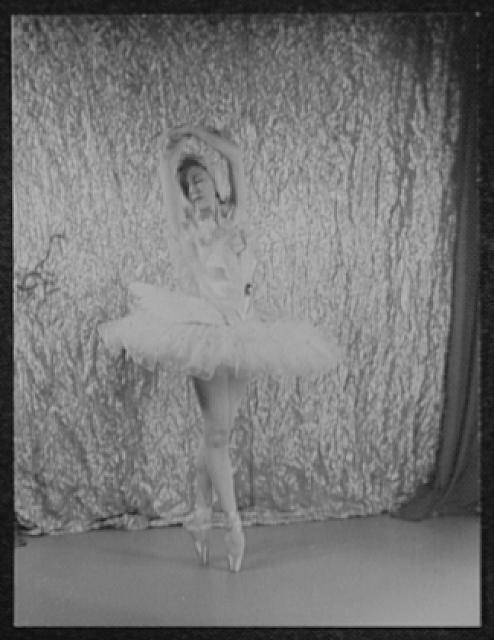
[Portrait of Alicia Markova, "The Dying Swan"]
Unknown artist
- Collection:
- Prints & Photographs
- Source:
- Library of Congress
- Rights:
- Rights vary by item — check the source record before reusing this image. Source record ↗
- Recorded as:
- Library of Congress — no known restrictions (verify per item)
Alicia Markova was one of the defining interpreters of the Dying Swan in the generation after Pavlova, and this photograph is evidence of how the role was performed and visually presented mid-century. The image also documents the costuming and formal portraiture conventions through which classical ballet dancers were publicly represented and remembered. For historians, the photograph is valuable as a precise record of a single dancer's relationship to one of ballet's most canonical works at a specific moment in time.
What you are looking at
A female dancer in a white tutu and pointe shoes stands alone against a shimmering curtained backdrop in a classical ballet pose. She is positioned in profile, turned slightly toward the camera, with her body held in an upright, elegant line characteristic of early 20th-century academic ballet. The photograph captures her mid-performance or mid-pose, the graininess and contrast typical of mid-20th-century photographic printing. The setting appears to be a studio or stage with heavy fabric drapes forming a textured background. The lighting is even and frontal, emphasizing the dancer's silhouette and the delicate detail of her costuming. The overall composition is formal and portraiture-like, despite the dance subject.
The dancing
The dancer stands in a classical ballet frame: upright torso, elongated neck, arms held in a refined position (one arm extended or held at shoulder height, the other at her side or similarly composed). Her weight is carried over one leg, with the supporting leg straight and turned out at the hip. The free leg appears to be in a position of extension or preparation—a position suggesting a moment between movements. Her posture demonstrates the turnout, lift, and precise alignment demanded by classical ballet technique. She is alone in the frame, the sole focus, with no partnering or interaction with other dancers.
The dance depicted
This is a portrait of the dancer Alicia Markova in the role of the dying swan, most likely referencing Michel Fokine's "The Dying Swan" (1905), the famous solo created for Anna Pavlova that became one of classical ballet's most iconic works. The Dying Swan is a short, solo choreography performed in a white tutu and pointe shoes, depicting the final moments of a mortally wounded swan through a series of fluid, increasingly desperate movements. Markova was one of the great interpreters of this role in the mid-20th century. The photograph does not capture the movement itself but rather documents the dancer in costume and in the aesthetic world of the role—a formal portrait of a performer in her most celebrated characterization.
How it was made
This is a black-and-white photograph, printed as a gelatin silver print or similar silver-based photographic paper common in the 1940s. The grainy texture and tonal range are characteristic of mid-20th-century portrait photography. Photography offered a new form of dance documentation that was faster and more portable than painted or drawn portraiture, yet still capable of lending glamour and formality to the subject. The frontal lighting and studio setting suggest this was a professional publicity or archival photograph, likely taken for theatrical purposes or press distribution. The technique allows for precise documentary detail while preserving the artist's own lighting and compositional choices.
About this work
This is a formal photographic portrait of the British-American prima ballerina Alicia Markova wearing the iconic white tutu costume of the Dying Swan, one of the most celebrated roles in classical ballet. The photograph documents not a moment of action but the dancer's presence and bearing in character—a record of how the role was embodied and performed in the mid-20th century. It belongs in a dance archive both as a record of Markova's artistry and as visual evidence of how this canonical work was interpreted across decades and dancers. The image preserves the aesthetic and physical standards of classical ballet performance in a period when documentation through still photography was a primary means of recording ephemeral theatrical art.
How to look at it
Attend to Markova's posture and the precision of her positioning—the turn-out, the lifted spine, the refined placement of her arms. Observe how the photographer has chosen to present her not mid-leap or in dramatic action, but in a composed, statuesque moment that emphasizes elegance and formality. This reflects the classical ballet aesthetic of the period: emphasis on line, stillness, and controlled beauty rather than spectacle or emotional intensity. The plain backdrop and professional lighting are conventions of mid-century dance portraiture, designed to isolate the dancer and costume from distraction. Consider what this formal, almost sculptural presentation tells us about how classical ballet was valued and how its dancers were publicly presented.
The artist
The photographer is not identified in the catalogue record. The photograph was likely produced as a studio or promotional image by a theatrical photography studio, a common practice for major ballet dancers. Such photographs were used for publicity, archival documentation, and press distribution, and were often taken by contract photographers working for dance companies or independent theatrical studios.
The period
This photograph was taken in 1948, a period of relative stability and internationalism in classical ballet following World War II. Alicia Markova was performing with the Ballets Russes de Monte-Carlo and other major companies during this era. The Dying Swan itself, created in 1905, had become canonical by this date—performed by successive generations of dancers and existing in multiple choreographic interpretations. Mid-20th-century theatrical photography emphasized glamour, formal pose, and costume detail, reflecting the ballet world's investment in creating iconic images of its stars. The photograph dates from an era before television and film dance became dominant, when still photography remained the primary visual record of live performance.
Where it lives
This photograph is held by the Library of Congress in the Prints & Photographs Online Catalog, a major institutional repository for American documentary and cultural photography. It is catalogued as a portrait from the mid-20th century and reflects the Library's holdings of theatrical and performance documentation.
Dance in this work
Questions about this work
What is the Dying Swan?
The Dying Swan is a solo choreography created by Michel Fokine in 1905 for Anna Pavlova. It is a short work (about four minutes) in which a single dancer, dressed in a white tutu and pointe shoes, portrays a swan in its final moments. The choreography builds from graceful, lyrical movement to increasing desperation and disorientation, ending in death. It has become one of the most iconic and frequently performed works in classical ballet, and generations of dancers have created their own interpretations of the role.
Who was Alicia Markova?
Alicia Markova (1910–2004) was a British prima ballerina who had an extraordinary career spanning more than six decades. She was trained in the Cecchetti method and danced with the Ballets Russes de Sergei Diaghilev, the Ballets Russes de Monte-Carlo, and numerous other companies. She was particularly celebrated for her interpretation of classical roles, including the Dying Swan, and was known for her technical precision, musicality, and dramatic presence.
How do photographers capture ballet dancers?
Studio portraiture of dancers typically involves controlled lighting, a neutral backdrop, and careful posing that emphasizes line and elegance. The photographer must understand ballet technique and aesthetics in order to choose moments and angles that convey the dancer's artistry. In the mid-20th century, black-and-white photography was standard; color film and digital photography would later expand the possibilities. Many of the most iconic images of classical ballet dancers come from such formal studio portraits rather than from action shots of performance.
More dance artwork





