49 works in this view — arrow keys or swipe to move between them.
Dance in Art
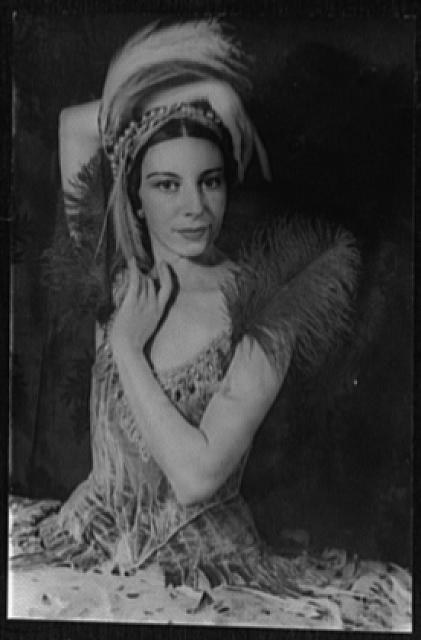
[Portrait of Alicia Markova, Bluebird variations, "Sleeping Beauty"]
Unknown artist
- Collection:
- Prints & Photographs
- Source:
- Library of Congress
- Rights:
- Rights vary by item — check the source record before reusing this image. Source record ↗
- Recorded as:
- Library of Congress — no known restrictions (verify per item)
Alicia Markova was a transformative figure in ballet history, instrumental in establishing classical ballet as a living art form in Britain and America during the mid-twentieth century. This portrait is evidence of the close tie between balletic authority and the visual presentation of the dancer's body in costume—a photograph not of performance but of persona, designed to make the role and the dancer inseparable in public memory.
What you are looking at
A woman in theatrical costume sits in a three-quarter pose against a dark background, her body angled toward the camera. She wears an elaborate headdress of layered white fabric with ornamental detailing, and a fitted bodice with short sleeves and decorative embroidery across the chest. Her arms are gracefully positioned—one raised near her face, the other resting on her lap—and her expression is poised and direct. Draped white fabric, possibly a skirt or wrap, falls across her lower body and pooling slightly at the base of the composition. The lighting is dramatic and directional, catching the texture of the fabrics and creating strong shadows that define her features and the sculptural quality of her costume. The photograph is shot in black and white, likely gelatin silver print.
The dancing
The dancer's upper body is held in an upright, dignified posture with shoulders relaxed and open. Her arms display the elongated, refined line characteristic of classical ballet, with the raised arm curved gracefully and the hand positioned with articulate fingers. The positioning suggests preparation or pause within a formal variation rather than mid-movement through space. Her face is composed in a calm, focused expression—the gaze steady and the features arranged in the classical ballet ideal of ethereal restraint. The overall frame conveys control and technical precision rather than dynamic action.
The dance depicted
This is a photograph of Alicia Markova in the Bluebird pas de deux from *The Sleeping Beauty*, as stated in the catalogue record. The Bluebird is one of classical ballet's most celebrated male roles—a display variation for a male dancer—yet the catalogue identifies this sitter as Markova, a prima ballerina. This suggests either a studio or costume portrait rather than a photograph taken during performance, or alternatively a variant staging in which the role was danced by a female dancer. The ornate headdress and jeweled bodice match the costume conventions of the Bluebird character as designed for the Imperial Russian ballet. The pose and lighting treatment are consistent with theatrical portraiture of the 1930s–40s, made to document and promote a dancer's association with a celebrated role.
How it was made
This is a black and white photograph, almost certainly a gelatin silver print made from a professional theatre portrait session. The professional studio lighting, sharp focus, and careful posing indicate work by a commercial photographer specializing in theatrical subjects. The printing quality and archival housing suggest this was made for distribution to press, patrons, or the dancer's own promotional use—standard practice for major ballet stars of the period. Such photographs were widely circulated in newspapers, magazines, and lobby cards, making them key documents of how roles were visually presented to audiences.
About this work
A studio portrait of the British prima ballerina Alicia Markova in the elaborate costume of the Bluebird variation from Tchaikovsky's *The Sleeping Beauty*. Markova was one of the twentieth century's greatest classical ballet dancers and a key figure in the British ballet establishment; her association with the repertoire of the Imperial Russian ballet was central to her fame. This photograph, dated around 1940, documents both the technical demands and the visual splendor of the role at mid-century, and serves as a record of how one of ballet's most iconic dancers presented herself to the public during a pivotal moment in her career.
How to look at it
Attend to the precision of the hand positions and the organization of the upper body, which signal the classical ballet training that defined Markova's technique. Notice how the photographer has used lighting and dark background to isolate and idealize the figure, a convention borrowed from high-art portraiture but applied to theatrical documentation. The choice to photograph the dancer in stillness rather than mid-movement is deliberate: it allows the costume and carriage to be read as a unified artistic statement, the way a role was understood in that era—as an ensemble of line, decoration, and bearing rather than primarily as kinetic display.
The artist
The photographer is not recorded in the catalogue, but the quality and style of the work suggest a professional theatre portrait studio, likely based in London or New York where Markova was performing. The conventions of pose, lighting, and framing align with theatrical photography of the 1930s–40s, a period when such portraits were essential to a dancer's public profile and served as primary documents of how roles were embodied and presented.
The period
By 1940, *The Sleeping Beauty* had been in the Western ballet repertoire for nearly two decades following the Ballets Russes seasons of the 1920s. The role of the Bluebird was a cornerstone of classical male technique, though it was occasionally danced by female soloists. This period saw the consolidation of Russian Imperial ballet as the global standard, transmitted through dancers like Markova who had trained in that tradition. Theatrical photography was at its height as a medium of publicity and artistic documentation, with major dancers commissioning and distributing portraits as part of their professional identity.
Where it lives
This work is held by the Library of Congress Prints & Photographs division, catalogued as a theatrical photograph from the collection of materials related to mid-twentieth-century performance. Its presence in a public archive indicates it was either acquired by the library as a significant document of dance history or was part of a larger donation related to Markova's career.
Dance in this work
Questions about this work
Why is Alicia Markova pictured in the Bluebird costume?
The Bluebird is traditionally a male role in *The Sleeping Beauty*, a virtuosic solo that showcases the male dancer's technique and athleticism. It is unusual to see a female dancer, particularly one of Markova's stature, associated with this role. This may reflect a studio session or costume study rather than a stage performance, or it may document a variant production in which roles were reassigned. The photograph was created as a promotional portrait, not necessarily a record of an actual performance.
What does this tell us about how classical ballet was performed in the 1940s?
This portrait reflects the visual and technical ideals of classical ballet at that moment: elongated line, refinement of the upper body and arms, and elaborate decoration that frames rather than obscures the dancer's form. The choice to photograph in stillness rather than in motion was typical of the period, when a role's identity was understood as much through costume and posture as through choreography. The photograph also shows how central the dancer's persona was to the reception of a work—the portrait conflates Markova with the Bluebird, suggesting that a great dancer's association with a role was as important as the role itself.
Is this from an actual performance?
This appears to be a professional studio portrait rather than a performance photograph. The controlled lighting, posed position, and studio background are consistent with theatrical portraiture of the era, made for promotional and archival purposes. It documents the costume and the dancer's interpretation of the character, but not a specific moment in a stage performance.
More dance artwork





