49 works in this view — arrow keys or swipe to move between them.
Dance in Art
Come out! Salsa Picante
Unknown artist
- Collection:
- Prints & Photographs
- Source:
- Library of Congress
- Rights:
- Rights vary by item — check the source record before reusing this image. Source record ↗
- Recorded as:
- Library of Congress — no known restrictions (verify per item)
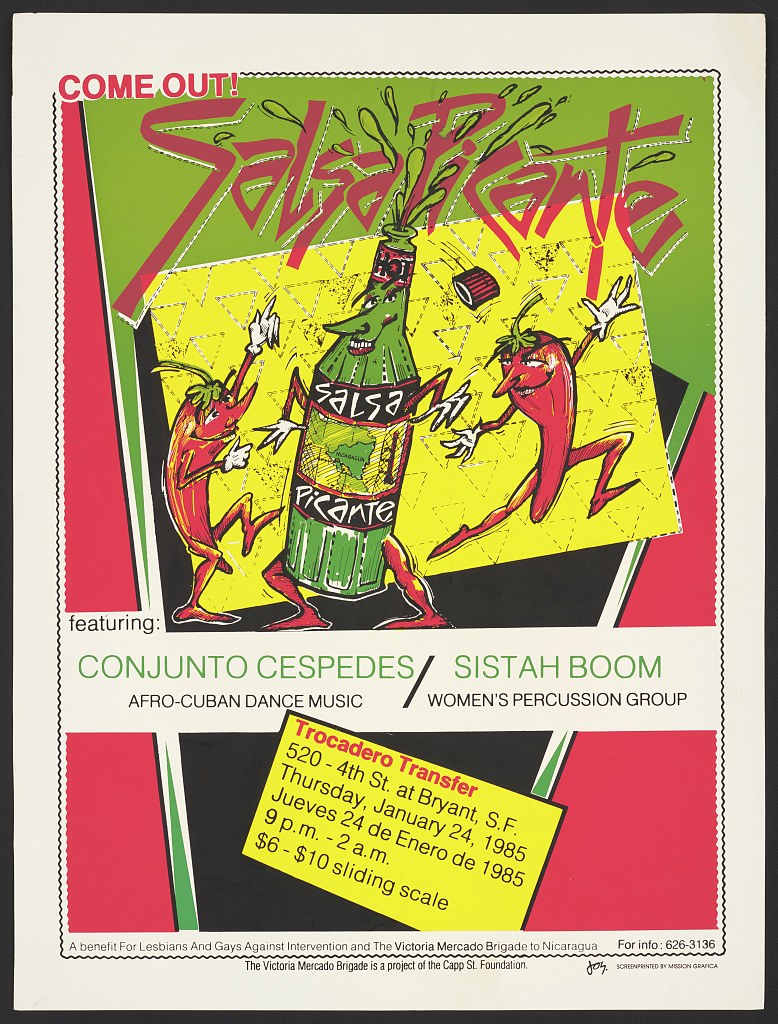
This poster documents how Latinx and Black queer communities used salsa culture—music, dance, and visual expression—as a vehicle for political organizing in the 1980s. It shows salsa not as a formalized performance genre but as a living, embodied expression of cultural identity and resistance, intimate enough to support fundraising for political causes.
What you are looking at
A vibrant, pop-art style poster announces a salsa dance event with explosive energy. Three anthropomorphized red chili peppers with white gloved hands occupy the center, dancing exuberantly around a green bottle labeled "salsa" and "picante." The peppers' bodies arc and twist in dynamic poses against a bright yellow rectangular background, which radiates outward with white radiating lines suggesting movement and sound. The composition is framed by bold blocks of hot pink and lime green, with the title "SALSA PICANTE" in large magenta letters across the top. At the bottom, a yellow rectangle contains event details in black type. The style is deliberately cartoonish and celebratory, using primary colors and high contrast to convey the heat and liveliness of both the dance and the sauce.
The dancing
The three chili peppers are rendered as cartoon characters with exaggerated, expressive postures. Their bodies lean and twist in playful, uninhibited movement—one extends an arm overhead, another reaches toward the bottle, and all three appear to be in mid-leap or mid-twist. The white-gloved hands are splayed and gestural, emphasizing joy and abandon. The peppers' positioning suggests they are moving around and toward the central salsa bottle, creating a circular, celebratory energy rather than a structured dance formation. The overall effect is loose, joyful, and expressionistic rather than technically precise.
The dance depicted
This is promotional imagery for a salsa dance event, though the cartoon peppers are not performing recognizable salsa technique. The poster advertises performances by Conjunto Céspedes (an Afro-Cuban dance music group) and Sistah Boom (a women's percussion group), indicating that the event centered on live salsa and related Caribbean music rather than theatrical salsa performance. The image captures the spirit and cultural energy of salsa—heat, vibrancy, social joy, and fusion of Latin and African traditions—through visual metaphor (the peppers and picante sauce) rather than through depicting actual dancers or steps.
How it was made
This is a screen-printed or lithographically printed poster, evident from the bold, flat areas of color, the graphic design sensibility, and the way text and image integrate into a unified composition. The technique allowed for affordable mass production and broad distribution—this is clearly meant to be posted in communities to advertise the event. The registration of multiple colors (magenta, green, yellow, pink, black) suggests careful planning and multiple passes through the press. The style is consistent with 1980s DIY and community-based visual activism, where accessible printing techniques supported cultural organizing and artistic promotion.
About this work
This is a 1985 promotional poster for a salsa dance event featuring live performances by Afro-Cuban and women's percussion ensembles. Rather than depicting actual dancers, the poster uses punning visual language—dancing chili peppers and a bottle of salsa sauce—to advertise the music and dance. The design is playful and accessible, using vibrant colors and cartoon imagery to appeal to a broad audience. The event was a benefit for LGBTQ+ political organizing in solidarity with Nicaragua, situating the celebration of Caribbean music and dance within a specific moment of queer activism and anti-imperialist politics.
How to look at it
The poster works through visual pun and metaphor rather than literal representation. The dancing chili peppers are a visual joke that collapses the salsa sauce into salsa music and dance, inviting the viewer to understand all three as expressions of the same cultural energy. The radiating lines and dynamic postures convey movement and excitement without requiring knowledge of salsa technique. Notice how the composition places the peppers in a playful, almost chaotic arrangement rather than the structured formations that would characterize a formal dance advertisement—this suggests the event as a celebration and gathering rather than a spectacle.
The artist
The artist is unrecorded. The style and letterpress suggest a community-based designer or artist collective typical of 1980s activist print culture, where graphic designers and artists worked in service of social movements. The quality and care of the design indicate professional skill deployed for political rather than commercial purposes.
The period
In 1985, salsa had established itself as a major force in American dance and music, particularly within Latinx communities. The genre had developed from Cuban son, mambo, and other Caribbean traditions and was performed in dance halls, nightclubs, and increasingly in theatrical and concert settings. Simultaneously, Afro-Cuban music and dance were experiencing a cultural resurgence as expressions of Black diasporic identity. The poster's date coincides with growing visibility of queer Latinx culture and the increasing use of cultural events as fundraising mechanisms for activist causes, particularly around Central American solidarity in response to U.S. military intervention.
Where it lives
This poster is held in the Prints & Photographs collection at the Library of Congress, catalogued as a benefit poster for Lesbians and Gays Against Intervention and the Victoria Mercado Brigade to Nicaragua. It represents the kind of grassroots activist print culture that documented and promoted community cultural events.
Dance in this work
Questions about this work
Who were Conjunto Céspedes and Sistah Boom?
Conjunto Céspedes was an Afro-Cuban music ensemble, part of the broader movement to revive and celebrate Cuban musical traditions within the diaspora. Sistah Boom was a women's percussion group. Their collaboration on this event suggests a deliberate pairing of Cuban/Latin and African-American musical traditions, reflecting the pan-Black cultural politics of the 1980s.
What does this tell us about salsa in 1985?
By 1985, salsa had moved beyond nightclub dancing into broader cultural visibility as an expression of Latinx identity and pride. This poster shows salsa as a vehicle for community gathering and political consciousness, not just entertainment. The use of salsa culture to fundraise for Central American solidarity reveals how deeply dance and music were woven into activist organizing.
Why are there chili peppers instead of actual dancers?
The peppers are a visual pun on the word 'salsa,' which means sauce in Spanish. Using this play on words makes the poster playful and memorable while connecting the heat and vibrancy of the sauce to the heat and energy of the music and dance. It's a design choice that prioritizes accessibility and fun over documentary realism.
More dance artwork





