49 works in this view — arrow keys or swipe to move between them.
Dance in Art
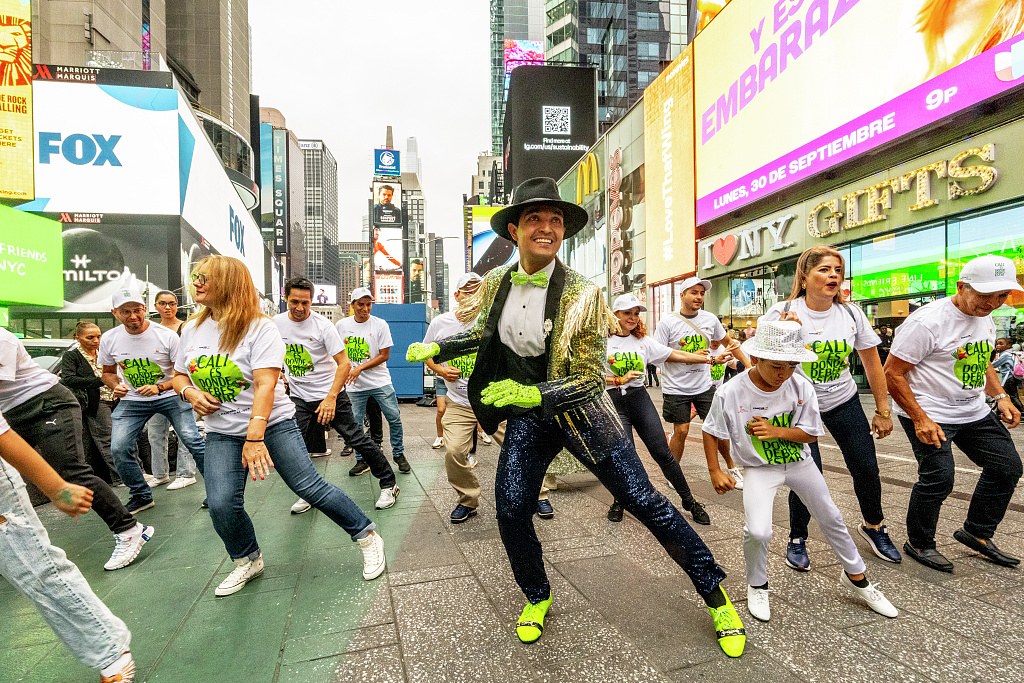
Salsa aficionados dancing with star salsero Brando Perez Loaiza from Cali, Colombia. 1530 Broadway, Manhattan
Unknown artist
- Collection:
- Prints & Photographs
- Source:
- Library of Congress
- Rights:
- Rights vary by item — check the source record before reusing this image. Source record ↗
- Recorded as:
- Library of Congress — no known restrictions (verify per item)
This image shows salsa in its most vital contemporary context—not as a competitive ballroom dance or a museum artifact, but as a living, participatory street culture that can mobilize dozens of people in public space and invite strangers into joyful movement together. For historians of diaspora dance and urban culture, it documents how Latin American dance forms have become woven into the fabric of American public celebration.
What you are looking at
A flash mob or organized street dance event takes place in Times Square, Manhattan, with 1530 Broadway visible as the anchor location. The photograph captures a moment of coordinated joy: a lead dancer in extravagant performance dress—a gold lamé jacket, black hat, white shirt, and neon yellow-green shoes—dances with expansive, joyful movement at the center. Surrounding him are dozens of participants wearing matching white t-shirts with neon green text (reading "CALI VERDE" or similar), arranged in loose formation around the central performer. The urban canyon of tall buildings, electronic billboards in pink and magenta, and overcast sky frame the scene. The composition emphasizes celebration and community participation, with the lead dancer's high-energy, arms-raised posture drawing the eye as onlookers and participants occupy the street.
The dancing
The lead dancer occupies center stage with an open, celebratory frame—knees bent, arms lifted and extended, shoulders relaxed, weight forward on the balls of the feet in an energized stance. His posture is expansive rather than technically controlled, suggesting joyful expression over formal technique. The surrounding participants mirror a more modest version of his energy, with bent knees and engaged torsos, moving in approximate synchrony without rigid formation. The contrast between the flamboyantly dressed central figure and the uniformly dressed crowd creates a clear focal hierarchy—leader and community.
The dance depicted
This is contemporary street salsa or social salsa in a participatory, grassroots context. The lead dancer is identified as Brando Perez Loaiza from Cali, Colombia, salsa's heartland, and the event appears to be a public celebration or promotion of salsa culture, likely organized to bring the dance into public space and invite community participation. The movement vocabulary—hip action, weight shifts, the open frame, the emphasis on joy and musicality over ballroom precision—is consistent with salsa's street and social variants rather than competitive ballroom forms. The setting and accessibility suggest this is salsa as lived culture and public celebration rather than a performance for an audience.
How it was made
This is a color photograph, likely digital or high-resolution film, taken in natural daylight in an urban setting. The medium captures the event as documentation of a real moment—a flash mob, street performance, or organized community dance—rather than a staged studio composition. The photograph's breadth of field and depth allow both the central performer and the surrounding crowd to be legible, emphasizing the participatory and public nature of the event. Its color saturation and clarity suggest professional or semi-professional documentation, the kind that might circulate on social media or be used for promotional purposes.
About this work
This is a contemporary documentary photograph of a salsa street dance event in Times Square, featuring Brando Perez Loaiza, a prominent salsero from Cali, Colombia, leading a crowd of participants in coordinated movement. The image captures salsa as public culture and participatory celebration, brought into the commercial heart of Manhattan. The work belongs in a gallery of dance imagery because it documents how contemporary salsa functions as both cultural expression and accessible community practice, erasing the boundary between performer and participant that formal ballroom dance maintains.
How to look at it
Notice the contrast between the lead dancer's theatrical, almost baroque elaboration of dress and movement and the simplicity of the surrounding participants' uniform t-shirts and more restrained energy. Watch how the photographer has framed the central figure to allow the crowd to remain visible and legible—this is not an image that isolates the virtuoso, but one that emphasizes the community. The moment chosen is one of peak expression, with the lead dancer's body opened and lifted, inviting others to match his energy.
The artist
The photographer is not recorded in the catalogue. The image appears to be a candid or semi-professional street photograph, the kind that circulates through event documentation, social media, or promotional materials for dance events and community organizations.
The period
This photograph dates to 2024, a moment when flash mobs, TikTok dances, and organized street performances have become common forms of public expression and cultural celebration in urban centers. Salsa itself emerged from Caribbean and Latin American communities in mid-20th-century New York and has become a global popular dance; by the 2020s, it is firmly established as a form accessible to all communities and often used as a vehicle for neighborhood celebration and cultural pride. The Times Square setting—the heart of commercial Manhattan—signals how thoroughly Latin dance has entered mainstream American culture.
Where it lives
The photograph is held in the Prints & Photographs collection of the Library of Congress, suggesting it entered institutional preservation as a record of a public event or cultural moment. The cataloguing is sparse, providing only the location, date, and the name of the featured dancer, but not the photographer, the organizing group, or the purpose of the event.
Dance in this work
Questions about this work
Who is Brando Perez Loaiza?
Brando Perez Loaiza is a salsero (salsa dancer) from Cali, Colombia, one of the world centers of salsa music and dance. Cali is often called the salsa capital of the world. The photograph captures him in a moment of public performance and teaching, sharing the dance with an urban community.
What is the difference between this salsa and ballroom salsa?
This image shows social salsa or street salsa, characterized by open movement, weight shifts driven by hip action, and an emphasis on musicality and joy over formal technique or competition. Ballroom salsa (used in dance sport competition) maintains tighter frames, more vertical posture, and standardized choreography. Both are salsa, but they emerge from different contexts and values.
Why is this in Times Square?
The event appears to be an organized public celebration or promotion of salsa culture, designed to bring the dance into visibility in a major urban commercial center and invite broad community participation. Times Square's visibility and foot traffic make it an ideal location for such events.
What does the white t-shirt text say?
The photograph's resolution does not permit certain reading of the text, but it appears to reference Cali (the Colombian city) or a specific salsa organization or event. The uniform dress signals coordinated participation rather than spontaneous street dancing.
More dance artwork





