49 works in this view — arrow keys or swipe to move between them.
Dance in Art
Chauncey Olcott in the great play Mavourneen
Unknown artist
- Collection:
- Prints & Photographs
- Source:
- Library of Congress
- Rights:
- Rights vary by item — check the source record before reusing this image. Source record ↗
- Recorded as:
- Library of Congress — no known restrictions (verify per item)
This poster is a primary source for understanding how theatrical producers visualized and marketed historical dance to audiences in the early 1900s, and specifically how Irish identity and history were performed on the American stage. It shows the conventions by which formal ballroom dance was depicted in popular theatrical imagery—the postures, the dress codes, the architectural settings—and how dance functioned as both spectacle and plot device in plays of the era.
What you are looking at
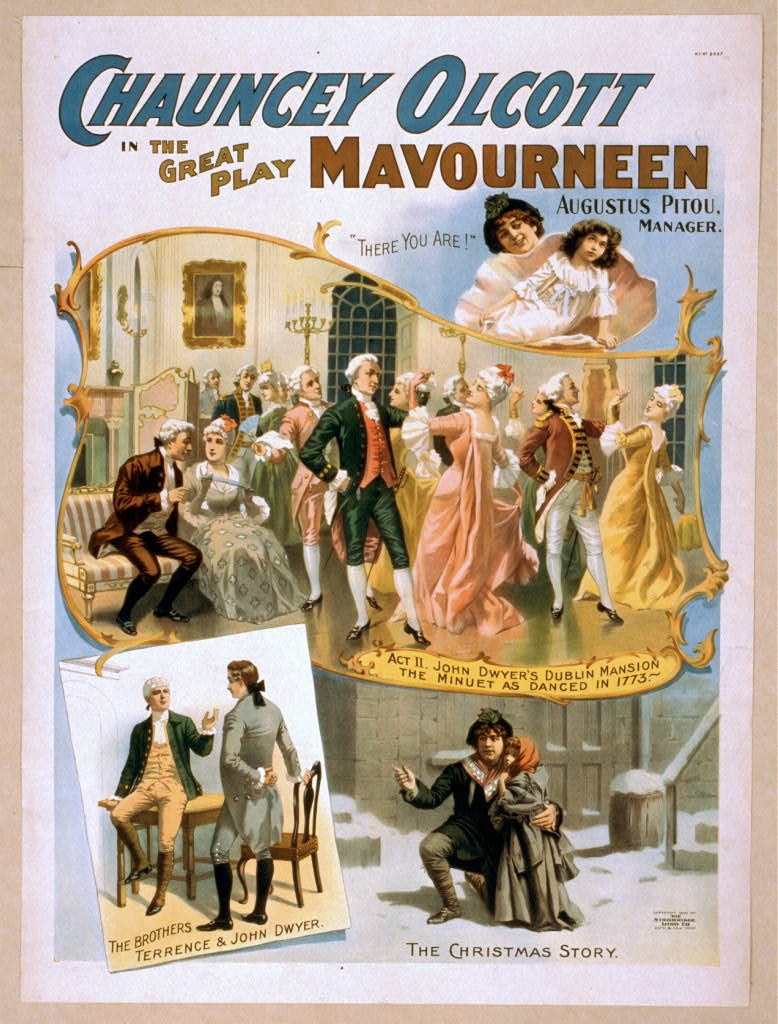
This is a theatrical poster advertising a stage production titled *Mavourneen*, featuring the actor Chauncey Olcott, managed by Augustus Pitou. The central image shows an elegant interior—a drawing room or salon—with a large gathering of figures in 18th-century dress engaged in a formal dance or social assembly. The room has pale walls, tall windows with panes, a fireplace with a mantelpiece topped by a portrait, and elaborate gilt ornamental frames. In the foreground, couples stand and move in stately attitudes; the women wear long gowns in pale tones (whites, pinks, yellows) with high waistlines and short sleeves typical of the Regency or late Georgian period, while the men wear dark tailcoats with colored vests. The composition is framed by a curving, rococo-style golden border. Below the main scene are two smaller vignettes: one labeled "The Brothers—Terrence & John Dwyer" showing two men in conversation or confrontation indoors, and another labeled "The Christmas Story" showing figures in an exterior snowy setting. At the top, a third image shows two figures (possibly children or cherubs) in an ornamental frame. The overall aesthetic is that of a late-19th-century theatrical lithograph, with soft coloring and fine detail characteristic of promotional materials for stage productions.
The dancing
The figures in the central ballroom scene stand in upright, formal postures consistent with Regency-era social dance. Several pairs appear to be in or near a closed dance position, though the precise hold is difficult to discern at this distance and in this artistic rendering. The women's bodies are turned gracefully, their arms held at modest heights; the men stand erect beside them. The crowd is arranged across the space with varying depths, creating the impression of a lively social gathering rather than a choreographed ensemble. Individual dancers are identifiable by their distinct dress colors and positions, but the artist has not rendered actual footwork or the mechanical details of movement, focusing instead on the elegance of posture and the narrative drama of the moment.
The dance depicted
The poster depicts what is labeled in a caption as "Act II. John Dwyer's Dublin Mansion as danced in 1775"—placing the action in a specific historical moment and location. The dance taking place is a formal Regency or late 18th-century ballroom dance, most likely a minuet, cotillion, or quadrille based on the upright postures, the formal dress, and the architectural setting. The image captures not the technical execution of the dance but rather the social spectacle: a moment of courtship, intrigue, or dramatic tension within a fashionable assembly. Chauncey Olcott, a prominent Irish-American actor and songwriter of the late 19th century, is the star of this production, suggesting the work was a dramatic piece set in historical Ireland with dance as a key element of the theatrical spectacle and plot.
How it was made
This is a color lithograph, a printing process that allowed theatrical producers to distribute affordable, colorful promotional posters to advertise stage productions. Lithography enabled the soft color palette, delicate gradations of tone, and fine detail visible in the fabrics, furnishings, and faces. The process allowed for rapid production and wide circulation, making this both a work of visual art and a document of theatrical marketing in the 1890s–1900s. The poster's design—with hierarchical composition, decorative framing, and multiple scenes—was standard for the period and made the image legible and appealing from a distance in lobbies and on streets.
About this work
This is a theatrical poster for *Mavourneen*, a play featuring Irish-American star Chauncey Olcott, produced in the early 1900s. The central image presents a fashionable ballroom scene set in 1775 Dublin, depicting a formal assembly in which dance and social interaction drive the dramatic action. The work belongs in a dance archive because it documents not only how ballroom scenes were staged and depicted in theatrical production, but also how late 19th-century theater employed historical costume dance as a vehicle for narrative and spectacle. The poster reveals what 1890s audiences understood "18th-century Irish ballroom dance" to look like: formal, elegant, and central to the emotional and social drama of the plot.
How to look at it
Attend to the composition of the ballroom scene: the artist has arranged the figures to suggest a moment of social and emotional significance—note the positioning of the women in the foreground, the gestures of attention or interaction among the groups, and the architectural framing that lends formality and elegance to the gathering. The poster employs a conventional theatrical grammar in which ballroom scenes signal wealth, social order, courtship, and high dramatic stakes. The smaller scenes below provide narrative context (the brothers in conflict, the Christmas setting) that would have been understood by viewers familiar with the plot. The overall effect is one of spectacle and romance, designed to appeal to audiences seeking escapism and historical glamour.
The artist
The artist is not recorded in the catalogue. However, the style, printing technique, and design conventions are consistent with theatrical poster production of the 1890s–1900s, a period in which specialized theatrical printers and lithographers (such as the Strobridge Lithographing Company) produced thousands of color posters for stage productions. These anonymous or now-forgotten artists were skilled in composition, color separation, and narrative illustration, creating images that balanced legibility, beauty, and commercial appeal.
The period
This poster dates to the era of American musical theater and Irish-American performance, when plays set in Irish history or featuring Irish characters were popular on Broadway and in touring productions. The early 1900s saw both a romantic revival interest in 18th-century aesthetics (evident in the Regency dress and decor) and the emergence of Irish-American cultural identity as a distinct theatrical market. Dance in such productions served multiple functions: it provided spectacle, authenticated the historical setting, and created moments of emotional or dramatic intensity. At the same time, lithographic theater posters had become a major art form and collecting category, often designed by accomplished visual artists and distributed widely.
Where it lives
This is a theatrical poster held by the Library of Congress Prints & Photographs collection. It is a promotional artifact from a commercial stage production, printed and distributed to advertise the show to potential audiences in theaters, on streets, and in newspapers or periodicals.
Dance in this work
Questions about this work
What dance is actually being performed in the ballroom scene?
The poster does not specify. Based on the formal dress, the upright postures, the 1775 Irish historical setting, and the social assembly context, the most likely dances are a minuet, cotillion, or quadrille—all fashionable ballroom forms of that era. However, the artist has depicted the scene as social spectacle rather than with technical precision, so the exact choreography cannot be determined from the image.
Who was Chauncey Olcott?
Chauncey Olcott (1858–1932) was an Irish-American actor, singer, songwriter, and playwright. He was particularly known for performing in plays set in Ireland or featuring Irish characters, and for writing popular songs including 'My Wild Irish Rose.' He was a major star of American musical theater in the late 19th and early 20th centuries and helped shape the theatrical market for Irish-American entertainment.
Why is this poster a historical source for dance?
Theatrical posters document how professional theater companies and audiences understood and visualized dance in specific historical and cultural contexts. This poster shows us what early 1900s theaters considered an appropriate, appealing representation of 18th-century Irish ballroom dance—the dress, postures, architectural setting, and narrative framing that made the scene legible and attractive to audiences.
Is this the original artwork or a reproduction?
This is the original lithographic print or a contemporary printing of it. The technique—color lithography—was the standard method for producing theatrical posters, so this artifact is both the advertisement and the artwork. The Library of Congress holds the print as a historical object.
More dance artwork





