49 works in this view — arrow keys or swipe to move between them.
Dance in Art
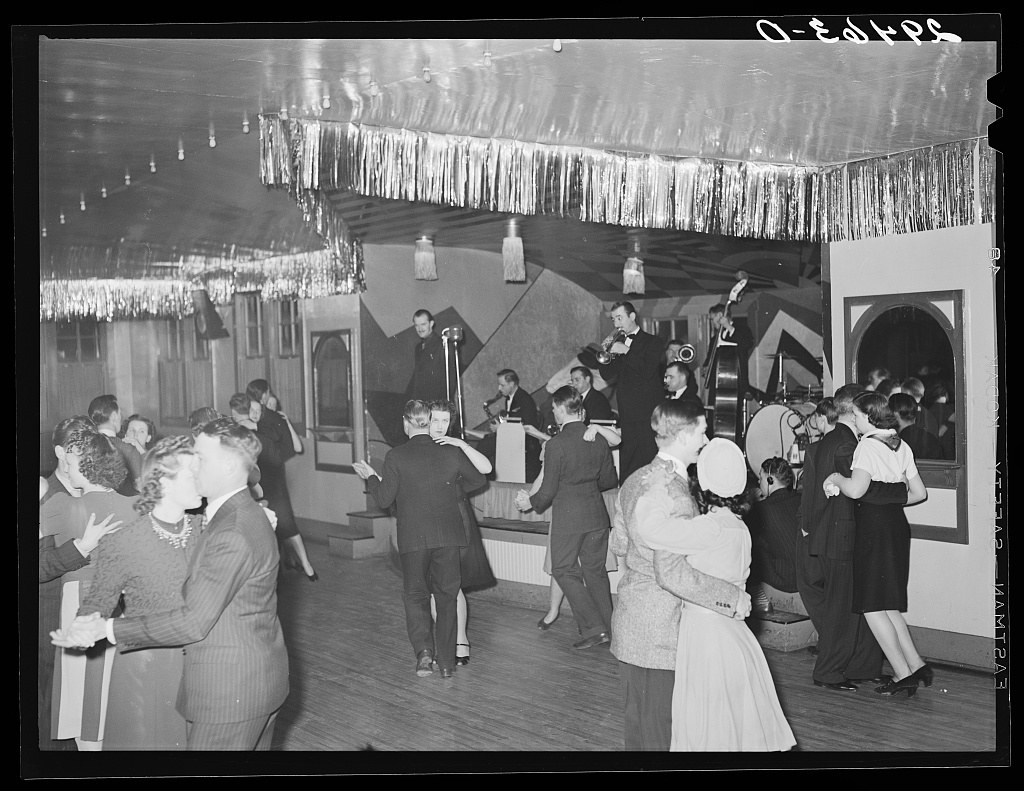
Dance hall, Saturday night. Marshalltown, Iowa
Unknown artist
- Collection:
- Prints & Photographs
- Source:
- Library of Congress
- Rights:
- Rights vary by item — check the source record before reusing this image. Source record ↗
- Recorded as:
- Library of Congress — no known restrictions (verify per item)
This photograph is rare evidence of how ordinary Americans actually danced in their own communities during the 1940s—not as performers or competitors, but as participants in social ritual. It shows the formal ballroom dances (waltz, foxtrot) that dominated American social life, the dress codes that governed them, and the mixed-gender couple dancing that was normative. For dance historians, it is a primary document of vernacular ballroom practice and of the spaces and occasions in which social dancing took place in rural and small-town America.
What you are looking at
A crowded ballroom dance hall packed with dancers and spectators on a wooden floor. The space is decorated with streamers and fringe garlands suspended from the ceiling, creating a festive atmosphere typical of a small-town Saturday night venue. The lighting is overhead and somewhat dim, casting the scene in a grainy, documentary quality. Couples occupy the dance floor in various configurations—some dancing closely, others standing or watching. The dancers wear formal attire: men in dark suits and ties, women in dark dresses, many with light-colored hats or hair accessories visible against the monochrome image. The crowded composition suggests this is a popular social venue, with people packed shoulder-to-shoulder, some dancing, others conversing or observing from the sides. A bandstand or stage is visible in the background on the right, where musicians are positioned to play for the dancers.
The dancing
The dancers are shown in closed and open social holds typical of ballroom dancing of the period. Several couples are in the standard waltz or foxtrot position—man's right hand on the woman's back, left hand holding her right hand at shoulder height. Most dancers maintain upright posture with the formality expected of 1940s social dancing. The density of the crowd means many figures are partially obscured, but those visible show the characteristic frame and posture of American smooth or swing-era social dancing, with bodies held at a polite distance. Some couples are stationary or moving very slowly, suggesting conversation and socializing rather than vigorous dancing.
The dance depicted
This is a social ballroom dance scene, most likely featuring American smooth dances popular in small-town America during the 1940s—principally waltz and foxtrot, with possible contemporary swing variations. The formal attire, the closed-position holds visible in the image, and the setting all confirm this is social ballroom dancing rather than theatrical performance. The scene documents how ordinary Americans danced on a Saturday night: in mixed couples, in a rented hall decorated for the occasion, to live music. The movement is social and recreational rather than competitive or virtuosic, with the emphasis on socializing and courtship within a formal dance framework.
How it was made
This is a black-and-white photograph, documentary in style and quality. The grainy texture, the composition, and the photographic technique suggest this is a press or archival photograph, likely taken with a flash or bright light source to capture the interior of the dimly lit hall. The image is cropped to frame the full depth of the dance floor and the crowd, suggesting it was shot from a fixed position overlooking the scene. The documentary approach—capturing an unposed, naturalistic moment of community social life—was characteristic of New Deal-era photography and suggests this may have been taken by a photographer working for a federal agency such as the Farm Security Administration or Works Progress Administration.
About this work
This is a documentary photograph of a Saturday night dance hall in Marshalltown, Iowa, captured in 1940. It shows a crowded ballroom filled with dancers in formal dress engaged in social ballroom dancing—primarily waltz and foxtrot—to live music. The scene is a snapshot of small-town American social life and courtship rituals during the Depression and early war years. The photograph documents not a performance or competition but the ordinary, intimate social function of dance in a community—the way dance was woven into weekend recreation and the rituals of sociability. It is valuable as both a visual record of 1940s fashion and dance practice and as evidence of how ballroom dancing served as the dominant mode of social interaction and courtship among American adults of this era.
How to look at it
Notice the formality of the dancers' posture and dress despite the crowded, informal setting. Look at the visible hand holds and body positions—they show the standard ballroom frame that was taught and expected. The density of the crowd and the mingling of dancers and spectators shows this was a social occasion as much as a dance event, with conversation and courtship as important as the dancing itself. The decorations overhead (streamers and fringe) and the visible bandstand show the effort made to transform an ordinary hall into a festive space for the evening.
The period
In 1940, ballroom dancing was at the height of its social dominance in America. The waltz and foxtrot were taught in schools and dance halls across the country, and weekly dances were standard social and courtship occasions in small towns. The formal closed-position dances had been the standard for decades, and while swing dancing and jitterbug were emerging as popular styles among younger dancers, the formal ballroom frame remained the expected mode in many communities. The photograph dates to the era just before American entry into World War II, when such local dance halls were still thriving community gathering places. The Federal Writers' Project and Farm Security Administration were actively documenting American life and labor during this period, and this photograph likely comes from that documentary impulse.
Where it lives
This photograph is held in the Prints & Photographs collection at the Library of Congress. It is part of the archival record of American life and likely comes from a New Deal-era documentation project such as the FSA or WPA, though the photographer is not identified in the catalogue record.
Dance in this work
Questions about this work
What dances are being performed?
The closed-position holds and formal posture visible in the photograph indicate waltz and foxtrot, the standard American smooth ballroom dances of the 1940s. Some dancers may have been doing contemporary swing variations, but the dominant mode was formal ballroom dancing.
Why was this photograph taken?
The photograph appears to be documentary in purpose—a record of American social life and community practices. It may have been taken by a photographer working for a federal agency such as the Farm Security Administration, which extensively documented American life during the 1930s and 1940s.
Is this a professional performance or a social dance?
This is entirely a social dance—a community ballroom open to ordinary participants, not a theatrical performance or competition. The formal dress and the closed-position holds reflect the etiquette and expectations of ballroom dancing as a social practice.
More dance artwork





