49 works in this view — arrow keys or swipe to move between them.
Dance in Art
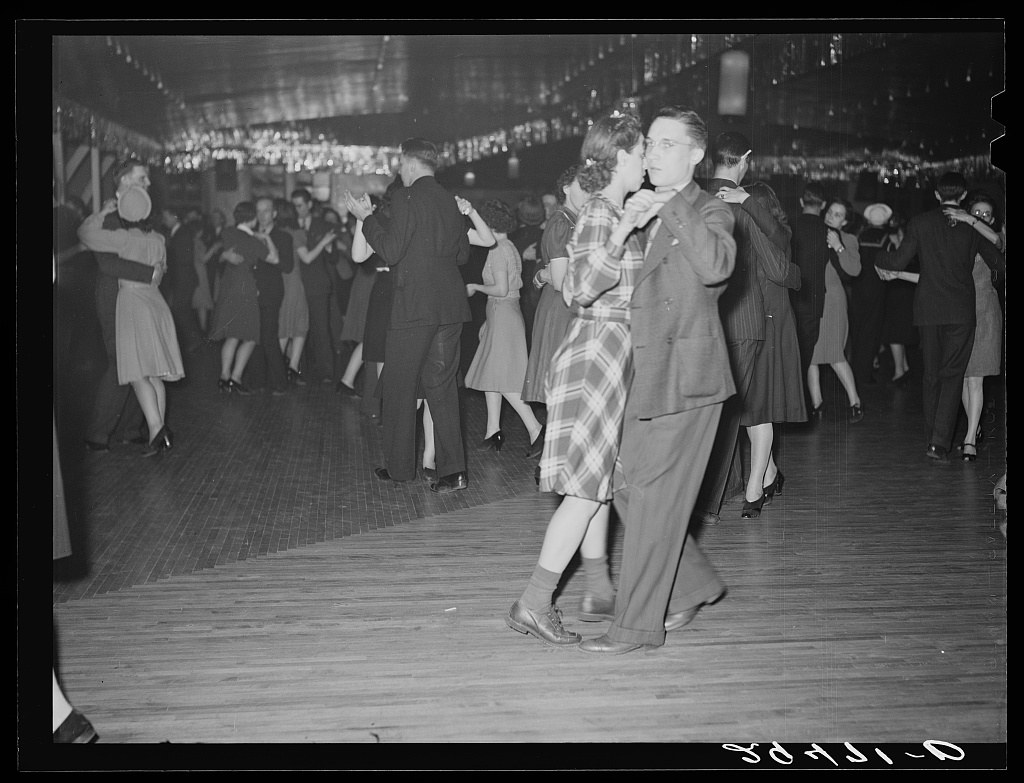
Dance hall, Saturday night. Marshalltown, Iowa
Unknown artist
- Collection:
- Prints & Photographs
- Source:
- Library of Congress
- Rights:
- Rights vary by item — check the source record before reusing this image. Source record ↗
- Recorded as:
- Library of Congress — no known restrictions (verify per item)
This is one of very few documentary photographs from the 1940s that captures vernacular American ballroom dancing in authentic social context, rather than in performance or competition frames. It shows the actual hold, frame, and social function of American ballroom dance before standardization and formalization had fully displaced regional and class-based variation. The image is evidence of a form of dance practice—intimate, weight-forward, informal—that differs visibly from the extended, lifted frame of contemporary competitive ballroom technique.
What you are looking at
A crowded dance hall in full swing, captured in black and white photography. The wooden floor is packed with couples and groups dancing, with string lights strung overhead creating pools of light across the ceiling. The photograph is taken from a low angle, emphasizing the depth and density of the crowd receding into shadow. In the foreground, a couple dominates the frame: a man in a dark suit and a woman in a patterned dress (appearing to be plaid or checked) dance in close embrace. Around them, dozens of other dancers fill the frame—women in light-colored dresses and men in suits—creating a sense of vigorous social activity. The lighting is theatrical, with suspended lights casting a diffuse glow that flattens and softens the scene. The composition captures a moment of uninhibited pleasure: bodies are in motion, some couples are pressed close, others are more relaxed, and the overall atmosphere is one of a thriving rural social event.
The dancing
The central couple dances in a closed ballroom position with the man's arm around the woman's waist and their bodies in contact. The woman's weight appears shifted into her partner, her body inclined slightly forward. The dance frame is compact and intimate rather than extended. Surrounding dancers show varied positions—some couples close and pressed, others more upright—suggesting multiple simultaneous conversations happening through the dance. The footwork is not clearly visible, but the overall postures suggest grounded, weight-forward movement rather than the lifted, extended frame of formal ballroom technique.
The dance depicted
This is social ballroom dancing of the 1940s American Midwest, most likely a foxtrot or waltz, the dominant couple dances of rural American dance halls. The image captures the vernacular ballroom practice of working-class and rural communities—informal, intimate, and social rather than competitive or theatrical. The embrace is closer and more relaxed than the formal 'closed position' of standardized ballroom technique, which was becoming codified during this period. This appears to be the social blues or country ballroom tradition rather than the competition or theatrical styles that were being professionalized simultaneously.
How it was made
This is a black and white photograph, likely a gelatin silver print from a documentary project. The source is the Library of Congress, suggesting this comes from the Farm Security Administration (FSA) photographic survey of American life conducted during the Depression and wartime years (1935–1944). The low-angle viewpoint, the shallow depth of field with the foreground couple sharp and the background crowd slightly soft, and the available-light flash or tungsten illumination are consistent with FSA documentary practice. The photographic medium allowed the photographer to capture an unguarded moment of vernacular social life that would have been invisible to fine-art traditions.
About this work
This photograph documents a Saturday night dance at a commercial dance hall in Marshalltown, Iowa, a working-class social institution that formed the backbone of rural American leisure culture. The image shows not choreography or performance, but the lived practice of ballroom dancing as a form of courtship, recreation, and community gathering among ordinary people. It is a document of how Americans danced when no one was watching formally—the actual technique, embrace, and social dynamics of mid-century working-class ballroom practice.
The photograph belongs in a gallery of dance art because it truthfully records a form of social choreography that is otherwise invisible in the historical record. Fine art and theatrical traditions documented ballroom dancing only in its formalized, codified versions; this image shows the messier, more human reality of how the dance was actually lived and experienced.
How to look at it
Observe the embrace of the central couple: notice how close they are, how the woman's body leans into the man's, how the frame is compact rather than extended. This is not the 'closed position' of competitive ballroom, with its vertical axis and extended arm line; it is a social, intimate hold shaped by the music, the crowd, and the simple pleasure of dancing with a partner. The background crowd is equally important: look at how the other dancers fill the frame, the variety of positions and proximities, the sense that this is not choreography but simultaneous individual choices. The lighting is key too—the overhead lamps create pools of illumination that make some couples visible and push others into shadow, suggesting the fleeting, ephemeral nature of the moment captured.
The artist
The photograph is unattributed in the Library of Congress record, but the composition, subject matter, and lighting are consistent with the work of FSA photographers documenting American rural and small-town life in the 1940s. The FSA employed photographers including Walker Evans, Dorothea Lange, Russell Lee, and Marion Post Wolcott, among others, who documented vernacular social life with both rigor and empathy. If the photograph is from an FSA project, it reflects the agency's commitment to recording the lived experience of ordinary Americans during the Depression and wartime.
The period
By 1940, American ballroom dancing was at a cultural crossroads. The 1930s had seen the rise of competitive ballroom dancing and the standardization of technique through British dance organizations (Cecchetti and the Imperial Society of Teachers of Dancing had codified 'International Standard' technique). Simultaneously, commercial dance halls remained a primary form of working-class entertainment and courtship, operating largely outside these codifying systems. Rural and small-town America relied on a more relaxed, regionally variable form of social dancing—closer to the blues traditions and jazz-influenced styles that had emerged from African American music and dance culture. The photograph captures this moment of transition, when vernacular practice and standardized technique coexisted in tension.
In art and photography, the 1940s saw a deepening commitment to documentary realism, influenced by the FSA's work in the 1930s. Photographers were increasingly interested in capturing ordinary American life as it actually occurred, rather than staged or idealized versions. The decision to photograph a dance hall on a Saturday night reflects this commitment to social realism and the value placed on working-class experience during the wartime period.
Where it lives
This photograph is held by the Library of Congress Prints and Photographs Online Catalog. Based on the subject matter, era, and photographic style, it very likely comes from the Farm Security Administration (FSA) Collection (1935–1944), a New Deal initiative that employed photographers to document American life during the Depression and World War II. The FSA collection is one of the most important American documentary photography archives.
Dance in this work
Questions about this work
Is this a posed photograph or a candid moment?
This appears to be a candid moment captured with available light and flash photography—the hallmark of FSA documentary work. The photographer was present at the dance hall and captured dancers engaged in authentic social activity, not staged for the camera. However, the photographer's presence and the use of photographic flash would have been noticed, so the dancers are aware of being documented even if they are not posed.
What dance style is this?
This is most likely an American foxtrot or waltz, danced in the vernacular style of working-class Midwest practice in the 1940s. The embrace is closer and more relaxed than the standardized 'closed position' taught in competitive ballroom, suggesting a style shaped by local tradition and the music being played rather than by formal technique.
Why does this matter for dance history?
This photograph is rare documentary evidence of how ordinary Americans actually danced in the 1940s—outside of performance, competition, or theatrical contexts. It shows the social function, the authentic hold and frame, and the intimate pleasure of vernacular ballroom dancing, a form of practice that is largely invisible in historical records because it was not formalized or codified.
Who took this photograph?
The photographer is not identified in the Library of Congress record. The style and subject matter suggest it comes from a Farm Security Administration (FSA) project documenting American rural and small-town life in the 1940s, but the specific photographer is not known from the catalogue data.
More dance artwork





