49 works in this view — arrow keys or swipe to move between them.
Dance in Art
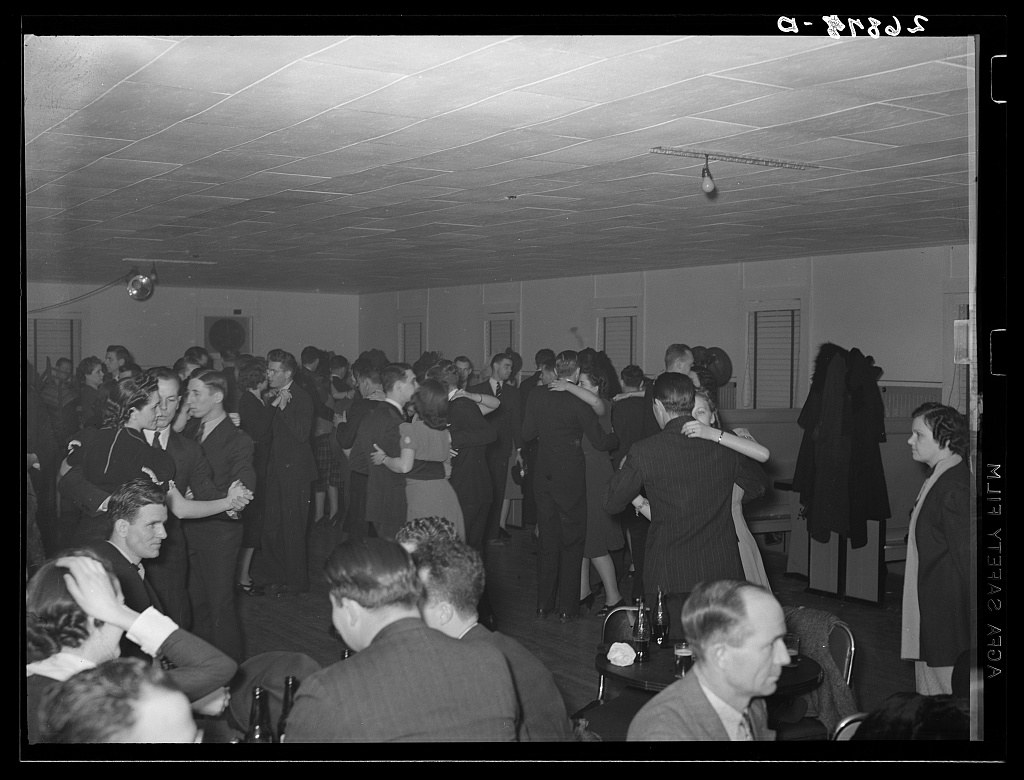
Allen's dance hall near Herrin, Illinois
Unknown artist
- Collection:
- Prints & Photographs
- Source:
- Library of Congress
- Rights:
- Rights vary by item — check the source record before reusing this image. Source record ↗
- Recorded as:
- Library of Congress — no known restrictions (verify per item)
The image shows social dancing not as a performance staged for an audience, but as a community practice in a modest rural venue—a corrective to the bias toward theatrical and ballroom competition dancing in archives. It is documentary evidence of vernacular American dance as it was actually lived and practiced by working people in the Depression era.
What you are looking at
A crowded ballroom or dance hall interior packed with patrons, photographed from an elevated vantage point. The space has a drop ceiling with exposed beams and a single pendant light fixture visible above. The crowd is predominantly dressed in dark suits and coats typical of 1930s working-class wear. Figures are clustered densely throughout the frame, standing and moving in small groups. Some couples appear to be dancing or positioned close together in the centre and background, while others stand or sit around the periphery. A few figures in the lower right sit on chairs at what appears to be a table with bottles visible. The lighting is flat and institutional—the photograph captures a weeknight or after-hours atmosphere in what appears to be a modest establishment serving a local community.
The dancing
The bodies in the frame are largely vertical and static, clustered rather than arranged in any formal dance formation. Where couples are visible in the midst of the crowd, the positioning suggests close, upright holds typical of 1930s social dancing—partners face-to-face with arms engaged. Most figures are standing or shifting weight rather than executing visible footwork; the density of the crowd limits clear sightlines to the dancers' feet. The mixed crowd includes men and women of varying ages, all in dark formal dress, suggesting this was a social occasion for a working community rather than a professional or theatrical performance.
The dance depicted
This is a social dance event in an American dance hall or community hall—most likely a swing, jazz, or vernacular blues social dance from the late 1930s. The close partnering, the upright frame, and the casual domestic setting suggest social dancing of the era rather than staged performance. The image does not permit confident identification of a specific style, but the period dress, the partner dancing, and the working-class venue point toward social blues, swing, or vernacular jazz in its community context. The photograph documents how ordinary people danced socially in their own spaces, away from professional stages.
How it was made
This is a black-and-white photograph, likely a documentary or sociological record from the Library of Congress collection. The elevated angle and the even, relatively flat lighting suggest professional or semi-professional documentary photography—possibly taken with a press camera or large-format camera and available interior light. The shallow depth of field and the crowd density make it difficult to isolate individual dancers, which is characteristic of interior flash or tungsten photography of the era. The image is a print or reproduction, and its presence in a Library of Congress collection indicates it was part of a systematic survey of American life and labor during the New Deal period.
About this work
This is a documentary photograph of a working-class dance hall filled with people engaged in social dancing, taken in 1939 at Allen's dance hall near Herrin, Illinois. The image captures the vernacular practice of social partner dancing in a community venue—not a staged or theatrical performance, but the living practice of people dancing together for recreation and courtship. The photograph is a primary source for understanding how ordinary Americans danced in the late 1930s, where they danced, and with whom. It belongs in a gallery of dance in art because it documents dance as a lived social practice and reveals the spaces, dress, and partnerships that defined the era.
How to look at it
Attend to the density and informality of the crowd—there is no stage, no orchestra pit, no separated audience. The lighting is functional rather than theatrical. Note the dark formal dress worn even in this modest space, and the close positioning of couples, which reveals the physical intimacy and structured partnering of social dance of the era. The elevated camera angle allows the viewer to see the patterns of movement and clustering that defined how people organized themselves on a dance floor.
The artist
The photographer is not recorded in the catalogue. The image is held by the Library of Congress Prints & Photographs division, consistent with New Deal-era documentary surveys conducted by the Farm Security Administration and other federal programs that employed photographers to document American social and labor conditions.
The period
In 1939, social dancing was a central recreational practice in American working-class communities, particularly in the Midwest and South. Swing, jazz, and blues music dominated dance halls and community spaces. This was also the era of the Lindy Hop and swing dancing in urban centres, though rural and small-town venues maintained their own vernacular styles of partner dancing. The photograph likely dates to the height of swing-era popularity, when big-band music and social dancing were primary forms of entertainment and courtship.
Where it lives
The photograph is held in the Library of Congress Prints & Photographs division, part of the American Memory collections. It is documented as a photograph of Allen's dance hall near Herrin, Illinois, dated 1939, but the photographer and precise circumstances of its creation are not recorded in the catalogue.
Dance in this work
Questions about this work
What kind of dancing is happening in this photograph?
The photograph shows social partner dancing—most likely swing, jazz, or vernacular blues dancing typical of American dance halls in the 1930s. The close, upright positioning of couples and the informal setting are consistent with social dancing of the era, not staged performance. The photograph does not permit identification of a specific named style, but the dress, positioning, and venue are all characteristic of working-class American social dancing.
Where is Herrin, Illinois, and why would a photographer document this dance hall?
Herrin is a small town in southern Illinois. The photograph is likely part of a systematic documentary project—possibly a New Deal-era survey by the Farm Security Administration or Library of Congress to document American social and labor conditions. Such surveys were interested in how ordinary people lived, worked, and recreated.
Why is the photograph taken from above?
The elevated angle gives a bird's-eye view of the dance floor and crowd, revealing patterns of movement, spacing, and interaction that would not be visible from eye level. This perspective was common in documentary photography and allowed the photographer to capture the overall scene and density of the crowd.
More dance artwork





