49 works in this view — arrow keys or swipe to move between them.
Dance in Art
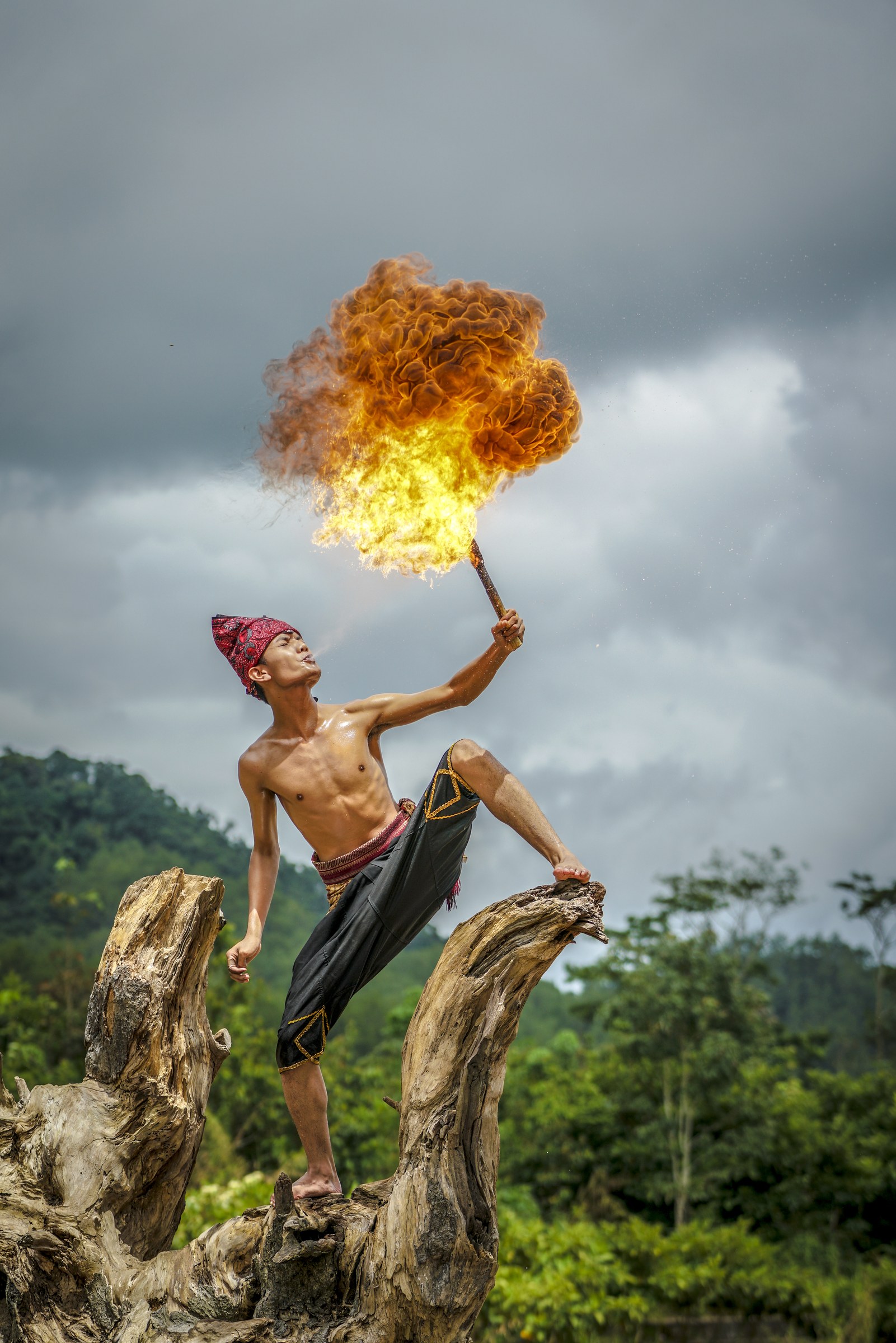
Fire dance Indonesia
Firman Hakim
- Source:
- Wikimedia Commons
- Rights:
- Reusable with conditions: credit the creator; share any adaptation under the same license. Source record ↗
- Recorded as:
- cc by-sa 4.0
Fire staff dancing represents a significant contemporary practice that bridges ceremonial tradition, acrobatic training, and theatrical spectacle. For dance historians, this work documents how traditional Indonesian fire performance has evolved and hybridized within global performance communities, and how documentation through photography shapes the visibility and meaning of performance practices.
What you are looking at
A shirtless young man stands balanced on two weathered tree stumps in a lush, forested landscape under an overcast sky. He wears a red patterned headwrap and dark pants with gold trim, suggesting Southeast Asian dress. His body is arched backward in an extreme extension, one arm stretched upward holding a wooden staff that erupts in a large burst of flame—brilliant yellow and orange fire blooming against the grey sky. The photograph captures the moment of maximum intensity: the fire is fully ignited, the dancer's spine is fully extended, and the jungle backdrop is sharp and verdant. The composition emphasizes both the technical difficulty of the pose and the spectacle of the flame, with the dancer's lean musculature and the scale of the fire creating a sense of controlled danger.
The dancing
A single male dancer, appearing to be in his twenties, demonstrates extreme spinal extension and balance. His weight is distributed across the two tree stumps, feet planted wide for stability. The extended arm holding the fire staff reaches vertically, displaying shoulder flexibility and control. His free arm is positioned across his torso. The posture suggests both acrobatic conditioning and deliberate theatrical presentation. The arched back and lifted gaze toward the flame suggest a moment of peak performance rather than transition or preparation.
The dance depicted
This is fire staff dancing, a performance art that blends dance, acrobatics, and fire manipulation. The photograph documents a specific moment in what the catalogue record identifies as a traditional Indonesian fire dance (tarian api). Fire staff performance in Southeast Asia typically occurs during ceremonial and celebratory occasions. The dancer's extreme flexibility and balance suggest training in both contemporary flow arts and classical forms. The setting—outdoors in a forest rather than a built ceremonial space—indicates this may be a contemporary performance or demonstration rather than a strictly traditional ceremonial context.
How it was made
This is a digital colour photograph, likely taken with a professional camera capable of freezing fast motion and capturing the intense brightness of the flames without significant overexposure. The photographer's choice to shoot outdoors in overcast light allows the fire to read as brilliantly bright without washing out the dancer's body or the surrounding landscape. The composition and technical quality suggest this is a documented performance piece rather than candid documentation, typical of contemporary flow arts and dance photography published online.
About this work
This photograph documents a Southeast Asian fire staff performance, a contemporary fusion of traditional ceremonial dance practice and modern circus arts. The image captures an acrobatic dancer at the moment of maximum physical extension and spectacle, balanced on tree stumps with a burning staff held high. The work represents the global circulation of flow arts and the adaptation of traditional fire performance into contemporary performance contexts, often documented and circulated through digital platforms.
How to look at it
Attend to the moment of maximum extension: the dancer has chosen an extreme arch rather than a moment of movement or transition. The photograph freezes a pose that would be unsustainable, creating a sense of intensity and risk. The composition places the fire at the apex of the frame, making it the focal point, while the dancer's body creates a path for the eye to travel upward. The overcast sky eliminates distracting shadows and allows both the fire and the forest detail to remain visible simultaneously.
The artist
Firman Hakim is a contemporary photographer based in Indonesia who documents dance and performance. The work circulates through Wikimedia Commons, indicating a commitment to public accessibility. His practice focuses on capturing Southeast Asian cultural performance in contexts that blend traditional and contemporary elements.
The period
This photograph was made in 2019, a moment when fire arts and flow arts had achieved significant global visibility through social media, online video platforms, and the international circus arts community. Southeast Asian performance traditions were increasingly documented and circulated through digital photography rather than written description or video, making photographic capture a primary mode of cultural documentation and dissemination.
Where it lives
The work is held in Wikimedia Commons, a public digital archive of freely licensed media. It was contributed as a document of Indonesian traditional performance practice and circulates as an educational resource available globally.
Dance in this work
Questions about this work
Is this a traditional dance or a modern performance?
It appears to be a contemporary hybrid: the catalogue identifies it as a traditional Indonesian fire dance (tarian api), but the outdoor forest setting, the photographic documentation, and the extreme acrobatic style suggest this is a modern adaptation or performance piece informed by tradition rather than a ceremonial context. Contemporary fire staff dancers often learn from multiple cultural traditions and train in circus arts.
How is the fire staff ignited?
The photograph does not show the ignition point, only the moment when the staff is fully burning. Fire staffs are typically soaked in fuel (often kerosene or special performance fuel) and ignited before the performance begins. The dancer would have prepared and lit the staff before assuming this pose.
What training is required to perform like this?
Fire staff performance requires years of training in balance, flexibility, spatial awareness, and fire safety. The extreme spinal extension visible here suggests training in acrobatics, yoga, or classical dance. Fire training is typically learned from experienced performers and includes extensive practice with unlit props before handling live flame.
Why would this dance happen in a forest rather than a ceremony?
The forest setting and photographic documentation suggest this is a performance or artistic demonstration rather than a traditional ceremonial context. Contemporary fire dancers often perform for documentation, tourism, and artistic purposes in natural settings that provide dramatic backdrops and outdoor safety.
More dance artwork





