49 works in this view — arrow keys or swipe to move between them.
Dance in Art
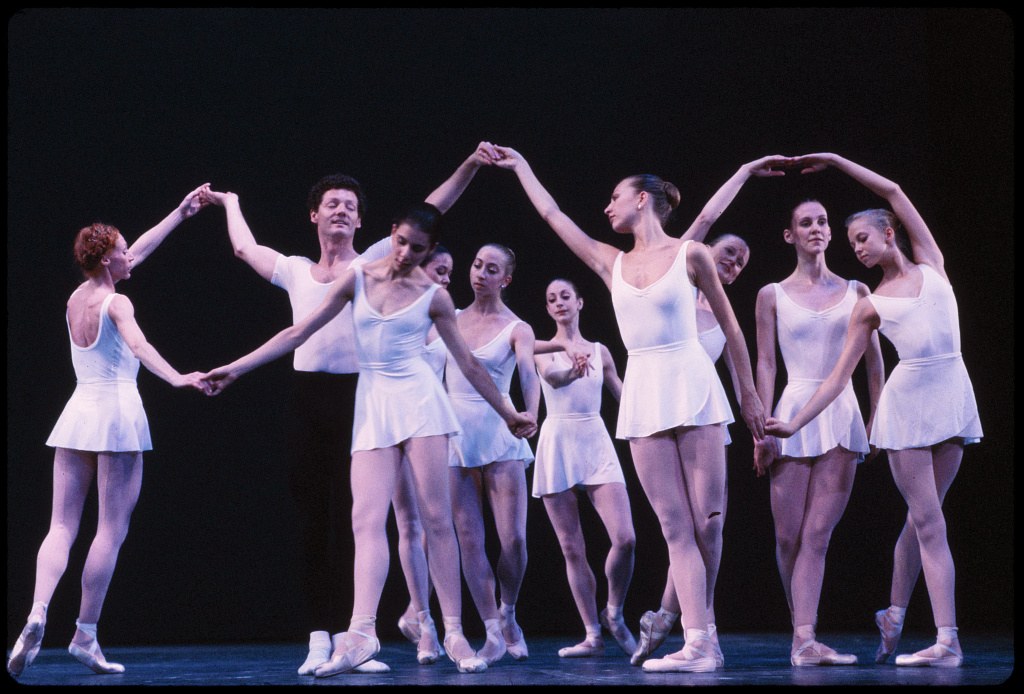
Concerto Barocco, "Ballets Canadiens"
Unknown artist
- Collection:
- Prints & Photographs
- Source:
- Library of Congress
- Rights:
- Rights vary by item — check the source record before reusing this image. Source record ↗
- Recorded as:
- Library of Congress — no known restrictions (verify per item)
Concerto Barocco represents the foundational shift in ballet from narrative and spectacle toward abstraction and pure movement. This photograph preserves not only a canonical work but a specific production by a Canadian company, extending the work's performance history beyond the New York City Ballet and suggesting its international reach and adaptability.
What you are looking at
Ten dancers in pale blue or white short classical tutus are arranged in a loose circle against a black background, creating an ethereal, weightless composition. The lighting is soft and diffuse, casting them in cool tones that emphasize the delicacy of their costumes. Several dancers are raising their joined hands upward in synchronized arcs, while others stand with arms extended to neighbors, creating an interlocking chain. The formation suggests a moment of unity or connection—less a narrative tableau than an abstract pattern of bodies. The dancers are all en pointe, their pale pink pointe shoes visible at the base of the composition. The dark, minimal stage background isolates the group entirely, focusing attention on the purity of line and form rather than any theatrical setting.
The dancing
The dancers maintain an upright, elongated carriage characteristic of classical ballet training. Their arms are extended softly from the body, often connecting hand-to-hand across the circle in a gentle, sustained configuration. The raised hands form repeating arcs overhead, suggesting either a moment of elevation or a deliberately abstract compositional choice. All dancers appear to be on pointe, with the weight distributed through a supported frame. There is no visible jumping, turning, or dynamic movement; instead, the image captures a static or near-static configuration that emphasizes line, symmetry, and the geometry of the group.
The dance depicted
This appears to be a scene from Concerto Barocco, the famous abstract ballet created by George Balanchine in 1941 to J.S. Bach's Concerto in D minor for Two Violins. The geometric formation and classical tutus are consistent with Balanchine's neoclassical aesthetic, which prioritized pure movement and formal design over narrative or theatrical spectacle. The circular arrangement and linked-arm gestures may depict one of the ensemble passages that punctuate the work's three-movement structure. The photograph shows the Ballet Canadiens (or Ballets Canadiens) in performance, likely during the 1980s based on the date in the record.
How it was made
This is a color photograph, probably from a 35mm film transparency or slide, as evidenced by the saturated color palette and the particular quality of the stage lighting. The photograph captures a moment of live performance, with the theatrical lighting design—cool spotlighting against a black void—deliberately composed for visibility and mood. The photograph itself is a preservation record of a specific performance, not a commission or artwork in its own right, and circulated as part of professional dance documentation and archival practice.
About this work
Concerto Barocco is one of the twentieth century's most important abstract ballets, and this photograph documents a performance by the Ballet Canadiens during the 1980s. The work has no plot or mime; instead, Balanchine used Bach's Concerto in D minor as a score for pure classical technique and geometric design. This image isolates a single moment—a circular formation of dancers in classical tutus, en pointe, with their arms linked in a sustained, symmetrical pattern. It exemplifies Balanchine's revolution in ballet aesthetics, in which the music and the body's movement, rather than pantomime or spectacle, became the primary content. The photograph is typical of mid-to-late twentieth-century dance documentation, when color photography began to record ballet performances for archival and promotional purposes.
How to look at it
Notice the deliberate symmetry and geometric precision: the dancers form an almost mathematical pattern, with arms creating repeating arcs. The image freezes a moment of stillness or suspension rather than capturing dynamic movement—a choice that emphasizes line and form over action. The pale costumes and dark background direct the eye entirely to the bodies and their alignment. This is the Balanchine principle at work: the dance is in the line of the body, the spacing between bodies, and the relationship to music, not in theatrical storytelling.
The period
Concerto Barocco premiered in 1941, during the early years of American ballet's emergence as an independent tradition. By the 1980s, when this photograph was made, the work had become a cornerstone of the classical ballet repertory, performed worldwide. The Ballet Canadiens' production reflects the global dissemination of Balanchine's choreographic method and the integration of Neoclassical Ballet into institutional companies. The photograph itself belongs to the era of professional color slide documentation, when ballet companies began systematically recording performances for archives and promotional use.
Where it lives
This is a color photograph from the Library of Congress Prints and Photographs collection, likely acquired as part of dance documentation or archival material. The image represents a moment of live performance by the Ballet Canadiens, a Canadian professional ballet company.
Dance in this work
Questions about this work
Who choreographed Concerto Barocco?
George Balanchine created Concerto Barocco in 1941 for the Ballet Caravan in the United States. It is one of his most performed works and a foundational text of twentieth-century abstract ballet.
What is the music?
J.S. Bach's Concerto in D minor for Two Violins, BWV 1043, which Balanchine structured into three movements corresponding to the ballet's structure—Allegro, Largo, and Allegro.
Why are there no props or scenery?
Balanchine's aesthetic privileged pure classical technique and spatial design. The absence of narrative props, scenery, or mime allows the audience to focus entirely on the bodies, the architecture of the group, and the relationship between movement and music.
What does the circular formation mean?
In abstract ballet, formations are formal and mathematical rather than symbolic. This arrangement demonstrates spatial design and creates a moment of unity and symmetry that the choreography and music have built toward.
More dance artwork





