49 works in this view — arrow keys or swipe to move between them.
Dance in Art
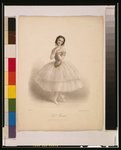
Mme. Ferraris, dans le ballet des elfes
Unknown artist
- Collection:
- Prints & Photographs
- Source:
- Library of Congress
- Rights:
- Rights vary by item — check the source record before reusing this image. Source record ↗
- Recorded as:
- Library of Congress — no known restrictions (verify per item)
This image is primary evidence for the visual and physical ideals of Romantic ballet as they were publicly promoted and consumed. It shows a specific dancer in a specific role, making it invaluable for understanding casting, costume practice, and the types of roles available to women in ballet during the period. For historians and dancers, it anchors the abstract notion of Romantic ballet in the concrete particularity of a single body, a single costume, and a single printed moment.
What you are looking at
A young woman in a Romantic-era ballet costume stands in a three-quarter pose against a plain background. She wears a fitted bodice with a full, knee-length tulle skirt in multiple layers, typical of mid-19th-century ballet dress. Her hair is styled in the period fashion, pulled back smoothly, and she wears a flower crown or wreath. Her arms are held in a graceful position, one extended and one curved. She stands en relevé or near-relevé, on the balls of her feet, suggesting the weightlessness and ethereal quality prized in Romantic ballet. The figure is rendered in lithographic tone with fine linear detail, against an unshaded background that emphasizes the clarity of the silhouette. The overall effect is that of a portrait of a specific dancer in a specific role.
The dancing
The dancer's frame is upright and elongated, with soft, rounded arm positions characteristic of Romantic ballet. One arm extends gently across the body, the other curves upward; the positions are neither sharply angulated nor dramatically raised. Her weight appears concentrated in a vertical alignment, with evident engagement through the legs suggesting the turned-out positions and lifted carriage of classical ballet training. She is a soloist, isolated in space, and the entire composition emphasizes the individual dancer's line and grace rather than interaction or narrative action.
The dance depicted
This is Romantic ballet of the mid-19th century, the era of *La Sylphide* (1832) and *Giselle* (1841). The costume—particularly the knee-length tulle skirt, fitted bodice, and flower crown—is the canonical dress of the ethereal female sylph or spirit roles that defined the period. The title identifies the dancer as Mme. Ferraris performing in "le ballet des elfes" (the ballet of the elves), almost certainly a corps de ballet or featured role within a larger Romantic ballet production. The image captures the ideal of the Romantic ballerina: weightless, otherworldly, and technically accomplished in the turned-out positions and sustained port de bras of the classical vocabulary.
How it was made
This is a lithograph, a print medium that allowed rapid and economical circulation of theatrical imagery. The technique employs fine linear work combined with tonal shading to create volume and fabric texture, particularly in the rendering of the tulle skirt. Lithography was the dominant medium for theatrical portraiture and dance imagery in the mid-19th century, because it permitted multiple impressions to be distributed to audiences, critics, and collectors. The quality of the line work and the restraint of the tonal range suggest professional theatrical publishing rather than popular or amateur production.
About this work
This is a portrait lithograph of a mid-19th-century Romantic ballet dancer, Mme. Ferraris, shown in the costume of an elf or sylph from a ballet ensemble piece. It documents both a specific performer and the visual conventions of Romantic ballet costume and carriage at the height of the form. The work belongs in a gallery of dance imagery because it is a direct record of how the Romantic ideal—the ethereal, weightless female dancer in her costume—was seen and circulated to the public of the 1850s. Lithographs like this were the mass medium of ballet publicity and criticism in the period, and they shaped how the era's dance was understood and remembered.
How to look at it
Focus on the dancer's posture and arm position: the slight forward tilt of the torso, the softness of the arm curves, and the vertical lift through the spine all embody the Romantic ideal of grace and effortlessness. Notice the tulle texture in the skirt—the lithographer has used tonal variation to suggest the weight and movement of the fabric. The flower crown and the ethereal quality of the whole figure would have signaled to a contemporary viewer that this is a supernatural or magical being, not a human heroine. The dancer is frozen at a moment of repose, not caught mid-leap or mid-turn; this was a common convention in theatrical portraiture, emphasizing the beauty of the line over the drama of action.
The period
The mid-19th century was the golden age of Romantic ballet, when ethereal supernatural beings—sylphs, spirits, and elves—dominated the repertory. The ideal dancer was young, slender, and technically trained in the vocabulary of classical ballet (turned-out positions, lifted port de bras, and relevé work), but she was presented as weightless and otherworldly rather than virtuosic or athletic. The 1850s saw the consolidation of ballet costume conventions: the tulle skirt, the fitted bodice, the flower crown, and the décolleté neckline became standardized markers of the Romantic heroine. Lithographic portraiture of dancers was a major industry during this period, feeding both public curiosity about famous ballerinas and the genre's need to market its new works and performers.
Where it lives
This is a lithographic print held in the Prints & Photographs collection at the Library of Congress. It is a theatrical portrait, the kind of promotional and commemorative image produced for circulation to audiences and critics during the run of a ballet.
Dance in this work
Questions about this work
Who was Mme. Ferraris?
The catalogue record does not identify her beyond her name and role. She was a dancer in a mid-19th-century European ballet company, cast in an ensemble or featured role in a ballet of elves or sylphs. Many dancers performed under stage names or married names during this period, and without additional documentation it is difficult to establish her full identity or career.
What is 'le ballet des elfes'?
This was likely a divertissement or standalone ballet featuring supernatural beings, probably a corps de ballet ensemble piece. The Romantic era produced many such works, ranging from short interludes to full evening ballets. Without additional documentation, we cannot identify the specific work or production.
Why does she stand en relevé?
Relevé—rising onto the balls of the feet—is fundamental to classical ballet technique and creates the visual illusion of weightlessness and lift that was central to the Romantic ideal. It also elongates the line of the leg and emphasizes the dancer's technical training and control.
What do the flower crown and tulle skirt tell us?
Together they are the unmistakable costume of the Romantic supernatural female: the sylph, the spirit, the elf. The knee-length length of the skirt (not floor-length, as in earlier court or narrative ballet) allowed audiences to see the dancer's feet and admire her footwork. The costume was so standardized that it would have been immediately recognizable to any viewer of the 1850s.
More dance artwork





